AI for Expert Learners : Reinforcement, Generative & Robotics

At UDHY – Unlock Digital Horizons for You, we are all about empowering learners to gain real skills, build meaningful projects, and achieve their goals.

Home  ›  AI Courses  ›  AI for Advanced Learners

Expert AI — Robotics Series · 3 Courses

Physical AI is no longer a research concept. NVIDIA GR00T, Google Gemini Robotics, and OpenVLA-7B are running in commercial deployments right now. This series teaches you how they work, how to deploy them, and how to secure them — at practitioner depth, completely free.

I have been in this industry for more than a decade — co-founding Moovita, Singapore’s first autonomous vehicle company, and spending years as a Principal Research Scientist at A*STAR’s Institute for Infocomm Research. The AI techniques taught in this expert series — Physical AI, VLA models, multi-agent coordination, fleet cybersecurity — are not future concepts. They are what the most advanced autonomous systems in the world are running on right now, in 2026.

What I have noticed in 30 years of building real systems is that the gap between “understanding AI” and “deploying AI” is enormous — and almost nothing in education addresses it at this level. Coursera and Udemy teach you what a VLA model is. This series teaches you how to run OpenVLA-7B inference, write the action chunking pipeline, configure SROS2 certificates for fleet-wide encrypted communication, and design a fault-tolerant multi-robot task allocation system. With working code. For free.

This series picks up directly from AI for Advanced Learners — if you are comfortable with deep learning, reinforcement learning, and autonomous navigation, you are ready. If not, start there first. Everything you learned in the advanced series — CNNs, RL policies, SLAM — becomes a component in the systems this expert series builds

Before you start — are you in the right place?

This series assumes you have completed — or can test out of — the following UDHY prerequisites:
Deep Learning for Robotics — CNNs, PyTorch, transfer learning, sim-to-real
Reinforcement Learning for Robotics — MDPs, Q-Learning, PPO, imitation learning
Expert Robotics Course — ROS 2 intermediate, VLA model basics, NVIDIA Isaac Sim
Python (advanced) · PyTorch (intermediate) · ROS 2 (intermediate) · Basic networking

What You Will Build Across This Series

COURSE 1

OpenVLA-7B inference pipeline outputting 7-DOF robot arm commands from a camera image and natural language instruction

COURSE 2

A full Contract Net Protocol auction system coordinating a heterogeneous fleet of 5 robots across competing task priorities

COURSE 3

A fully secured SROS2 fleet with per-robot X.509 certificates, topic-level access control, and a live behaviour anomaly detector


The Three Advanced Courses — At a Glance

Course 1 of 3 · Start here

Physical AI and Vision-Language-Action Models

Physical AI is the era when foundation models stop living in data centres and start living in machines that touch the physical world. This course teaches you how VLA models — the unified architectures that see, reason in natural language, and output robot motor commands — actually work. You will run OpenVLA-7B inference, understand NVIDIA GR00T’s System 1/System 2 architecture, implement action chunking for real-time deployment, and fine-tune a VLA model with LoRA for a custom manipulation task. The course closes with the safety architecture that every Physical AI deployment must have — workspace monitoring, force limits, confidence thresholding, and anomaly detection.
Physical AI, OpenVLA-7B inference, NVIDIA GR00T N1.5, LoRA fine-tuning, Action chunking,

⏱ 15–20 hours · Self-paced 📋 6 modules 💻 3 Python projects ✅ Free

What you will build: You will understand the VLA architecture from vision encoder to action head, run real OpenVLA-7B inference producing 7-DOF robot arm commands, and have a LoRA fine-tuning pipeline ready for your own robot manipulation task. Pairs directly with Expert Robotics Course Module 7.

Course 2 of 3

Multi-Agent Robot Systems and Fleet Intelligence

A single intelligent robot is impressive. A fleet of 200 coordinating robots — handling competing task priorities, adapting to robot failures in real time, and optimising utilisation across a heterogeneous mix of AMRs, drones, and manipulators — is commercially transformational. This course teaches the architecture behind Amazon Robotics, Waymo’s fleet management, and autonomous delivery operations. You will implement a complete Contract Net Protocol auction system in Python, configure ROS 2 multi-robot namespaces, build a fleet status aggregator with emergency alerts, and design fault-tolerant dynamic task reassignment that keeps operations running when individual robots fail.

Multi-Agent Systems, Contract Net Protocol, ROS 2 multi-robot, Fleet task allocation, Digital twins, Fault tolerance

⏱ 14–18 hours · Self-paced📋 5 modules💻 3 code projects ✅ Free

What you will build: You will have a working auction-based task allocator for a 5-robot heterogeneous fleet, a ROS 2 fleet status aggregator with failure detection, and understand the digital twin architecture behind production robot fleet management. Pairs with Autonomous Navigation and SLAM — each robot in your fleet uses Nav2 for local navigation.

Course 3 of 3 – Capstone

Cybersecurity for Autonomous Robot Fleets

When a software system is compromised, you lose data. When a robot fleet is compromised, you can lose production, equipment, and in the worst case, people’s safety. Upstream Security documented 494 autonomous system cyber incidents in 2025 — 92% conducted remotely, 44% ransomware. This course teaches you to protect the systems built in Courses 1 and 2. You will implement a complete robot fleet asset inventory (NIST CSF IDENTIFY), configure SROS2 with per-robot X.509 certificates and topic-level access control policies (PROTECT), build a statistical behaviour anomaly detector that flags compromised robots in real time (DETECT), and execute an automated incident response that quarantines affected robots without disrupting fleet operations (RESPOND and RECOVER).

SROS2 & DDS-Security, X.509 certificates, NIST CSF 2.0, Anomaly detection IDS, Incident response. Fleet asset inventory

⏱ 14–18 hours · Self-paced📋 5 modules💻4 code projects ✅ Free

What you will build: A complete 2D LiDAR SLAM system with ICP scan matching and occupancy map generation, an A* path planner navigating a grid with obstacles, and a Nav2 waypoint navigation client for multi-stop autonomous routing in ROS 2.

Where This Series Fits — The Full UDHY Learning Path

LevelWhat you learnTime
🟦 AI for BeginnersWhat AI is · Best tools 2026 · How ML works3–5 hrsExplore →
🟧 AI for AdvancedDeep Learning · Reinforcement Learning · Autonomous Navigation & SLAM35–45 hrsExplore →
⭐ AI for Experts ← You are herePhysical AI · VLA Models · Multi-Agent Fleets · Robot Cybersecurity45–55 hrsThis page
🟩 Robotics (Beginners → Experts)Sensors · ROS 2 · Kinematics · Perception · Physical AI deployment65–90 hrsExplore →

top ai application

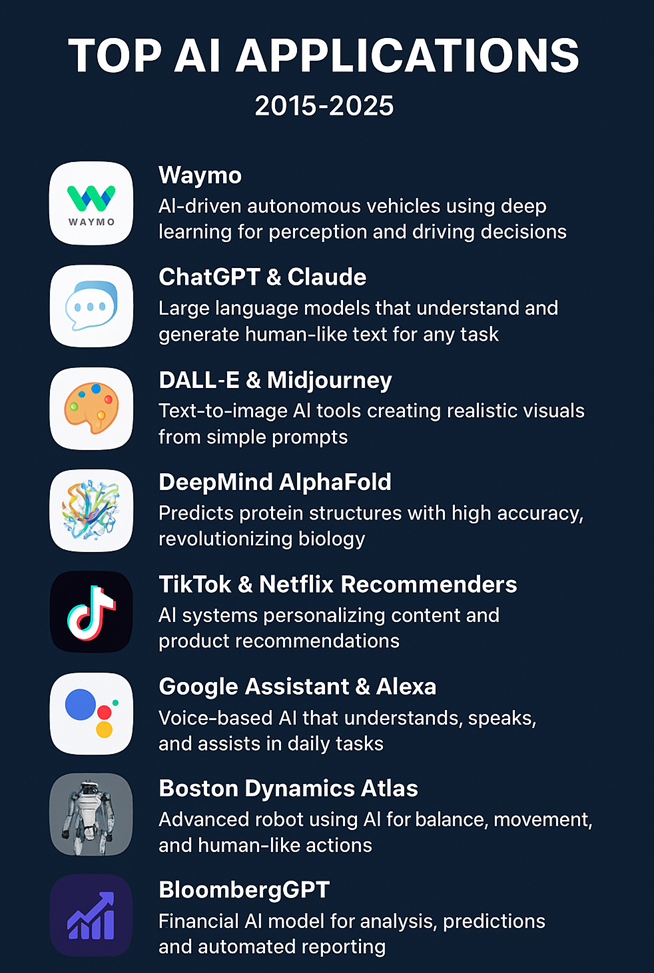
AI applications (2015–2025)

Waymo & Tesla FSD – AI-driven autonomous vehicles using deep learning for perception and driving decisions.
ChatGPT & Claude – Large language models that understand and generate human-like text for any task.
DALL·E & Midjourney – Text-to-image AI tools creating realistic visuals from simple prompts.
DeepMind AlphaFold – Predicts protein structures with high accuracy, revolutionizing biology.
TikTok & Netflix Recommenders – AI systems personalizing content and product recommendations.
Google Assistant & Alexa – Voice-based AI that understands, speaks, and assists in daily tasks.
Boston Dynamics Atlas – Advanced robot using AI for balance, movement, and human-like actions.
BloombergGPT – Financial AI model for analysis, predictions, and automated reporting.
Darktrace – Cybersecurity AI detecting and preventing online threats in real time.
DeepMind Energy AI – Optimizes data center and grid energy use to cut emissions and save power.

Dr. Dilip Kumar Limbu — Series Author

Designed by Dr. Dilip Kumar Limbu — Former Principal Research Scientist, A*STAR · Co-Founder, Moovita, Singapore’s first autonomous vehicle company · 30 years building real-world autonomous systems. UDHY.com.

Scroll to Top