Autonomous Vehicles in 2026: The Honest Truth About Waymo, Tesla FSD, and Level 4 Autonomy
If you’re searching for Autonomous Vehicles in 2026: What Waymo and Tesla FSD Are Doing, Their Challenges, and the Road Ahead, you’ve come to the right post. Based on my 25+ years of hands‑on experience in AI, robotics, and autonomous driving, this article reveals insights you won’t find in press releases. Read through to the end to uncover the full details, hard truths, and expert perspectives that matter.
TL;DR — Quick Insights
- Waymo is the current world leader in Level 4 autonomous driving, targeting 1 million rides per week by end of 2026 across 20 cities.
- Tesla FSD (Supervised) remains Level 2 — the driver must supervise at all times, despite the misleading name.
- True Level 5 (drive anywhere, any condition, no human ever) is not happening in the next decade.
- The AV industry has split into multiple tracks: robotaxi (Waymo, Zoox, Baidu Apollo, WeRide, Pony.ai), Autonomous Shuttle (Moovita, WeRide), Autonomous Truck (Aurora Innovation, Gatik, Kodiak AI) and even consumer ADAS systems (Mercedes, BYD).
- The biggest unsolved challenges are not sensors or compute — they are edge cases, regulation, and public trust.
25 Years on the Autonomy Frontier: The Real State of Self‑Driving Cars in 2026
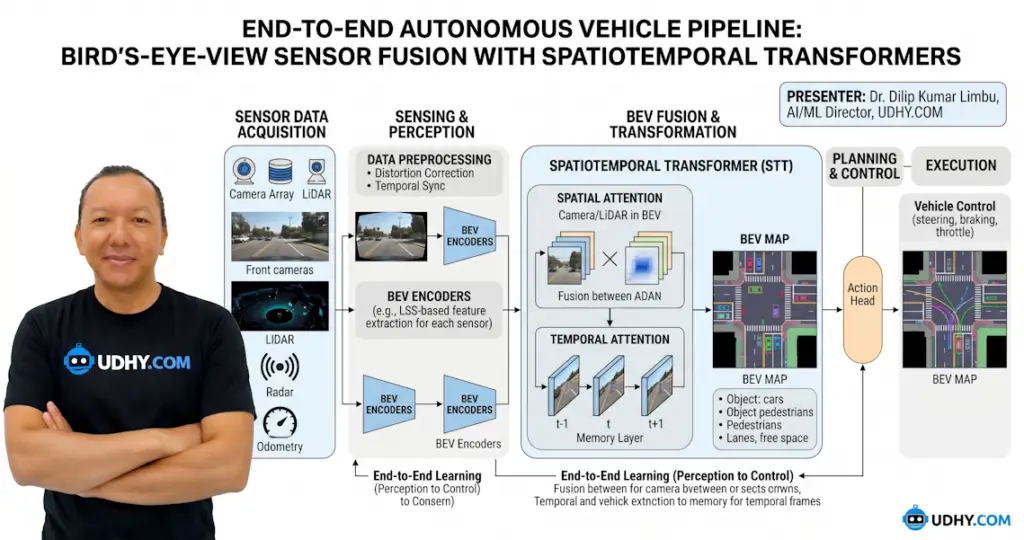
The autonomous vehicle (AV) industry in 2026 is undergoing a massive architectural shift, moving away from fragmented, legacy perception blocks toward end-to-end multi-modal models and unified Bird’s-Eye-View (BEV) spatial transformers. However, understanding where true production-grade autonomy stands requires cutting through marketing hype and looking directly at the underlying code, sensor topologies, and edge-case realities.
This technical assessment is built directly upon my 25 years of deep-tech engineering experience in artificial intelligence and autonomous systems. Prior to co-founding Moovita—where we pioneered and deployed Singapore’s very first autonomous vehicle and scaled fleets — I spent a decade working as a Principal Research Scientist at A*STAR’s Institute for Infocomm Research (I2R).
In this post — I share a grounded assessment of what’s real, what’s hype, and what remains unsolved. Read on for the honest truth.
Introduction: The Promise and the Reality
In early 2016, many industry leaders were predicting fully autonomous vehicles on every road by 2020. It did not happen. In 2020, new predictions said 2025. It still has not happened — not in the way most people imagined.
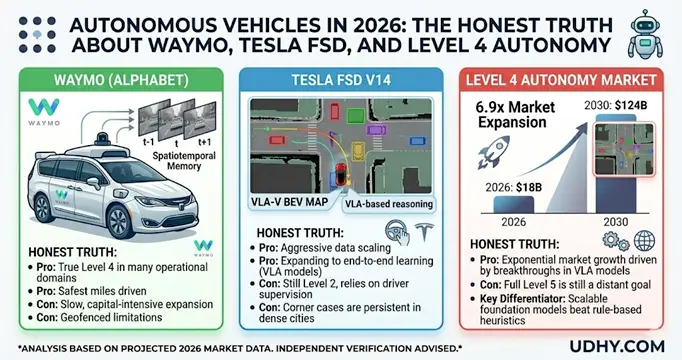
It’s equally wrong to dismiss autonomous vehicles as hype. Waymo is already offering a fully autonomous taxi service scaling to new cities at pace, delivering millions of rides per year, and operating as a genuine replacement for human-driven taxis in its operating domains. As of mid-2026, The table below highlights the cities where Waymo operates fully commercial, paid services:
| City | Service Type | Status |
|---|---|---|
| Phoenix, AZ | Fully commercial | Original market, 4+ years operational |
| San Francisco, CA | Fully commercial | Dense urban, 3+ years operational |
| Los Angeles, CA | Fully commercial | Large metro expansion |
| Austin, TX | Fully commercial | 2025 launch, 2026 scaling |
| Atlanta, GA | Fully commercial | 2025 launch |
| Miami, FL | Fully commercial | 2026 launch |
| Houston, TX | Fully commercial | 2026 launch |
| San Antonio, TX | Fully commercial | 2026 launch |
| Orlando, FL | Fully commercial | 2026 launch |
| Dallas, TX | Fully commercial | 2026 expansion |
| San Diego, CA | Expanding | Operational testing |
Waymo, the Alphabet-owned autonomous vehicle company, has raised $16 billion in February 2026 as it plans to grow its fleet of driverless taxicabs this year to more than a dozen new cities internationally, including London and Tokyo.
From my engineering background, what impresses me most about Waymo is not the headline numbers — it is the architectural decisions that made those numbers possible. Waymo has built a fundamentally different approach to autonomous driving than any of its competitors, and those differences are the primary explanation for its safety record and operational scale.
The reality of autonomous vehicles is more complex than both the optimists and the skeptics suggest. Yes, they are real and already in commercial use — but they don’t look like the ‘self‑driving cars’ most people imagined. To understand what’s truly happening versus what was promised, you need to know Society of Automotive Engineers (SAE) autonomy level framework.
The SAE J3016 Framework: Six Levels Precisely Defined
Before diving into the SAE J3016 Framework: Six Levels Precisely Defined, it’s essential to understand why this framework matters. Without a clear grasp of these six levels, discussions about autonomous vehicles often become confusing or misleading. SAE J3016 provides the standardized language and definitions that regulators, engineers, and the public rely on to distinguish between driver assistance, partial automation, and full autonomy. Knowing this framework is the foundation for understanding how autonomous vehicles are classified, evaluated, and regulated
The SAE J3016 framework was first published in 2014 and has since been adopted by the US Department of Transportation as the official classification standard. The key dividing line in the framework is between Level 2 and Level 3:
- Levels 0–2 (assistance): The human driver is responsible for the vehicle at all times, regardless of what assistance systems are active.
- Levels 3–5 (automation): The automated driving system assumes responsibility for the vehicle during its operational period.
This line — between “assistance” and “automation” — has enormous legal, insurance, regulatory, and engineering implications. Crossing it changes who is liable when something goes wrong.
| Level | Name | Who drives? | What it means in practice |
|---|---|---|---|
| 0 | No automation | Human | Standard car. No assistance. |
| 1 | Driver assistance | Human | One automated function: adaptive cruise OR lane keeping, not both |
| 2 | Partial automation | Human (always) | Both ACC + lane keeping simultaneously. Human must supervise. Tesla Autopilot, GM SuperCruise |
| 2+ | Enhanced partial | Human (always) | Advanced L2 with hands-free on approved roads. Ford BlueCruise, BYD God’s Eye |
| 3 | Conditional automation | System (in ODD) | Eyes-off in specific conditions. System asks human to take over. Mercedes Drive Pilot |
| 4 | High automation | System (in ODD) | No human needed within defined Operational Design Domain (ODD). Waymo, Baidu Apollo Go & Zoox robotaxis |
| 5 | Full automation | System | Drive anywhere, any condition, any weather — no human ever. Does not exist commercially |
The critical detail: Levels 0–2/2+ are driver assistance systems. The human is always legally and operationally responsible. Levels 3–5 are automated driving systems — the car (or the company operating it) is responsible.
2026 Level 4 deployments — The table below outlines the confirmed Level 4 deployments in 2026 — showcasing commercial operations already in service:
| Company | Service | Markets | Weekly Rides |
|---|---|---|---|
| Waymo | Waymo One | 11 US cities | 500,000+ |
| Baidu Apollo Go | Apollo Go | 15+ Chinese cities | 250,000+ |
| Zoox (Amazon) | Zoox robotaxi | San Francisco, Las Vegas | Pilot scale |
Level 4 vehicles are already on public roads today. These never require anyone on board, and they can detect problems and safely pull over without human intervention, but they operate within some constraints, like specific locations, weather conditions, or times of day. Waymo currently operates about 2,500 robotaxis across San Francisco, Los Angeles, Phoenix, Austin, Atlanta, and, most recently, Miami.
What defines a Level 4 ODD:
An Operational Design Domain (ODD) specifies the conditions within which a Level 4 system can safely operate:
- Geographic bounds: Specific geo-fenced areas (cities, routes) with HD maps
- Weather limits: Typically no heavy snow or severe precipitation
- Speed limits: Usually up to highway speeds but with route-specific constraints
- Time of day: Most current Level 4 systems operate 24/7, though some have night restrictions
When a Waymo vehicle encounters conditions outside its ODD — extreme weather, a completely unmapped road construction diversion — it does not attempt to continue. It finds a safe stopping point and contacts remote operations for assistance. This safe fallback behaviour is a mandatory requirement of Level 4 certification.
My opinion: The Level 2 / Level 4 framing obscures more than it reveals. There is an enormous practical gap between Tesla’s Level 2+ FSD and Waymo’s Level 4 — far larger than the single number difference suggests. A Level 4 system has genuinely solved autonomous driving within its operational domain. A Level 2 system, no matter how sophisticated, has not.
Waymo: The Current Gold Standard
In 2026, Waymo is completing 500,000 paid rides every single week. Parents are using Waymo to transport their children to school activities. City councils are debating not whether to allow robotaxis but how fast to expand their service areas. The paradigm has shifted so completely that the question is no longer “will robotaxis work?” — it is “how quickly can they scale?”
As such, Waymo is the most advanced commercially deployed autonomous vehicle system in the world in 2026. This is not a marketing claim — it is the consensus of independent safety researchers and the evidence of millions of publicly logged rides.
What Waymo Has Built
Waymo’s technology stack includes:
- Sensor fusion: LiDAR + radar + cameras combined into a unified 3D world model, updated in real time
- HD mapping: Centimetre-accurate maps of every road in its operating domain
- Redundant compute: Multiple independent processing systems so a single failure cannot cause an accident
- Operational Design Domain (ODD): Specific geographic areas, weather conditions, and road types within which Level 4 is guaranteed — not everywhere, but perfectly within the domain
Waymo’s 2026 Progress
Waymo is aiming to reach 20 cities and achieve one million rides per week by the end of 2026 — a scale that, while still small compared to Uber, represents genuine validation of Level 4 autonomous driving as a commercially viable technology.
Waymo remains the global leader in Level 4 robotaxi services, with the most common current examples of fully driverless vehicles on public roads — operating without anyone on board, able to detect problems and safely pull over without human intervention, within its defined operational domains.
Safety data released by Waymo consistently shows significantly fewer injury-causing incidents per million miles than the average human driver. This is the most compelling argument for autonomous vehicles: not that they are perfect, but that they are already measurably safer than we are.
The honest limitation: Waymo operates within a carefully defined geographic fence. Leave that fence, and Level 4 disappears. It cannot currently drive in heavy snow, navigate construction zones with novel road markings, or handle every edge case a human driver encounters. These are real limitations, not minor footnotes.
Tesla FSD: Brilliant Technology, Misleading Name
Tesla markets Full Self-Driving (Supervised). The “(Supervised)” qualifier is legally significant: the driver must stay attentive and ready to intervene, placing it firmly at SAE Level 2. “FSD Unsupervised” — a version that operates without a human driver — is Tesla’s stated goal, not a commercially certified product. Tesla’s FSD is one of the most impressive and most misnamed products in the automotive industry.
What FSD Actually Is
Tesla FSD (Supervised) remains at Level 2 — requiring constant driver attention at all times. The system now explicitly labelled as “Supervised” includes lane-keeping, adaptive cruise control, traffic light recognition, and Smart Summon — but the driver must always be ready to take over immediately.
Tesla’s approach is fundamentally different from Waymo’s:
- Camera-only system: No LiDAR. Tesla’s CEO argues cameras are sufficient because humans drive with eyes, not LiDAR. This remains technically controversial.
- Fleet learning: Tesla’s massive fleet of customer vehicles continuously collects training data, allowing rapid model improvement. This is a genuine competitive advantage.
- Neural net end-to-end: Tesla has moved away from modular, rule-based systems toward end-to-end neural networks that map sensor inputs directly to driving actions.
My Honest Assessment of Tesla FSD
Tesla FSD is an extraordinary engineering achievement. The improvement from FSD v10 (2021) to FSD v13 (2025) is dramatic — the system handles a vastly wider range of scenarios and requires far less driver intervention.
But it is not Level 4. And calling it “Full Self-Driving” while requiring constant driver supervision has created a dangerous public perception that the car can actually drive itself. Several fatal accidents have been attributed to drivers over-trusting FSD.
For practical purposes in 2026, consumers will mostly encounter two categories: Level 2/2+ driver assistance (Tesla Autopilot and FSD Supervised, GM SuperCruise, Ford BlueCruise) and, separately, robotaxi services like Waymo and Zoox operating in specific cities.
My opinion: Tesla’s data advantage is real, and its end-to-end approach may ultimately prove more scalable than Waymo’s HD-map-dependent approach. But the timeline claims from Tesla’s CEO have been consistently wrong by years, not months. Evaluate FSD on what it does today, not on promises about next year.
Waymo vs. Tesla FSD — The table below provides a clear, side‑by‑side comparison.
| Dimension | Waymo | Tesla FSD (Supervised) |
|---|---|---|
| SAE Level | 4 (within ODD) | 2 (driver always responsible) |
| Sensor approach | LiDAR + radar + cameras | Cameras only |
| Mapping | HD maps required | Real-time map-free |
| Driver required? | No (within ODD) | Yes, always |
| Geographic coverage | ~10 U.S. cities (2026) | Everywhere (with supervision) |
| Safety data | Publicly published | Limited public disclosure |
| Revenue model | Robotaxi fleet | Per-vehicle subscription + future robotaxi |
| Fleet size | ~1,000+ vehicles | Millions of FSD-capable vehicles |
| Training data | Company-collected fleet | Customer fleet (largest in industry) |
| Honest status | Real L4, limited domain | Advanced L2, broad domain |
My verdict: These are not competitors in the same race. Waymo has solved autonomous driving within a constrained domain. Tesla is building a vastly more scalable, map-free system that, if it works at L4, will outclass Waymo on coverage. The bet is whether camera-only, end-to-end learning can generalise to Level 4 without HD maps. I think it can — but it has not yet.
The Other Players: BYD, Zoox, May Mobility, and Beyond
BYD God’s Eye
Potentially the most underappreciated development in AV for 2026. BYD, now the world’s largest automaker by volume, has rolled out its “God’s Eye” Level 2+ system as standard equipment on mainstream models at remarkably low price points. The combination of scale, cost, and capability makes BYD a sleeping giant in the ADAS space.
The BYD/Wayve consumer AV trend represents where edge AI meets its hardest real-world test: unlike geofenced robotaxis, consumer vehicles need to handle any road, any carrier network, any weather condition.
Zoox (Amazon)
Zoox is building a purpose-built robotaxi — a vehicle designed from the ground up for Level 4 operation with no steering wheel and no driver controls at all. It is bi-directional (no front or back), seats 4 passengers facing inward, and is purely designed for urban ride-hailing. Expanding in Las Vegas and San Francisco with paid rides in 2026.
May Mobility
Focused on fixed-route, low-speed autonomous shuttles in geofenced areas — university campuses, retirement communities, airports. Less glamorous than robotaxis, but commercially viable today and already deployed in multiple U.S. cities.
The Five Hardest Unsolved Problems in Autonomous Driving
With over 25 years of experience in AI and robotics — including hands‑on autonomous vehicle work — I’ve identified the problems that remain genuinely hard. These challenges are still unsolved, no matter what company press releases may claim.
1. Long-Tail Edge Cases
Any autonomous vehicles can be trained on millions of normal driving scenarios. But the accidents happen in the rare, unusual scenarios — a mattress fallen on the highway, a child chasing a ball, a construction worker making ambiguous hand signals. The “long tail” of rare events is effectively infinite, and you cannot train on events you have never seen.
2. Adverse Weather
Adverse weather remains one of the toughest unsolved challenges in autonomous driving. LiDAR performance degrades sharply in heavy rain, dense fog, and snowstorms, while camera‑only systems struggle with glare, wet road reflections, low contrast, and even lens obstruction from mud or ice. Radar can penetrate some conditions but often lacks the resolution needed for precise object detection. No commercial AV system in 2026 operates at full capability in heavy snow or during extreme weather events such as flash floods, sandstorms, or tropical downpours. This is a real, unsolved limitation that continues to define the edge cases of autonomy.
3. V2X (Vehicle-to-Everything) Infrastructure
For AVs to reach their safety and efficiency potential, they need to communicate with each other and with road infrastructure in real time — traffic lights, construction signs, emergency vehicles. V2X deployment is patchy, slow, and inconsistently standardised globally.
4. Regulation and Liability
Regulation and liability remain major barriers to autonomous vehicle deployment. Who is legally responsible when a Level 4 vehicle causes an accident? The answer varies widely across countries, states, and legal systems — and is still being debated. In the United States, liability may shift between the manufacturer, software provider, or fleet operator depending on state laws. In the European Union, GDPR and product liability directives complicate cross‑border operations. In Asia, countries like Japan and Singapore are drafting AV‑specific insurance frameworks, while China emphasizes state oversight and data localization. Questions also remain around liability in mixed‑traffic scenarios — for example, if an autonomous shuttle collides with a cyclist, or if a robotaxi misinterprets a police officer’s hand signals. Until clear regulatory frameworks and insurance models are established, large‑scale commercial deployment of autonomous vehicles will remain constrained.
5. Public Trust
Public trust remains one of the biggest hurdles for autonomous vehicles. Safety concerns persist — recent incidents, such as a Waymo vehicle striking a child near a school, show that the technology still has work to do. Despite strong overall safety data, public confidence is fragile. Importantly, acceptance is not just a technical challenge; it is a communication and governance challenge. Without public trust, large‑scale commercial scaling is impossible. Different countries are tackling this issue in varied ways: the United States emphasizes transparency through NHTSA investigations and public safety reports; the European Union requires strict compliance with GDPR and product liability rules to reassure citizens; Japan has introduced AV insurance frameworks to build consumer confidence; Singapore mandates rigorous safety trials before allowing public deployment; and China enforces strong state oversight and data localization to maintain control and trust. These approaches highlight that winning public acceptance is as critical as solving technical edge cases.
If you’d like to dive deeper into The Five Hardest Unsolved Problems in Autonomous Driving, I recommend reading the post: Why Self-Driving Cars Still Fail: The Edge Case Problem.
Where Will We Be in 2030? My Honest Prediction
Based on current trajectory:
- Waymo-style robotaxis will operate in 50+ cities globally by 2030, handling the majority of urban ride-hailing trips in their operating domains
- Tesla FSD will achieve Level 3 in the next 2–3 years, and possibly Level 4 in specific highway scenarios by 2028–2029 — later than claimed, earlier than sceptics predict
- Level 5 (anywhere, any condition) will not be commercially deployed by 2030 — likely not before 2035
- Consumer ADAS (Level 2/2+) will be standard equipment in most new vehicles above $25,000 globally
- Trucking will be the first sector with widespread Level 4 deployment (highway-only, known routes) — simpler ODD, massive ROI
The “last driver’s licence holder is already born” prediction is likely true — but the timeline is decades, not years.
Lessons Learned: What Building an AV Company Taught Me
- Simulation is non-negotiable. No serious AV company tests only on real roads. Simulation is how you achieve the billions of test miles needed to validate safety. If you are learning AV engineering, simulation is the first skill to develop.
- The hardest problems are not the obvious ones. Straight highway driving is easy. A four-way stop with ambiguous right-of-way is not. Design your system around the hard cases, not the easy ones.
- Sensor fusion is more important than any single sensor. LiDAR is great; cameras are great; radar is great. A well-fused combination of all three is far more robust than any single sensor at its theoretical maximum. Tesla’s camera-only bet is bold — I am watching, not convinced.
- Trust takes years to build and seconds to destroy. Every high-profile AV incident sets public trust back by months. Safety must be the first principle, not a constraint on speed to market.
- The regulatory environment determines the deployment timeline more than the technology. We had technology at MooVita that was technically ready before the regulatory framework existed to deploy it. Know your regulatory landscape as well as your technology stack.
FAQs on Autonomous Vehicles in 2026
References
- Waymo Safety Report
- SAE International
- GreenCars
- News.Market.us
- IEEE Intelligent Transportation Systems Society
- NVIDIA
- Tesla
- NHTSA
- Stanford HAI
About the Author
Dr. Dilip Kumar Limbu Co-Founder, Moovita | Former Principal Scientist, A*STAR | PhD, Auckland University of Technology
Connect via LinkedIn Direct Inquiry.
Disclaimer
The views expressed here are personal and based on 25+ years in the industry, including my work at Moovita. They do not necessarily reflect the views of any organization.
Enjoying this post? Subscribe to get more AI insights.