AI Safety in Autonomous Vehicles: Black‑Box Risks & 2026 Regulations
In just 60 seconds, I’ll break down why AI safety in autonomous vehicles hinges on black‑box risks and the 2026 global regulations reshaping certification.
TL;DR — Quick Insights
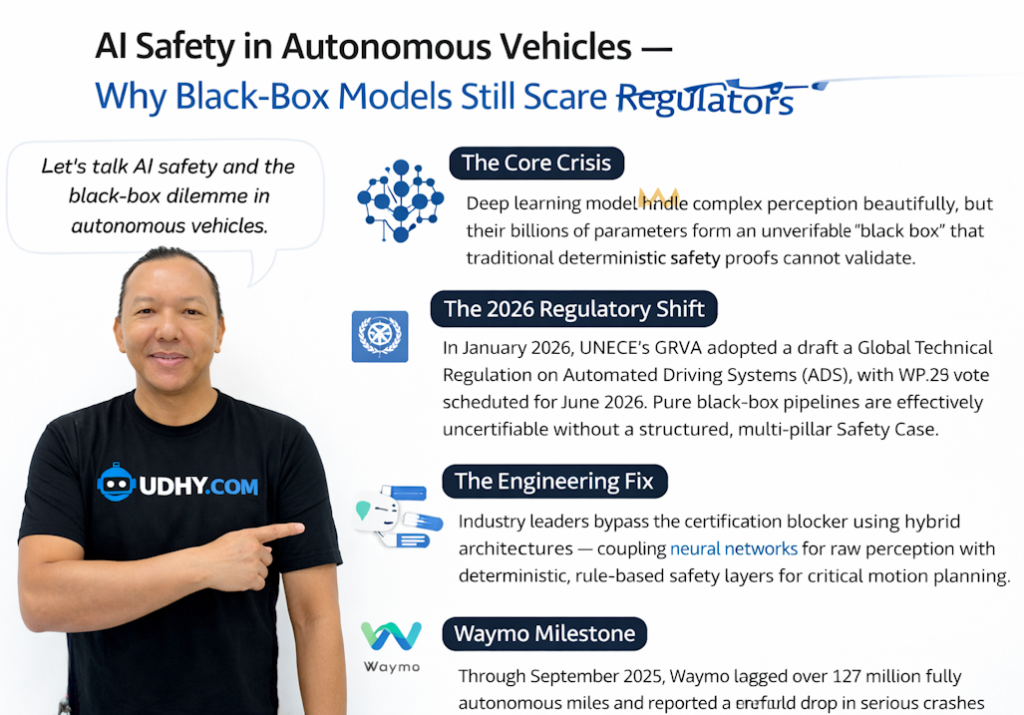
- The Core Crisis: Deep learning models handle complex perception beautifully, but their billions of parameters form an unverifiable “black box” that traditional deterministic safety proofs cannot validate.
- The 2026 Regulatory Shift: In January 2026, UNECE’s GRVA adopted a draft Global Technical Regulation on Automated Driving Systems (ADS), with WP.29 vote scheduled for June 2026. Pure black-box pipelines are effectively uncertifiable without a structured, multi-pillar Safety Case.
- The Engineering Fix: Industry leaders bypass the certification blocker using hybrid architectures — coupling neural networks for raw perception with deterministic, rule-based safety layers for critical motion planning and override.
- Waymo Milestone: Through September 2025, Waymo logged over 127 million fully autonomous miles and reported a tenfold drop in serious crashes versus human drivers — built on a transparent, layered safety architecture.
Introduction: The Hidden Friction Blocking Mass AV Deployment
Autonomous vehicles are routinely heralded as the definitive future of mobility. Yet a close look at public roads globally reveals deployment that is highly localized, tightly constrained, and carefully monitored. The reason isn’t sensor quality or raw computational horsepower. The friction is fundamentally mathematical and architectural: black-box AI models.
Deep learning systems excel at parsing unstructured environments, but their internal decision pathways are utterly opaque. For an industry built on traditional aerospace and automotive verification principles — where every line of code must map to a deterministic, auditable outcome — this opacity makes structural certification near-impossible. The gap between AI capability and regulatory acceptance is the defining engineering challenge of 2026 autonomous vehicle deployment.
This article examines why black-box models alarm regulators, how the 2026 UNECE Global Technical Regulation reshapes the compliance landscape, and what engineering teams are doing right now to build certifiable, transparent autonomous systems.
The Black-Box Problem: Billions of Parameters, Zero Traceability
Modern autonomous systems rely heavily on Deep Neural Networks (DNNs). These models ingest high-dimensional sensor data — LiDAR point clouds, camera streams, radar signals — and map them directly to driving actions. While phenomenally adaptive, DNNs function as statistical estimators containing hundreds of millions to billions of parameters. Because these parameters interact in non-linear, high-dimensional spaces, tracking exactly why a model chose a specific steering angle or deceleration rate under novel conditions is impossible via standard code-auditing techniques.
Unlike classical rule-based software that follows crisp logical constraints, a deep learning network’s logic is distributed across weights and biases. This creates a critical engineering tradeoff:
- As a model’s operational flexibility increases, its inspectability plummets.
- The same neural update that improves highway lane-keeping can introduce edge-case failures on unmarked rural roads.
- Imperceptible input perturbations, known as adversarial examples, can radically alter the output of deep learning models. Attack methods such as FGSM (Fast Gradient Sign Method) and JSMA (Jacobian‑based Saliency Map Attack) exploit the mathematical structure of convolutional neural networks (CNNs). Because CNNs process localized pixel matrices, adding high‑frequency noise — invisible to the human eye — shifts the latent vector outside its decision boundary. The result: a stop sign misclassified as a speed limit sign, undermining safety‑critical perception in autonomous vehicles.
Consider Tesla’s Full Self-Driving (FSD) system. Iterative neural network updates have significantly improved lane-keeping and path-smoothing over time. Yet the same architecture has repeatedly struggled with construction zones, emergency vehicle scenarios, and sun glare at specific angles. Read Why Self-Driving Cars Still Fail for details. For consumers, this is a quirk; for safety regulators certifying millions of road interactions per day, an unmapped behavioral edge case is completely unacceptable.
Why Regulators Are Terrified: The 3 Core Hurdles
1. The Verification Gap
Traditional automotive safety relies on deterministic proofs. ISO 26262 grades software using Automotive Safety Integrity Levels (ASIL), with ASIL-D (the highest classification) requiring absolute, verifiable determinism. Read more Autonomous Vehicle Safety: Sensors, AI & Cybersecurity. ISO 21448 (SOTIF — Safety of the Intended Functionality) demands that engineers map out the full boundaries of safe operation for every functional scenario. Black-box models are inherently probabilistic. They cannot offer absolute, bounds-tested guarantees under novel real-world conditions that fall outside training distributions.
The fundamental SOTIF (Safety of the Intended Functionality) performance metric is the reduction of both Known Unsafe Scenarios and Unknown Unsafe Scenarios — corresponding to Areas 2 and 3 of the SOTIF risk matrix. In practice, black‑box neural networks continuously convert unknown‑unsafe parameters into known‑safe parameters through massive simulation cycles and structured testing. This iterative process grounds the discussion in formal systems engineering, demonstrating how safety cases evolve from uncertainty toward certifiable robustness.
This creates what regulators call the “open-world problem”: no finite test dataset can prove that a neural network will behave safely across all possible environmental configurations. An AV tested in 100 million simulation scenarios can still encounter scenario 100,000,001 on a public road — and the model’s response under that novel condition is fundamentally unprovable in advance.
2. The Liability and Accountability Void
When a human driver crashes, liability is handled by established traffic law. When a rule-based software component fails, engineers can trace the exact logic failure through the codebase to a specific conditional branch. When an end-to-end deep learning model misinterprets an environment and causes a collision, attributing liability becomes an algorithmic nightmare. Is it the data labeler’s fault? The training optimization algorithm? The lack of out-of-distribution (OOD) data? Regulators refuse to approve systems where fault cannot be explicitly localized, documented, and corrected.
The 2021 Uber ATG and 2023 Cruise San Francisco incidents both demonstrated this accountability vacuum — post-incident investigations required months of log analysis simply to reconstruct the decision sequence that led to each failure, and even then, root cause attribution remained contested.
3. The Fragility of Public Trust
Public acceptance of automated systems is extraordinarily fragile. A single highly publicized edge-case accident can set regulatory frameworks back by years. The 2018 Uber Tempe fatality delayed multiple state-level AV deployment frameworks by an average of 18 months. Transparency is the only currency that builds long-term public trust, and black-box systems are, by definition, bankrupt of transparency.
Polling data consistently shows that public trust in AVs tracks directly with perceived explainability. Systems that can generate human-readable justifications for their decisions — even simplified post-hoc explanations — receive significantly higher trust scores than systems that offer only statistical confidence percentages.
The 2026 Regulatory Landscape: The UN Global Technical Regulation on ADS
The era of self-certifying autonomous software with loose oversight has ended. In January 2026, the UNECE Working Party on Automated/Autonomous and Connected Vehicles (GRVA) adopted the draft Global Technical Regulation on Automated Driving Systems (ADS). This landmark framework — the result of nearly a decade of international negotiation — is scheduled for formal adoption by the UNECE World Forum for Harmonization of Vehicle Regulations (WP.29) at its June 23–26, 2026 session.
Rather than forcing engineers to explicitly chart billions of neural parameters, the 2026 regulation uses a technology-neutral, performance-based multi-pillar validation methodology. At its core is the Safety Case approach — a structured, evidence-based argument demonstrating that the ADS is sufficiently safe for market introduction.
Key requirements under the draft GTR include:
- Safety Management System (SMS): Manufacturers must operate a certified SMS governing safety across the entire vehicle lifecycle — from development through production, deployment, and post-market monitoring.
- Multi-Method Validation: ADS approval requires a structured blend of high-fidelity simulation testing, closed-track validation, real-world trials, and independent third-party audits.
- Data Storage System for Automated Driving (DSSAD): Vehicles must run a mandatory onboard recording system capturing real-time ADS performance data to maintain continuous regulatory compliance.
- Performance Standard: The ADS must perform at a level “at least equivalent to a competent and careful human driver” and operate entirely free from unreasonable risk.
The US NHTSA opened a public comment period on the draft GTR in January 2026. China indicated it would align its national standard with the global regulation’s structure. Japan expressed strong support. The EU has confirmed the framework aligns with its existing AI Act and Regulation (EU) 2019/2144 advanced vehicle safety mandates.
“The adoption of this draft demonstrates that safety, innovation and public trust can advance together. By working globally, we provide clarity to the industry and confidence to consumers.” — Richard Damm, Chair of GRVA, UNECE (February 2026)
Technical Comparison: Architecting Autonomous Logic
| Technique | Strengths | Weaknesses | Example Use Case |
| Rule-Based Systems | Transparent, auditable, fully deterministic. Easy to trace failures. | Brittle in complex environments; scales poorly with scenario diversity. | Early AV prototypes; legacy ADAS systems. |
| End-to-End Deep Learning | Flexible, adapts seamlessly to complex and novel environments. | Opaque, unverifiable, extremely difficult to certify under ISO 26262. | Tesla FSD neural pipelines. |
| Hybrid Architectures | Balances deep learning adaptability with deterministic safety guarantees. | Increases integration complexity; requires careful interface design. | Waymo fleets; Moovita autonomous transit buses. |
| Explainable AI (XAI) Wrappers | Generates human-readable justifications for model decisions. | Post-hoc explanations may not fully reflect internal model logic. | Regulatory compliance layers; academic AV research. |
Engineering Deep-Dive: The Dual-Layer Hybrid Safety Architecture
To navigate certification requirements, leading engineering teams have abandoned pure end-to-end deep learning in favor of Dual-Layer Hybrid Safety Architectures. In this framework, the ADS software pipeline is split into two rigorously isolated modules:
Layer 1: The Perception Layer (Neural Network)
This layer handles high-dimensional, unstructured input processing — LiDAR point cloud segmentation, camera-based bounding box classification, radar target clustering, and lane boundary estimation. Read more sensor fusion explained. The neural network’s output is a structured set of environment descriptors: object positions, velocities, classifications, and confidence scores. Crucially, this layer is not permitted to command the vehicle directly.
Layer 2: The Deterministic Safety Layer (Rule-Based)
The perception layer’s structured output feeds into a verification gate written in strict, auditable, rule-based code. This layer enforces safety envelopes — mathematically defined boundaries for safe vehicle behavior — and intercepts any path trajectory that violates them. The safety layer operates at hardware interrupt priority and can override the perception layer’s commands within microseconds.
Under the Dual‑Layer Hybrid Safety Architecture, the deterministic safety layer acts as a rule‑based backup to perception networks. This framework relies on Control Barrier Functions (CBFs) and Responsibility‑Sensitive Safety (RSS) models to enforce mathematically provable safety boundaries.
Even if a neural network misclassifies its environment — for example, hallucinating an open highway — the deterministic layer applies hard constraints based on active time‑to‑collision (TTC) calculations. These constraints guarantee that deceleration commands remain within safe limits, preventing unsafe maneuvers regardless of perception errors.
By coupling probabilistic AI perception with deterministic safety logic, the hybrid architecture ensures that autonomous vehicles maintain certifiable safety even under black‑box uncertainty.
Here is a simplified conceptual example of how a trajectory verification gate operates within this deterministic safety framework:
def verify_trajectory(predicted_path, safety_envelope_m):
    """
    Verify whether the predicted trajectory is safe.

    Logic:
    - Iterate through each point in the predicted path.
    - If any obstacle is detected within the safety envelope,
      trigger a safe deceleration protocol.
    - Otherwise, execute the planned actuation command.

    Parameters:
        predicted_path (list): Sequence of trajectory points, each with an obstacle_distance attribute.
        safety_envelope_m (float): Minimum safe distance threshold in meters.

    Returns:
        Command: Either a deceleration protocol or actuation command.
    """
    for point in predicted_path:
        if point.obstacle_distance < safety_envelope_m:
            return initiate_safe_deceleration_protocol()

    return execute_actuation_command(predicted_path)
This architectural separation of concerns — neural perception from deterministic actuation — has transitioned from specialized research into a mandatory operational standard for commercial AV fleets seeking regulatory approval in 2026.
Waymo’s Safety Case: What Transparency Looks Like in Practice
Waymo provides the industry’s most detailed public safety case framework, with published research exceeding 50 peer-reviewed papers. Through September 2025, Waymo logged over 127 million fully rider-only autonomous miles across five US cities, reporting a tenfold reduction in serious crashes compared to human driver benchmarks. A key element of Waymo’s regulatory strategy is radical data transparency: publishing crash rates, incident analyses, and safety methodology openly, inviting third-party scrutiny. Read more at Waymo Safety Report 2025.
Waymo’s 2026 safety research papers — including work on “Building a Credible Case for Safety” (Favaro et al., 2026) and crash rate benchmarks from stoplights to on-ramps (Scanlon et al., 2026) — exemplify the type of structured, evidence-based Safety Case that the 2026 UNECE GTR now codifies as mandatory. The data includes:
- 170.7 million rider-only miles logged through December 2025 without a human driver.
- Serious injury crash rates significantly below human driver benchmarks in comparable urban driving contexts.
- Recall of 3,067 robotaxis in early 2025 following reports of improper behavior near school buses — demonstrating that real-time safety monitoring and swift corrective action are built into operational practice.
Practical Insight from the Field
“During my years at A*STAR and later co-founding Moovita — Singapore’s first autonomous vehicle company — I saw firsthand how global regulators struggle with opaque models. We encountered instances where purely data-driven systems performed flawlessly on public roads, yet failed basic edge-case scenario testing on a closed track because of micro-shifts in lighting conditions. To resolve this, we piloted hybrid systems where deterministic rules handled safety-critical maneuvers while deep learning managed perception. If the perception network experiences an anomaly or drops into low-confidence bounds, the deterministic safety rules override the system to initiate controlled braking or a structured roadside pullover. This separation of concerns has transitioned from a specialized research paradigm into a mandatory operational standard across 2026 commercial fleets.”— Dr. Dilip Kumar Limbu, Co-Founder of Moovita
The Road Ahead: Explainable AI and Runtime Monitoring
Beyond hybrid architectures, the next frontier in AV safety certification involves Explainable AI (XAI) tools that generate human-interpretable justifications for neural network decisions. Techniques like SHAP (SHapley Additive exPlanations) and LIME (Local Interpretable Model-agnostic Explanations) allow engineers to attribute model outputs to specific input features — providing a partial window into the black box without requiring full internal transparency.
Runtime monitoring frameworks — where deployed models are continuously compared against formally verified behavioral specifications during live operation — are also gaining regulatory traction. The UNECE GTR’s mandatory DSSAD requirement is essentially a codified version of this principle: continuous evidence collection that the ADS is operating within its validated safety envelope across real-world conditions.
Frequently Asked Questions (FAQ)
Further Reading on UDHY
- Why Self-Driving Cars Still Fail
- Level 3 vs Level 4 Autonomous Driving: Key Differences
- Is AI Speeding Up or Slowing Down AV Development?
- Autonomous Vehicle Safety: Sensors, AI & Cybersecurity (Expert Course)
- Physical AI & VLA Models: Powering Tomorrow’s Robots
- Deep Learning for Robotics & Autonomous Systems
References & External Sources
- UNECE (2026). Draft Global Regulation on Automated Driving Systems.
- Sidley Austin LLP (2026). A New Global Milestone for Autonomous Vehicles: What the UN GTR on ADS Means for Autonomy.
- NHTSA / Federal Register (2026). Notice and Request for Comment on Draft UN GTR for ADS (Docket NHTSA-2026-0034). https://www.federalregister.gov/documents/2026/01/23/2026-01274/
- Waymo (2026). Safety Impact Hub — 170.7M Rider-Only Miles.
- Waymo Research (2026). Building a Credible Case for Safety; Crash Rate Benchmarks for ADS Evaluation.
- Favaro, F. et al. (2026). Building a Credible Case for Safety: Waymo’s Approach. SAE Technical Paper.
- Scanlon, J.M. et al. (2026). From Stoplights to On-Ramps: Crash Rate Benchmarks for ADS Evaluation. SAE International Journal of Transportation Safety, 14(2).
- ISO 26262 (2018). Road Vehicles — Functional Safety. International Organization for Standardization.
- ISO 21448 (2022). Road Vehicles — Safety of the Intended Functionality (SOTIF). International Organization for Standardization.
- IEEE Xplore (2026). Autonomous Vehicle’s Impact on Traffic: Empirical Evidence From Waymo Open Dataset.
About the Author
Dr. Dilip Kumar Limbu Co-Founder, Moovita | Former Principal Scientist, A*STAR | PhD, Auckland University of Technology
Connect via LinkedIn Direct Inquiry.
Disclaimer
The views expressed here are personal and based on 25+ years in the industry, including my work at Moovita. They do not necessarily reflect the views of any organization.
Enjoying this post? Subscribe to get more AI insights.