Sensor Fusion Failures in Autonomous Vehicles: Why Perception Breaks and How Engineers Fix It
About the Author
I am Dr. Dilip Kumar Limbu, Co-Founder of Moovita — Singapore’s first autonomous vehicle company — and former Principal Research Scientist at A*STAR’s Institute for Infocomm Research (I2R). With over 25+ years of hands‑on experience in building and scaling autonomous shuttle fleets across Singapore, Malaysia, and China, I’ve seen firsthand the failure modes that textbooks rarely cover — LiDAR ghost points in monsoon rain, cameras blinded by tropical sun glare, and radar tracks misaligned with multiple sensors. In this post, I explain why sensor fusion breaks in production autonomous vehicles and share proven architectural techniques that actually fix these issues.
TL;DR — Quick Insights
- Sensor fusion doesn’t fail randomly — it fails in three predictable categories: calibration/synchronization drift, environmental degradation (glare, rain, occlusion), and temporal misalignment (sensor staleness – leading to outdated or “stale” information being fused together). Every production AV failure traces back to one of these three.
- BEV (Bird’s-Eye-View) fusion solves the occlusion and scale-variation problem that plagued perspective-view perception for a decade — by projecting every sensor modality into a unified top-down coordinate frame.
- Uncertainty-aware fusion is the 2026 frontier: instead of trusting every sensor equally, modern architectures dynamically down-weight degraded sensors using confidence scores — Bayesian deep learning, Monte Carlo dropout, and evidential deep learning are now production techniques, not research curiosities.
- Sensor staleness — not sensor failure — is an underrated cause of fusion errors: when LiDAR, camera, and radar data arrive with different latencies, naive fusion creates phantom velocity errors that can directly corrupt downstream trajectory prediction.
- No single sensor modality is sufficient at Level 4: cameras fail in glare and low light, LiDAR degrades in heavy rain and snow, radar lacks semantic resolution. Redundancy isn’t conservatism — it’s the only architecture that has been validated at meaningful commercial Level 4 scale.
- Introduction: Why Perception Is the Hardest Problem in Autonomous Driving
- Part 1: Why Single-Sensor Perception Cannot Work at Level 4
- Part 2: The Three Categories of Fusion Failure
- Part 3: BEV Fusion — The Architecture That Changed Everything
- Part 4: A Practical Failure-Mode Reference Table
- Part 5: Engineering Insights — What Teams Should Build Today
- Lessons Learned – Engineering Principles for Robust Sensor Fusion
- AV Sensor Fusion FAQs: Failures, Causes & Fixes 2026
- References
Introduction: Why Perception Is the Hardest Problem in Autonomous Driving
Every autonomous vehicle system is built on one core idea: the vehicle must know, with very high confidence, exactly what is around it before it can decide how to act. That may sound obvious, but in my 25 years of building these systems, it remains the hardest unsolved engineering challenge in the AV stack — tougher than planning, tougher than control, and even tougher than the regulatory and safety work I led at Moovita.
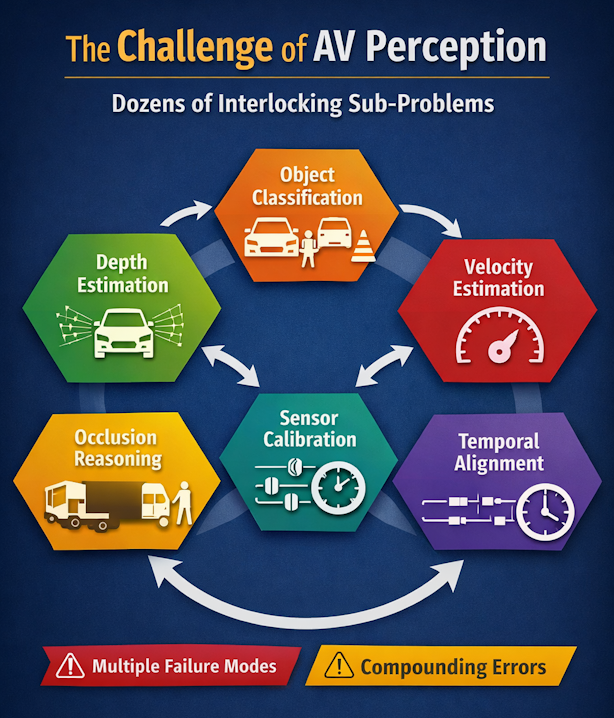
The reason is that perception is not one problem. It is dozens of interlocking sub-problems — depth estimation, object classification, velocity estimation, occlusion reasoning, sensor calibration, temporal alignment — each with its own failure modes, each degrading under different environmental conditions, and each compounding the errors of the others when they go wrong simultaneously.
This post provides a technical breakdown of how sensor fusion fails in real‑world autonomous vehicle deployments, and the specific architectural techniques production engineering teams use to solve these issues. Many of these solutions were implemented and evaluated during Moovita’s operations in Singapore’s tropical, sensor‑hostile climate. This is not a marketing overview — it is the engineering reality behind the AV stack.
Part 1: Why Single-Sensor Perception Cannot Work at Level 4
Before discussing how sensor fusion works, it’s necessary to be precise about why no individual sensor modality is sufficient on its own.
Cameras: Rich Semantics, Fragile Physics
Cameras provide the richest semantic information of any AV sensor — they are the only modality that can natively read a traffic sign, distinguish a plastic bag from a rock, or recognize a pedestrian’s intent through body language. But camera perception is fundamentally constrained by the physics of visible light.
Table : Camera Strengths vs. Failures
| Aspect | Strengths (Rich Semantics) | Failures (Fragile Physics) |
|---|---|---|
| Object Recognition | Excellent at classifying vehicles, pedestrians, signs, and lane markings. | Struggles in low light, glare, fog, or heavy rain; semantic cues vanish in poor visibility. |
| Color & Texture | Provides rich detail for traffic lights, road signs, and surface markings. | Washed out by bright sunlight, reflections, or wet road surfaces; color cues become unreliable. |
| Depth Estimation | Can infer relative distance using perspective and motion cues. | Lacks precise depth; easily confused by scale variation and occlusion. |
| Cost & Availability | Affordable, widely available, lightweight sensors. | Fragile optics; performance degrades quickly in harsh environments (dust, snow, tropical rain). |
| Integration | Easy to mount and integrate with AV systems; high resolution feeds. | Requires heavy compute for image processing; latency leads to temporal misalignment. |
| Semantic Richness | Captures context (e.g., gestures, road signs, traffic signals) that LiDAR/Radar cannot. | Physics limitations mean semantics collapse when photons are blocked, scattered, or distorted. |
Camera-based perception systems face significant challenges from environmental factors that can degrade visual data quality, and one of the most critical issues is camera occlusion, where contaminants like dirt, raindrops, or snow obstruct the lens, leading to significant reduction in image clarity. Beyond physical occlusion, cameras suffer from dynamic range limitations — a camera correctly exposed for a shaded street will saturate to pure white the instant it points toward direct sun, exactly the scenario implicated in several documented vision-only system failures.
LiDAR: Precise Geometry, Weather-Vulnerable
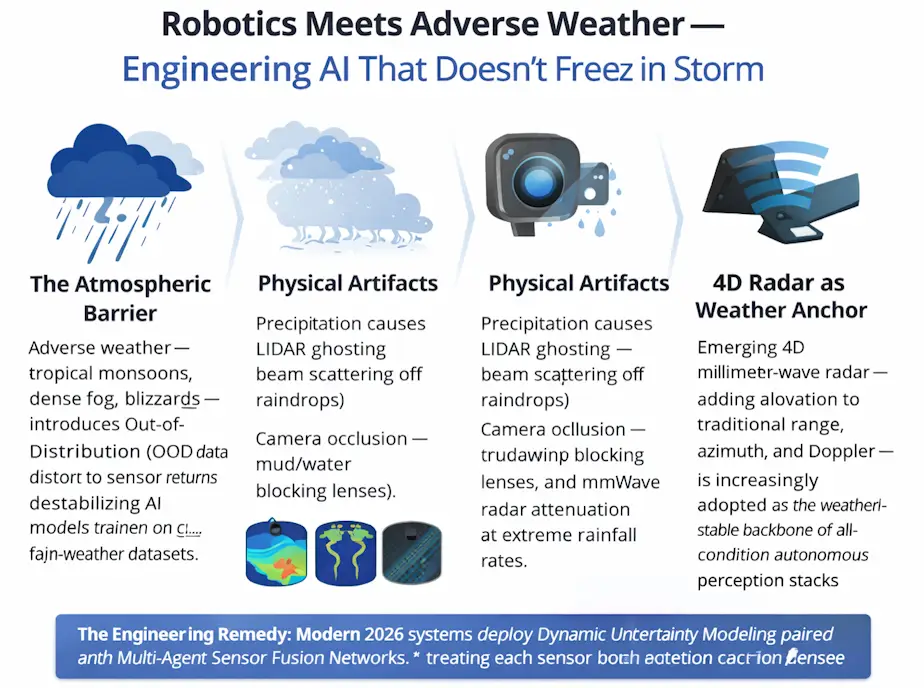
LiDAR provides extremely precise 3D geometric information by measuring the time-of-flight of laser pulses. This geometric precision is unmatched by any other sensor — but LiDAR performance degrades significantly in adverse weather, including fog, heavy rain, and snow, where water particles in the air scatter and absorb the laser pulses, creating false returns or “ghost points” that did not correspond to a real object in Moovita’s monsoon-season testing.
Title : LiDAR in Autonomous Vehicles: Precise Geometry, Weather Vulnerabilities, and Fusion Challenges
| Aspect | Strengths (Precise Geometry) | Failures (Weather‑Vulnerable) |
|---|---|---|
| 3D Mapping | Provides millimeter‑level precision in spatial geometry, ideal for lane boundaries and objects. | Performance degrades in heavy rain, fog, and snow due to backscatter and signal attenuation. |
| Depth Accuracy | Delivers exact distance measurements, outperforming cameras in range estimation. | Water droplets, dust, and snowflakes create false returns, reducing reliability. |
| Lighting Independence | Works equally well in day or night; unaffected by ambient light conditions. | Strong sunlight or reflective surfaces can cause blooming and ghost points. |
| Object Detection | Detects shape and position of vehicles, pedestrians, and infrastructure with high accuracy. | Struggles with transparent or reflective objects (e.g., glass walls, shiny cars). |
| Sensor Fusion Role | Provides the geometric backbone for AV perception, complementing cameras and radar. | Vulnerable to environmental noise, requiring fusion with radar/cameras for robustness. |
| Engineering Value | Essential for Level 4+ autonomy; precise geometry enables safe planning and control. | High cost and weather fragility limit scalability in mass‑market deployments. |
Radar: All-Weather Reliability, Low Semantic Resolution
Radar performs well in adverse weather conditions, such as fog or rain, where cameras may fail, because radio waves are far less attenuated by water droplets than visible light or infrared laser pulses. But radar’s angular and spatial resolution is an order of magnitude coarser than camera or LiDAR — radar can confidently tell you something is there and how fast it’s moving, but struggles to tell you what it is.
Table : Radar in Autonomous Vehicles: All‑Weather Reliability vs. Low Semantic Resolution
| Aspect | Strengths (All‑Weather Reliability) | Failures (Low Semantic Resolution) |
|---|---|---|
| Weather Performance | Operates reliably in rain, fog, snow, and dust; unaffected by poor visibility. | Cannot capture fine details like lane markings, traffic lights, or pedestrian gestures. |
| Range & Velocity | Excellent at measuring distance and relative speed of moving objects with Doppler accuracy. | Limited ability to distinguish object type (car vs. cyclist vs. pedestrian). |
| Robustness | Resistant to environmental interference; works day and night. | Struggles with clutter in dense urban environments; reflections cause ghost detections. |
| Cost & Scalability | Affordable, compact, and widely used in automotive safety systems. | Provides coarse point clouds; lacks rich geometry compared to LiDAR. |
| Sensor Fusion Role | Complements cameras and LiDAR by adding reliable velocity and range data. | Needs fusion with other sensors to achieve semantic understanding of the environment. |
| Engineering Value | Critical for collision avoidance and adaptive cruise control; backbone of ADAS systems. | Insufficient alone for full autonomy; semantic gaps limit perception quality. |
The Conclusion Every Production AV Architecture Reaches
No single sensor modality — whether cameras with rich semantics but fragile physics, LiDAR with precise geometry yet weather vulnerabilities, or radar with all‑weather reliability but low semantic resolution — has ever been validated as sufficient for genuine Level 4 autonomous vehicle deployment at commercial scale.
Every system that has successfully crossed from demonstration into sustained, regulator‑approved commercial operation — including Waymo’s fleet, Moovita’s Singapore deployment, and Baidu’s Apollo Go — relies on multi‑modal sensor fusion as a foundational architectural decision. Sensor fusion is not an optional enhancement; it is the engineering reality that enables safety, scalability, and regulatory approval in real‑world autonomous driving. In addition, perception and localization are tightly coupled — for the complementary problem of knowing where you are when sensors degrade, see GPS-Denied Localization in Autonomous Vehicles.
Part 2: The Three Categories of Fusion Failure
From debugging production fusion pipelines for over a decade, I categorize fusion failures into three distinct types. Understanding which category a failure belongs to is the first step to fixing it — each category requires a fundamentally different engineering solution.
Category 1: Calibration and Synchronization Drift
Calibration drift happens when a sensor’s physical position or internal measurement properties silently shift away from their original factory or installation settings — and it is the most common, least visible cause of fusion errors in deployed AV fleets.
Example: A LiDAR unit mounted at exactly 0.5 metres above the front bumper, angled 2 degrees downward, is calibrated against that exact position. After six months of road vibration, the mounting bracket loosens by 1.5mm and the angle drifts to 2.3 degrees. The LiDAR itself still works perfectly — but every point cloud it returns is now systematically offset by a few centimetres relative to what the camera and radar expect. The fusion system doesn’t see a “broken sensor” — it sees three sensors that quietly disagree with each other, and without continuous calibration monitoring, nobody catches it until a downstream tracking error shows up. Precise calibration and synchronization are required to align heterogeneous sensors with differing resolution and noise characteristics — misalignment degrades downstream tasks.
Basically, every sensor on an autonomous vehicle has a physical mounting position and orientation relative to the vehicle’s reference frame (extrinsic calibration), and an internal characterization of its own measurement properties (intrinsic calibration). Both drift over time — vibration loosens mounting brackets, temperature cycling shifts lens properties, and a LiDAR unit replaced after a hardware failure will never have exactly the same extrinsic calibration as the unit it replaced.
The engineering fix: Production systems run continuous online calibration — algorithms that monitor cross-sensor consistency (does the LiDAR point cloud projected into the camera frame align with detected edges?) and flag or auto-correct calibration drift before it propagates into fusion errors. At Moovita, we ran calibration health checks at every depot charging cycle, catching drift before it ever reached the live perception stack. This continuous calibration approach aligns with IEEE’s published guidance on extrinsic sensor calibration for autonomous systems, which identifies drift detection as a primary reliability requirement for Level 4 deployment.
Category 2: Environmental Degradation
Environmental degradation happens when real-world conditions — weather, lighting, or physical obstruction — reduce the quality of raw sensor data faster than any single sensor can compensate for on its own.
Example: At 5:45pm on a clear day, a camera facing west directly into a low setting sun will saturate to near-total white for several seconds as the vehicle turns onto a west-facing road — a textbook case of dynamic range failure, not a hardware fault. During those seconds, the camera contributes effectively zero usable semantic data. A fusion system without environmental degradation handling will either trust a blank camera feed (dangerous) or simply drop the modality entirely (wasteful, since LiDAR and radar can still see fine). The correct fix — covered below — is dynamic confidence weighting that detects the saturation in real time and shifts trust to the still-functioning sensors for those few seconds.
Edge cases such as glare, precipitation, or occlusion challenge sensor consistency — this is the category most people think of when they imagine sensor fusion failing, and for good reason: it’s the hardest to fully solve because it’s a function of physics, not engineering precision.
The engineering fix is two-pronged. First, robust fusion design incorporates probabilistic reasoning and fallback strategies to maintain operational integrity — meaning the system doesn’t simply average all sensor inputs equally, it weights them based on real-time confidence. Second, end-to-end neural fusion models are increasingly replacing modular pipelines, learning cross-modal relationships directly rather than relying solely on engineered integration logic — letting the model learn, from millions of miles of training data, exactly which sensor to trust under which specific lighting and weather signature.
Category 3: Temporal Misalignment (Sensor Staleness)
Temporal misalignment — sensor staleness — happens when different sensors report data at different moments in time, and a fusion system treats those mismatched timestamps as if they were simultaneous.
Example: A pedestrian steps off a curb and is moving at 1.4 m/s. The camera frame capturing this arrives at the fusion module 33ms after it was taken. The LiDAR sweep covering the same moment arrives 100ms after it was taken — nearly 3x later. If the fusion pipeline simply combines “the latest reading from each sensor” without correcting for that 67ms gap, the LiDAR-derived position for the pedestrian will be calculated as if it were captured at the same instant as the camera frame — placing the pedestrian roughly 9.4cm behind where they actually are. That 9.4cm error doesn’t sound dangerous on its own, but it directly corrupts the velocity estimate the trajectory predictor relies on, and at higher vehicle or pedestrian speeds, the same timing gap produces proportionally larger position errors.
This is the category I consider most underrated outside of specialist engineering circles. Sensor staleness — where data from different sensors arrives with varying delays — poses significant challenges, and temporal misalignment between sensor modalities leads to inconsistent object state estimates, severely degrading the quality of trajectory predictions that are critical for safety.
Here’s the practical version of this problem: your camera frame arrives every 33 milliseconds. Your LiDAR sweep completes every 100 milliseconds. Your radar updates every 50 milliseconds. If your fusion pipeline naively combines the “most recent” reading from each sensor without accounting for exactly how stale each reading is relative to the current moment, a fast-moving object’s fused position will be subtly, dangerously wrong — and that error compounds directly into your motion prediction and planning stack.
The engineering fix: Zoox’s published research addresses this with a per-point timestamp offset feature — for LiDAR and radar both relative to camera — that enables fine-grained temporal awareness in sensor fusion, paired with a data augmentation strategy that simulates realistic sensor staleness patterns observed in deployed vehicles. The practical lesson: don’t treat “the latest reading from each sensor” as synchronized data. Treat timestamp offset as a first-class feature the fusion model must explicitly reason about.
This same temporal-integrity principle underpins SROS2’s message authentication layer, covered in the Cybersecurity for Autonomous Robots course — a delayed or replayed sensor message is functionally indistinguishable from a spoofed one unless timestamps are cryptographically verified.
Part 3: BEV Fusion — The Architecture That Changed Everything
If you’re reading this, it means you’re ready to dive deeper into Bird’s-Eye-View (BEV) fusion — the single most consequential architectural shift in autonomous vehicle perception over the past three years.
Why Perspective-View Fusion Was Fundamentally Limited
Perspective-view fusion was fundamentally limited because it processes the world the way a single camera sees it — where distance and occlusion change an object’s apparent size and visibility, rather than its actual position.
Example: A child standing directly behind a parked delivery van, visible only from the knees down in the camera frame, may be classified by a perspective-view model as “partial pedestrian, low confidence” or missed entirely depending on the exact viewing angle. Ten metres further down the road, with the van no longer blocking the view, the same child is suddenly “high confidence pedestrian.” Nothing about the actual physical situation changed — only the camera’s viewing geometry did. A safety engineer reviewing this behavior has no way to predict when detection will succeed or fail, because the failure is a function of camera geometry, not genuine risk.
For most of the 2010s, AV perception stacks fused sensors in perspective view — the native coordinate frame of a camera or forward-facing LiDAR. This approach has a structural flaw: BEV avoids common issues in 2D tasks such as occlusion and scale variation — in the perspective view, objects may experience occlusion or scale changes due to perspective (e.g. appearing smaller when farther away), but these problems are significantly mitigated in bird’s-eye view.
In practice, this meant a pedestrian partially hidden behind a parked car looked completely different to the perception model depending on the viewing angle and distance — sometimes detected, sometimes not, with no consistency a safety engineer could reason about.
How BEV Fusion Actually Works
BEV fusion works by converting every sensor’s raw output into a single shared top-down map of the area around the vehicle, so that an object’s position is described the same way regardless of which sensor detected it.
Example: A cyclist 15 metres ahead and 2 metres to the left is captured by the camera as a 2D bounding box at a specific pixel location, by the LiDAR as a cluster of 3D points, and by the radar as a single return with a velocity value. In perspective-view fusion, these three completely different data formats must be reconciled against each other directly — a brittle, error-prone process. In BEV fusion, all three are independently projected onto the same top-down grid first, so they all describe the cyclist using the same coordinate system before fusion even begins. The cyclist simply becomes “occupied cell at (15, -2) moving at 4 m/s” — a description any of the three sensors could have produced, and one the planning system downstream can use directly.
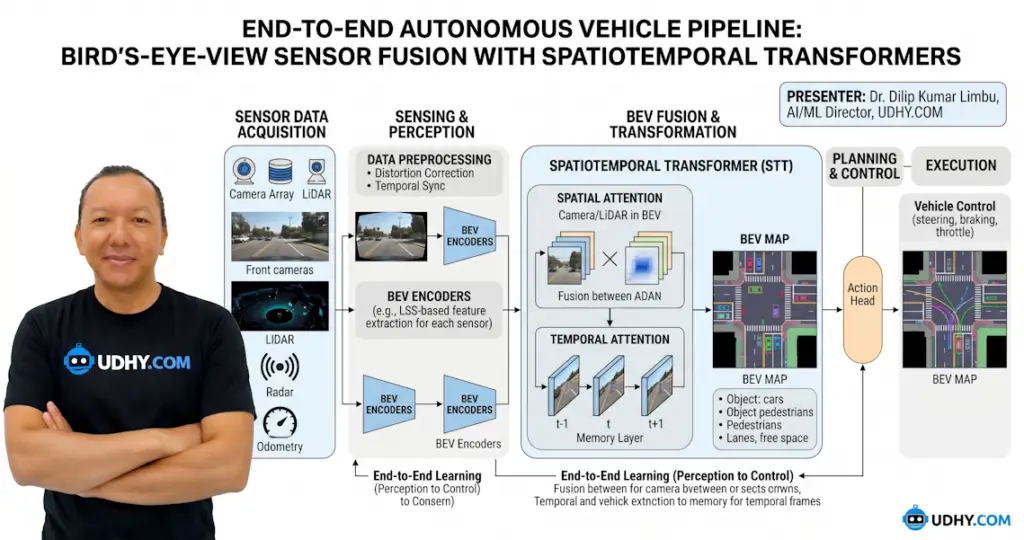
BEV adopts a unified world coordinate system, enabling the integration of data from different sensors, temporal sequences, and spatial information. Every sensor’s raw output — camera pixels, LiDAR points, radar returns — is projected (or “lifted”) into a shared top-down grid representing the area around the vehicle, regardless of which physical sensor originally captured it. Once everything lives in the same coordinate frame, fusion becomes a matter of combining grid cells rather than reconciling fundamentally different geometric representations.
This is the same architectural family covered in more mathematical depth in our companion post: BEV Sensor Fusion with Spatiotemporal Transformers — that post covers the transformer-based lifting mechanisms (LSS, BEVFormer-style deformable attention) in full technical detail if you want to go deeper into the model architecture itself.
The 2026 Frontier: Uncertainty-Aware Dynamic Weighting
Uncertainty-aware dynamic weighting works by having each sensor’s fusion model report not just “what it sees” but “how confident it is right now” — and using that confidence score to automatically shift trust toward whichever sensors are most reliable at that exact moment.
Example: During a sudden rain shower, the LiDAR’s confidence score drops sharply as ghost points from water scattering increase — the model itself flags “low confidence” on its own output. Simultaneously, radar’s confidence score stays high since radio waves aren’t meaningfully affected by rain. A static-weight fusion system would keep trusting LiDAR at its normal level and produce a degraded combined estimate. An uncertainty-aware system automatically re-weights the fusion calculation toward radar the moment LiDAR’s confidence drops — without any human intervention or pre-programmed “if it’s raining” rule — because the confidence signal itself is doing the work.
The genuinely new development in 2026 production fusion systems is uncertainty-aware sensor reliability modeling, where confidence estimation and dynamic sensor weighting directly influence downstream decision quality. Each sensing branch outputs both task predictions and confidence measures, such as epistemic uncertainty, aleatoric variance, entropy-based confidence, or evidential belief scores — and these uncertainty estimates are then used to adapt fusion weights dynamically, allowing the perception stack to down-weight degraded modalities under fog, glare, occlusion, or sensor malfunction.
Practically, this means the fusion model stops asking “what do all my sensors say?” and starts asking “what do my most-trustworthy sensors say right now, given current conditions?” — a fundamentally more robust framing, implemented through Bayesian deep learning, Monte Carlo dropout, ensemble variance estimation, Dempster–Shafer evidence fusion, and confidence-gated transformer attention.
Part 4: A Practical Failure-Mode Reference Table
| Failure Mode | Root Cause | Affected Sensors | Production Mitigation |
|---|---|---|---|
| Ghost LiDAR returns | Water droplet scattering | LiDAR | Confidence-weighted point filtering, radar cross-check |
| Camera washout/blindness | Direct sun glare, HDR limits | Camera | Multi-exposure capture, polarizing filters, LiDAR/radar fallback |
| Phantom velocity error | Temporal misalignment | Camera + LiDAR + radar | Per-sensor timestamp offset features, staleness-aware augmentation |
| Occluded pedestrian missed | Perspective-view scale/occlusion | Camera (perspective view) | BEV projection, V2X infrastructure sharing |
| Calibration drift | Vibration, thermal cycling, part replacement | All sensors | Continuous online extrinsic/intrinsic calibration checks |
| Degraded radar resolution | Inherent angular resolution limits | Radar | Camera/LiDAR cross-validation for object classification |
| Rare/long-tail object missed | Limited onboard field of view | All onboard sensors | Collaborative perception via V2X sharing data among vehicles and infrastructure |
Part 5: Engineering Insights — What Teams Should Build Today
If I were advising an engineering team building a perception stack from scratch in 2026, here is the advice I would give based on what actually worked — and what didn’t — at Moovita:
I. Don’t focus on adding more of the same sensor — focus on mixing different types. f you install six identical cameras, you only protect against one type of failure (like one camera breaking). But if all cameras face the same weakness — say, direct sunlight blinding them at a certain angle — then all six fail together.
Instead, combine different sensors:
- 1 LiDAR for precise distance and shape detection.
- 1 radar for reliable performance in rain or fog.
- 3 cameras pointing in different directions for rich visual detail.
This mix gives you true redundancy. For example:
- If sunlight blinds the cameras, radar still works.
- If rain scatters LiDAR beams, cameras and radar fill the gap.
- If radar mislabels an object, LiDAR geometry and camera semantics correct it.
Bottom line: One LiDAR + one radar + three diverse cameras will outperform nine identical cameras in real‑world conditions.
II. Always design your system to handle sensor staleness from the start. Many teams only realize it’s a problem after a failure — for example, a car predicts a pedestrian’s path incorrectly because one sensor’s data was delayed. By then, fixing it means an expensive retrofit.
Instead, build timestamp‑aware fusion right away:
- Example 1: If LiDAR detects an object at time but the camera frame arrives 200 ms later, the fusion system should know the camera data is “older” and adjust accordingly.
- Example 2: Radar data might be fresh, while camera data is stale — the system should weight radar more heavily in that moment.
Bottom line: Invest in staleness‑aware fusion early. It’s cheaper, safer, and prevents costly surprises later.
III. Bird’s‑Eye‑View (BEV) is now essential — not optional. If you’re starting a perception system today, don’t use perspective‑view fusion. It struggles with occlusion (objects blocking each other) and scale variation (near objects look huge, far ones look tiny).
BEV solves these problems by projecting all sensor data into a top‑down view:
- Example 1: In a crowded city street, a truck blocking a pedestrian is flattened into BEV space, so the pedestrian is still detected.
- Example 2: Cars at different distances appear consistent in size, making tracking and prediction more reliable.
Bottom line: BEV isn’t just a small upgrade — it’s the difference between a system that handles dense urban occlusion gracefully and one that fails.
IV. Treat your Operational Design Domain (ODD) as a technical specification, not just marketing. Every sensor failure depends on conditions:
- Example 1: Cameras fail under glare at a certain sun angle.
- Example 2: LiDAR struggles in heavy rain above a certain intensity.
- Example 3: Occlusion becomes critical in dense traffic.
Your ODD should list these conditions explicitly and show which ones your fusion system has been tested against. Just as important, your fallback behavior must trigger the moment you leave that safe envelope:
- Safe stop if sensors can’t see clearly.
- Driver handover when conditions exceed validation.
- Geofence exit if the vehicle leaves its approved area.
For the complete Safety Case and fallback architecture this ODD specification feeds into, see UDHY’s Autonomous Vehicle Safety: Sensors, AI & Cybersecurity course.
Bottom line: ODD is the contract between your perception system and the real world. Build it as a specification, not a sales pitch.
Lessons Learned – Engineering Principles for Robust Sensor Fusion
Redundancy is a requirement, not a luxury. Every Level 4 autonomous system in commercial use today relies on multi‑modal fusion. No single sensor — whether camera, LiDAR, or radar — has ever been validated as sufficient. For example, Waymo combines LiDAR, radar, and cameras to ensure safe operation in Phoenix’s bright sun and sudden rain. Budget for diversity from the start, not as an afterthought.
Categorize failures before fixing them. Different problems demand different solutions:
- Calibration drift → requires recalibration tools.
- Environmental degradation (rain, fog, glare) → needs sensor diversity.
- Temporal misalignment (data arriving late) → solved with timestamp‑aware fusion. Misdiagnosing wastes engineering time and delays deployment.
Bird’s‑Eye‑View (BEV) fusion is the baseline. Perspective‑only pipelines are outdated in 2026. BEV handles occlusion and scale variation far better. For example, Tesla’s FSD and Baidu Apollo both use BEV to detect pedestrians hidden behind vehicles in dense urban traffic.
Confidence‑aware fusion beats static weighting. The frontier today is uncertainty estimation and dynamic sensor weighting. If LiDAR is degraded by rain, the system automatically shifts trust toward radar and cameras. This adaptive weighting ensures fail‑operational behavior when conditions are worst — exactly when safety matters most.
Treat your ODD as a perception spec. Your Operational Design Domain should list the exact conditions your system has been validated against:
- Sun glare angles tested.
- Rain intensity thresholds.
- Traffic density limits. Fallback behaviors must trigger immediately when leaving that envelope — whether it’s a safe stop, driver handover, or geofence exit. Think of it as a safety engineer’s checklist, not a legal disclaimer.
AV Sensor Fusion FAQs: Failures, Causes & Fixes 2026
References
- Promwad. (February 2026). Sensor Fusion for Autonomous Transport in 2026 | Integrating LiDAR, Cameras, Radar and AI.
- MDPI Sensors. (May 2026). Multimodal Sensor Fusion in Autonomous Vehicles: Technologies, Architectures, and Open Challenges.
- ScienceDirect — Advanced Engineering Informatics. (2026). A Comprehensive Survey on Multi-Sensor Information Processing and Fusion for BEV Perception in Autonomous Vehicles.
- ScienceDirect. Multi-sensor fusion on autonomous driving perception: A comprehensive survey.
- Fan, M., Zuo, Y., Blaes, P., Montgomery, H., Das, S. (Zoox Inc). Robust sensor fusion against on-vehicle sensor staleness. arXiv:2506.05780.
- arXiv. (2026). Progressive Bird’s Eye View Perception for Safety-Critical Autonomous Driving: A Comprehensive Survey.
- arXiv. Minimizing Occlusion Effect on Multi-View Camera Perception in BEV with Multi-Sensor Fusion.
- IEEE Intelligent Transportation Systems Society.
- NVIDIA Developer Blog — Isaac Platform for Physical AI.
- SAE International — J3016 Taxonomy.
About the Author
Dr. Dilip Kumar Limbu Co-Founder, Moovita | Former Principal Scientist, A*STAR | PhD, Auckland University of Technology
Connect via LinkedIn Direct Inquiry.
Disclaimer
The views expressed here are personal and based on 25+ years in the industry, including my work at Moovita. They do not necessarily reflect the views of any organization.
Enjoying this post? Subscribe to get more AI insights.