Robotics Meets Adverse Weather — Engineering AI That Doesn’t Freeze in the Storm
In just 60 seconds, I’ll break down how robotics tackles adverse weather — and how engineers are building AI that won’t freeze when the storm hits.
TL;DR — Quick Insights
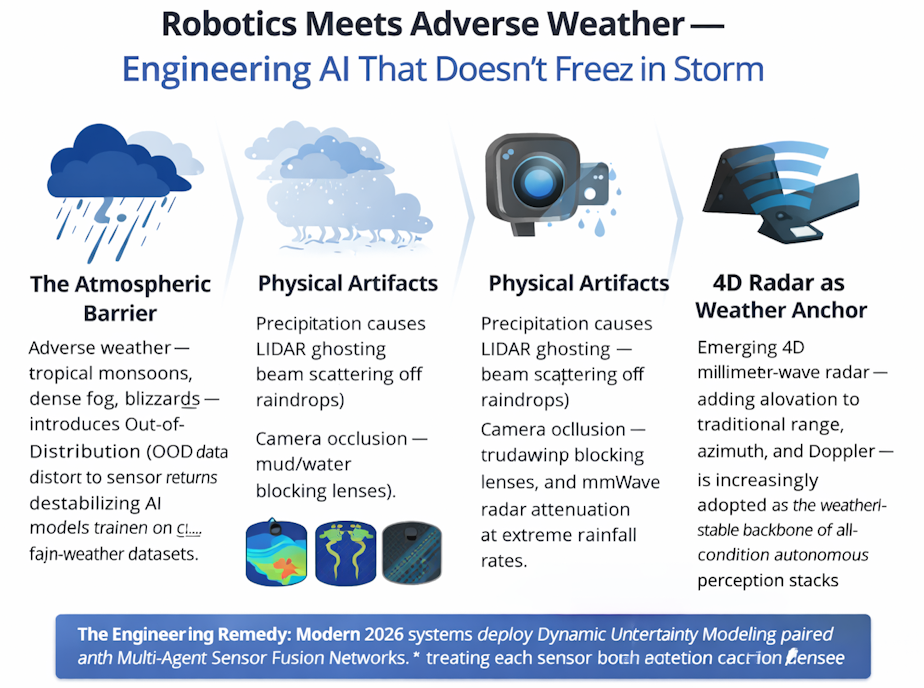
- The Atmospheric Barrier: Adverse weather — tropical monsoons, dense fog, blizzards — introduces Out-of-Distribution (OOD) data that distorts sensor returns and destabilizes AI models trained on clear-weather datasets.
- Physical Artifacts: Precipitation causes devastating real-world sensor phenomena: LiDAR ghosting (beam scattering off raindrops), camera occlusion (mud/water blocking lenses), and mmWave radar attenuation at extreme rainfall rates.
- The Engineering Remedy: Modern 2026 systems deploy Dynamic Uncertainty Modeling paired with Multi-Agent Sensor Fusion Networks — treating each sensor as an autonomous agent that outputs both a detection result and a real-time confidence score. Learn more Autonomous Navigation and SLAM.
- 4D Radar as Weather Anchor: Emerging 4D millimeter-wave radar — adding elevation to traditional range, azimuth, and Doppler — is increasingly adopted as the weather-stable backbone of all-condition autonomous perception stacks.
Introduction: The Sunny-Day Illusion of Autonomous Robotics
Sunny demo drives are easy. Real roads are not. It is relatively straightforward to make an autonomous vehicle or robotic platform look flawless on a clear, dry afternoon inside a geo-fenced tech park. The real world does not operate within pristine parameters. When tropical monsoons, thick morning fog, or winter blizzards roll in, the clean environmental inputs that autonomous perception systems rely on quickly disintegrate.
For robotics engineers, weather is not merely an operational inconvenience — it represents a fundamental machine learning crisis known as Out-of-Distribution (OOD) data. When computer vision models and neural networks are fed corrupted inputs that deviate wildly from their clear-weather training distributions, their detection metrics plunge. Algorithms suffer catastrophic drops in confidence, or worse, hallucinate phantom obstacles and freeze in their tracks.
A 2025 study published in Sensors (MDPI) — “Evaluating LiDAR Perception Algorithms for All-Weather Autonomy” — systematically tested perception algorithm performance across fog and snow scenarios, confirming severe degradation in all tested architectures under moderate-to-severe adverse conditions. Overcoming this atmospheric barrier requires deep engineering interventions at the hardware, software, and data-fusion layers.
How Weather Breeds Chaos: The Physics of Sensor Failure
1. LiDAR Ghosting: When Raindrops Become Walls
LiDAR (Light Detection and Ranging) systems emit near-infrared laser pulses and calculate distance from the time-of-flight of those pulses bouncing off physical objects. Raindrops and snowflakes act as tiny, chaotic prisms. They reflect and scatter the emitted laser pulses mid-air, returning false echo points directly to the receiver — a phenomenon known as LiDAR ghosting. Learn how to choose the right LiDAR for autonomous vehicles.
In heavy rain, the point cloud surrounding a vehicle becomes saturated with phantom returns, creating artificial obstacle clusters that can completely block the perception system’s view of real targets. Research published via IEEE surveying LiDAR perception in adverse weather confirms that light scattering and occlusion cause significant performance degradation, with ghost point density increasing non-linearly with precipitation intensity.
Snow presents an even more insidious challenge. Accumulated ground snow raises the effective reflective surface, while airborne snowflakes create dense “swirl effects” in point clouds that resemble large moving obstacles. VTT Technical Research Centre of Finland has published documentation of this swirl phenomenon, showing how turbulent snow from a leading vehicle can generate voids and phantom clusters simultaneously.
2. Camera Occlusion and Contrast Loss
Optical cameras mimic human vision. In dense fog or heavy rain, atmospheric water droplets cause severe light scattering that attenuates environmental contrast, making it extremely difficult for object detection pipelines to distinguish between objects with similar reflectance profiles. A concrete highway barrier against a rainy grey sky becomes effectively invisible to standard camera detection.
Beyond atmospheric scattering, physical occlusion is a persistent hardware problem. Road spray tosses mud, road salt, and water drops directly onto camera lenses — blinding critical sectors of the visual envelope. In a multi-camera 360-degree setup, even partial occlusion of two or three cameras can create dangerous coverage gaps in the vehicle’s situational awareness.
3. Radar Noise and 4D Radar as the Weather Anchor
Long-range millimeter-wave (mmWave) radar operates in the 76–81 GHz band, corresponding to millimeter-scale wavelengths. Unlike optical or near‑infrared pulses, these longer wavelengths penetrate water droplets far more effectively, making radar the most weather‑resilient primary sensing modality.
Even under tropical downpours, radar maintains signal integrity because its wavelengths are orders of magnitude larger than atmospheric particles:
- Fog droplets: typically 10–50 µm
- Heavy raindrops: typically 1–4 mm
This size disparity prevents Rayleigh scattering, which cripples LiDAR and camera systems.
However, at extreme rainfall intensities, radar still faces backscattering noise — high‑frequency interference that can corrupt object clustering and velocity tracking.
The 2025 AAAI paper “L4DR: LiDAR-4DRadar Fusion (understanding sensor fusion explained) for Weather-Robust 3D Object Detection” quantified this tradeoff precisely: the performance gap between LiDAR and 4D radar decreases as weather severity increases, with 4D radar maintaining object detection accuracy at precipitation levels that severely degrade LiDAR. 4D radar — which adds elevation data to traditional range, azimuth, and Doppler measurements — is increasingly adopted as the weather-stable backbone of all-condition AV perception stacks.
Sensor Modality Failure Reference Table
| Sensor Modality | Primary Weather Threat | Physical Failure Mechanism | Algorithmic Impact | Weather Resilience |
| LiDAR | Rain, Snow, Fog | Laser pulse scattering off precipitation particles | Phantom obstacle clustering (ghosting); false positive explosion | ⚠ Low–Moderate |
| Optical Camera | Fog, Heavy Rain, Dust | Atmospheric contrast attenuation; lens occlusion by water/mud | Total edge-detection failure; classification collapse | ⚠ Low |
| mmWave Radar (3D) | Heavy Rain (extreme) | Signal backscattering from intense precipitation | Target dropouts; elevated noise floor | ✅ High |
| 4D Radar | All weather | Minimal — mmWave passes through precipitation particles | Maintains detection accuracy in fog, rain, snow | ✅ Very High |
| Thermal Imaging | Fog, Night | Limited by extreme temperature uniformity | Object contrast loss in uniform thermal environments | ✅ High (fog/night) |
The Engineering Solution: Multi-Agent Sensor Fusion and Uncertainty Modeling
Simply adding more sensors onto a vehicle’s roof rack does not solve the weather problem. In fact, basic early-stage sensor data concatenation — where raw point clouds and camera pixels are combined into a single matrix — often introduces more noise than clarity. If an AI model treats a noise-filled rain-slicked LiDAR stream with equal weight to a clean radar return, overall tracking accuracy plummets.
Modern 2026 architectures solve this through Dynamic Uncertainty Modeling and Multi-Agent Voting Fusion Networks. Each individual sensor type is treated as an autonomous intelligent agent that outputs both a detection target and a real-time confidence score (derived from signal entropy analysis). A meta-network continuously monitors these confidence scores and adjusts sensor fusion weights dynamically.
How Dynamic Sensor Fusion Works
When environmental conditions deteriorate, the entropy of incoming data streams rises. If the LiDAR agent’s returns show high entropy due to raindrop scattering, the fusion gate dynamically scales down its voting weight while scaling up data dependency on the radar and thermal imaging tracks. This weight redistribution happens in real time, at millisecond intervals, without any manual override required.
def verify_trajectory(predicted_path, safety_envelope_m):
    """
    Verifies whether the predicted trajectory is safe.
    If any point in the path violates the safety envelope,
    initiate a safe deceleration protocol. Otherwise, execute actuation.

    Parameters:
        predicted_path (list): Sequence of trajectory points with obstacle_distance attribute
        safety_envelope_m (float): Minimum safe distance threshold in meters

    Returns:
        Command: Either a deceleration protocol or actuation command
    """
    for point in predicted_path:
        if point.obstacle_distance < safety_envelope_m:
            return initiate_safe_deceleration_protocol()

    return execute_actuation_command(predicted_path)
SAMFusion: Attention-Based Multimodal Fusion
Research from 2025 introduced SAMFusion — a Sensor-Adaptive Multimodal Fusion architecture for 3D object detection under adverse weather. The system fuses LiDAR and camera data through attentive, depth-based blending schemes, with learned refinement on the Bird’s Eye View (BEV) plane. A transformer decoder weighs sensor modalities based on distance and visibility. In challenging foggy scenes, SAMFusion improved average precision for vulnerable pedestrians by 17.2 AP compared to the next-best method. This architecture is now influencing production-level sensor fusion stacks.
Weather Mitigation Framework Comparison
| Technique | Strengths | Weaknesses | Example Use Case |
| Multi-Modal Sensor Fusion | Reduces single-point hardware failures; redundancy across modalities. | Requires expensive, highly redundant sensor suites; complex calibration. | Waymo AV fleets; Aurora commercial trucks. |
| Dynamic Uncertainty Modeling | Explicitly quantifies real-time algorithmic confidence; adaptive to conditions. | Probabilistic output; demands significant onboard silicon memory. | Toyota Research Institute (TRI); Motional. |
| 4D Radar Integration | Weather-stable elevation data; minimal degradation in rain/fog/snow. | Lower spatial resolution than LiDAR; angular precision limits. | Continental, ZF, Arbe Robotics sensor suites. |
| Hardened Fallback Protocols | Guarantees vehicle structural safety when perception confidence drops below threshold. | Can disrupt urban traffic flow; passenger frustration during stops. | Moovita autonomous transit buses; Cruise robotaxi safe stops. |
| OOD Data Augmentation | Trains models on simulated adverse scenarios to harden distributions. | Synthetic data gaps; real-world edge cases may still surprise trained models. | MIT CSAIL generative weather modeling; CARLA simulator. |
Real-World Evidence: What the Field Data Shows
The consequences of inadequate adverse weather engineering are documented in operational logs. Cruise robotaxis in San Francisco were repeatedly documented pausing in dense fog, defaulting into “safe mode” roadside stops when internal confidence thresholds dropped below operational minimums. While safety-correct, this behavior created city traffic gridlock — highlighting that fallback protocols, while necessary, must be calibrated carefully against urban flow requirements.
Toyota Research Institute (TRI) has published continuous research from winter testing programs across snow-covered test beds in Michigan and Japan. Their probabilistic machine learning frameworks explicitly quantify prediction uncertainty under adverse conditions, enabling vehicles to maintain reduced-speed operation even when one or more sensors are compromised — rather than defaulting immediately to full stop.
The December 2025 MDPI Sensors study “Evaluating LiDAR Perception Algorithms for All-Weather Autonomy” provided a systematic benchmark of point cloud filtering methods for fog and snow noise mitigation, finding that advanced filtering combined with multi-sensor redundancy provided the most robust perception across all tested adverse conditions.
Practical Insight from the Field
“At Moovita, our autonomous buses operating in Guangzhou routinely encountered severe tropical downpours and lightning storms. These storms generated massive amounts of OOD data that caused standard vision networks to entirely miscalculate lane positioning boundaries. To ensure operational continuity, we deployed multi-agent coordination architectures. When torrential rain struck, if one sensor array failed or lost tracking lock, adjacent sensors dynamically voted on target track confidence. Crucially, because these automated sensory overrides occur at microsecond speeds across the vehicle’s internal communication buses, robust fleet cybersecurity is mandatory to ensure these fallback protocols can never be intercepted or spoofed by external network injections. These resilient safety systems are running in active production environments today, not as research experiments.” — Dr. Dilip Kumar Limbu, Co-Founder of Moovita
Frequently Asked Questions (FAQ)
Further Reading on UDHY
- Autonomous Vehicle Safety: Sensors, AI & Cybersecurity (Expert Course):
- Multi-Agent Robot Systems and Fleet Coordination
- Autonomous Navigation and SLAM
- Deep Learning for Robotics & Autonomous Systems
- Why Self-Driving Cars Still Fail
- Autonomous Delivery Robots in Future
References & External Sources
- Gupta, H. et al. (2025). Evaluating LiDAR Perception Algorithms for All-Weather Autonomy. Sensors, 25(24), 7436. https://doi.org/10.3390/s25247436
- Zhang, Y. et al. (2021). Perception and Sensing for Autonomous Vehicles Under Adverse Weather Conditions: A Survey. arXiv:2112.08936.
- IEEE Xplore. Survey on LiDAR Perception in Adverse Weather Conditions. https://ieeexplore.ieee.org/document/10186539/
- Li, Y. et al. (2025). L4DR: LiDAR-4DRadar Fusion for Weather-Robust 3D Object Detection. AAAI 2025. arXiv:2408.03677.
- SAMFusion: Sensor-Adaptive Multimodal Fusion for 3D Object Detection in Adverse Weather. arXiv:2508.16408.
- Promwad (2026). Sensor Fusion for Autonomous Transport in 2026. https://promwad.com/news/sensor-fusion-autonomous-transport-safety-2026
- Toyota Research Institute. Progress Reports on Dynamic Winter Testing and Probabilistic Machine Learning under Heavy Snow Conditions. tri.global.
- VTT Technical Research Centre of Finland. LiDAR Point Cloud Swirl Effects in Snow Weather — Field Documentation.
- MIT CSAIL. Handling Out-of-Distribution Data in Adverse Climates via Generative Modeling.
- PatSnap (2026). Sensor Fusion Patents for ADAS Accuracy in 2026. https://www.patsnap.com/resources/blog/articles/sensor-fusion-patents-for-adas-accuracy-in-2026/
About the Author
Dr. Dilip Kumar Limbu Co-Founder, Moovita | Former Principal Scientist, A*STAR | PhD, Auckland University of Technology
Connect via LinkedIn Direct Inquiry.
Disclaimer
The views expressed here are personal and based on 25+ years in the industry, including my work at Moovita. They do not necessarily reflect the views of any organization.
Enjoying this post? Subscribe to get more AI insights.