Why Self‑Driving Cars Still Fail: The Edge Case Problem and Four Solutions
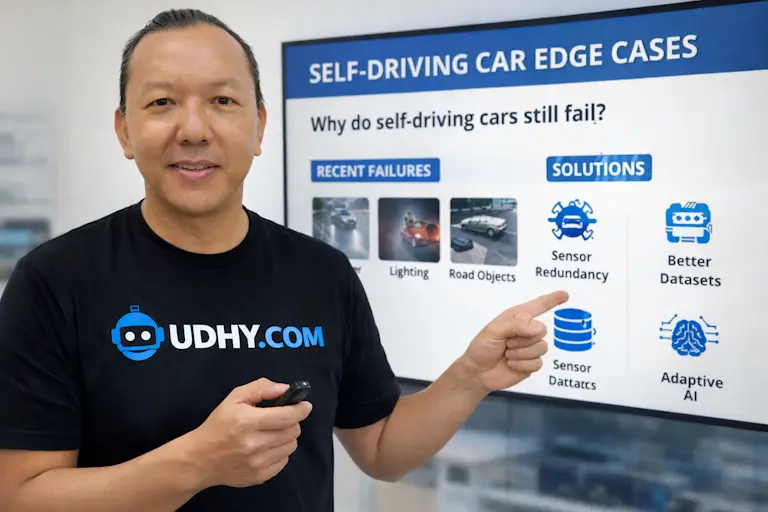
In just 60 seconds, discover why self‑driving cars still fail — the edge case problem explained, plus four solutions that could finally make autonomy work.
TL;DR — Quick Insights:
– Self-driving AI handles routine driving well. The real challenge is the “long tail” — the near-infinite variety of rare scenarios that training data barely touches.
– A sticker on a stop sign can fool a state-of-the-art camera classifier. Heavy rain can cut LiDAR range in half. These aren’t theoretical — they’re documented failures in deployed systems.
– Real-world AV incidents cluster disproportionately in these undertrained edge scenarios. The gap between lab performance and road performance is the edge case gap.
– Four approaches are racing to close it: more real-world data, synthetic simulation, deliberate edge case curation, and foundation models for driving. None has solved it alone — the industry is converging on all four simultaneously.
- What Is an Edge Case — and Why Does It Matter So Much?
- Six Edge Cases That Break State-of-the-Art AV Systems
- 1. Adverse Weather → Sensor Fusion Weighting + Edge AI
- 2. Construction Zones → HD Map Updates + V2X + Teleoperation
- 3. Adversarial Pedestrian Behaviour → Diverse Data Curation + Trajectory Forecasting
- 4. Sensor Spoofing / Adversarial Objects → Multi-Modal Redundancy
- 5. Unmapped/Changed Road Infrastructure → SLAM + Crowdsourced Fleet Correction
- 6. Handover Scenarios (Level 3) → Re-engagement Alerts + Progressive Handover + Level 4 Architecture
- Why This is Fundamentally a Data Problem
- The Four Approaches Racing to Solve the Edge Case Problem
- The Connection to Delivery Robots and Humanoid Robots
- FAQ — The Edge Case Problem in Autonomous Vehicles
- Complete Your UDHY Autonomous Systems Reading List
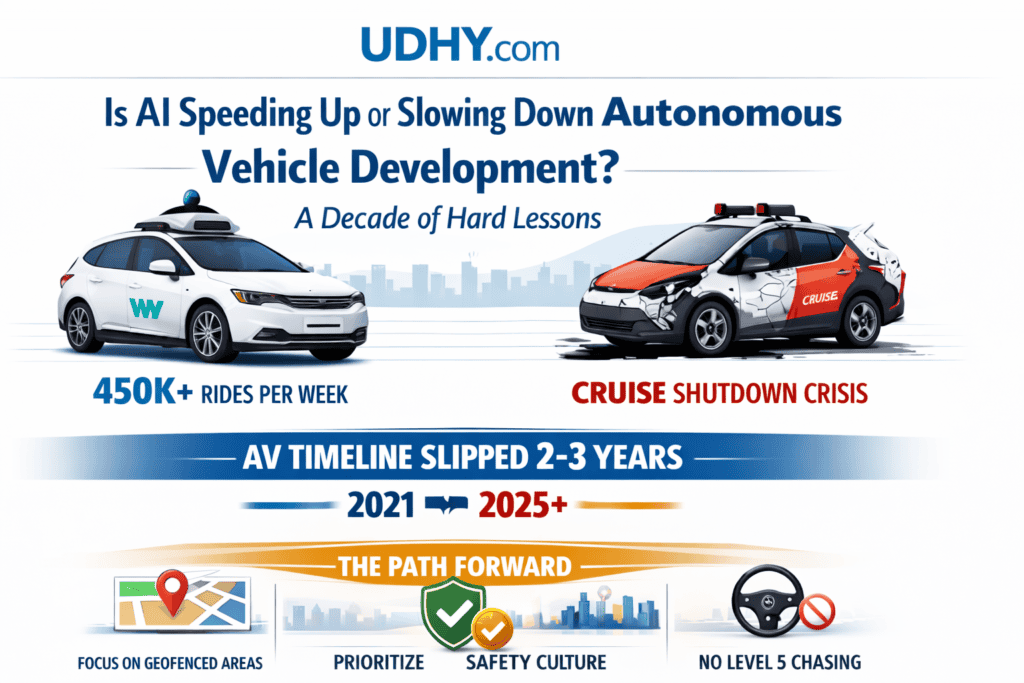
According to CNBC, Waymo’s robotaxis now complete over 450,000 rides per week across U.S. cities, while autonomous delivery robots have surpassed 10 million trips and self‑driving trucks are hauling freight commercially. Yet, edge cases — a child darting into traffic, a police officer overriding signals, a sticker on a stop sign, or floodwaters hiding lane markings — can still cause dangerous behavior in state‑of‑the‑art AVs. This is the edge case problem. It is not a bug but a fundamental challenge in how AI learns, generalizes, and fails. Recognizing this gap is essential to move beyond headlines and understand why, despite remarkable progress, full autonomy everywhere remains unsolved.
What Is an Edge Case — and Why Does It Matter So Much?
In machine learning, an edge case is a scenario that sits at the boundary of what a model was trained to handle — rare, unusual, or outside the distribution of training data. The term comes from mathematics, where “edge cases” are inputs at the extreme boundary of a function’s expected domain.
For autonomous vehicles, edge cases are the driving scenarios that happen infrequently enough that they were underrepresented in the training dataset — but frequently enough that, across a fleet of thousands of vehicles driving millions of kilometres, they are encountered constantly. The “long tail” of driving scenarios is the technical term for this: a distribution where the most common scenarios (highway cruising, urban intersections, roundabouts) are well-covered by training data, but the tail of rare scenarios extends almost infinitely.
For example, environmental noise can blind autonomous navigation stacks completely. To understand how engineers overcome this, read our master guide on AI robotics built for adverse weather challenges.
Here is the mathematical reality. A self-driving system that handles 99.9% of driving scenarios correctly sounds impressive. But across 450,000 rides per week, that 0.1% failure rate produces 450 potential incidents every week. At 450,000 km driven per day across a large fleet, it produces a failure scenario every 450 km — roughly every 30 minutes of continuous operation somewhere in the network. This is why the industry does not talk about eliminating edge cases. It talks about managing them.
Six Edge Cases That Break State-of-the-Art AV Systems
These are not hypothetical and comprehensive scenarios. Each is documented in real-world AV trial data, academic literature, and incident reports from deployed systems.
Table : Six Real‑World Edge Cases That Break Autonomous Vehicles. Scroll right to see full details on mobile.
| Edge Case Type | Why It Breaks AVs | Engineering Solution |
| Adverse weather (heavy rain, fog, snow) | LiDAR loses up to 50% range; cameras degrade in low visibility; radar accuracy drops in dense moisture | Sensor fusion weighting — dynamically trust radar over LiDAR in rain; Edge AI processing reduces latency by 40% |
| Construction zones | Road markings absent or contradictory; temporary signs conflict with mapped routes; workers give informal hand signals the AI cannot read | HD map real-time update pipelines; V2X communication from construction zone beacons; exception-based teleoperation |
| Adversarial pedestrian behaviour | A person walking backward, in a costume, or on a skateboard breaks pedestrian classification models trained on standard walking data | Diverse training data curation; behavioural prediction models using trajectory forecasting rather than object classification alone |
| Sensor spoofing / adversarial objects | Stickers placed on stop signs can fool camera-based classifiers; laser pulse injection can create phantom objects in LiDAR | Multi-modal redundancy — any classification must be confirmed by ≥2 independent sensor types before acting |
| Unmapped or changed road infrastructure | New roundabouts, altered lane layouts, or road closures not yet in the HD map cause localisation failures | SLAM-based real-time map update; crowdsourced fleet map correction via vehicle telemetry |
| Handover scenarios (Level 3) | Human driver disengaged mentally; 3–7 second re-engagement time means 100–200m uncontrolled at highway speed | Mandatory re-engagement alerts; progressive handover protocols; Level 4 architecture avoids handover entirely |
1. Adverse Weather → Sensor Fusion Weighting + Edge AI
The problem: Heavy rain scatters LiDAR laser pulses before they reach their target, cutting detection range by up to 50%. Cameras fog up or blur. Snow covers lane markings entirely.
How sensor fusion weighting works: Each sensor (camera, LiDAR, radar) is assigned a confidence weight in real time. In clear weather, all three contribute roughly equally. When the vehicle’s onboard system detects rain (via a rain sensor, or by noticing LiDAR return quality degrading), it programmatically down-weights LiDAR and camera inputs and up-weights radar — because radar uses longer radio waves that pass through water droplets far more effectively than laser pulses or visible light.
Think of it like a mixing board: the engineer (in this case, an algorithm) turns down the channels that are producing noise and turns up the reliable ones. The decision isn’t binary (use radar OR LiDAR) — it’s a continuous, weighted blend that shifts dynamically as conditions change.
How Edge AI fits in: Rather than sending raw sensor data to the cloud for processing, Edge AI runs the perception algorithms directly on the vehicle’s onboard compute chip. This matters in adverse weather because latency kills — at 60 km/h, a 200ms cloud round-trip means the car has already moved 3.3 metres before it “sees” the obstacle. Edge AI cuts that processing latency by ~40%, keeping the perception loop tight enough to react safely even with degraded sensors.
2. Construction Zones → HD Map Updates + V2X + Teleoperation
The problem: Lane markings disappear, temporary signs contradict the stored map, and human workers wave vehicles through in ways no training dataset anticipated.
How HD map real-time update pipelines work: Autonomous vehicles don’t use Google Maps — they use High Definition maps accurate to 10–20cm, storing every lane boundary, sign, and road feature. When a construction zone reroutes traffic, the vehicle’s stored map is suddenly wrong. The fix is a fleet telemetry pipeline: every AV in the fleet continuously uploads discrepancies between what its sensors see and what the map says. A cloud system aggregates these reports, detects consensus (“17 vehicles all saw a barrier where the map shows a lane”), and pushes a corrected map patch to the entire fleet — sometimes within minutes.
How V2X (Vehicle-to-Everything) works: Construction zones can be equipped with roadside beacons that broadcast structured data directly to passing vehicles: “Lane 2 closed ahead, reduce speed to 30 km/h, temporary right merge.” The vehicle receives this like a radio signal — no camera or LiDAR needed — and updates its planning layer accordingly. It’s essentially giving the car advance notice that the map is about to be wrong.
How exception-based teleoperation works: When the vehicle encounters something it genuinely can’t handle (a worker waving it through a red light), it flags the situation and a remote human operator — watching a live feed — takes over for that specific 30-second manoeuvre, then hands control back. The operator isn’t driving the whole route; they’re handling only the exception. One operator can manage multiple vehicles this way.
3. Adversarial Pedestrian Behaviour → Diverse Data Curation + Trajectory Forecasting
The problem: A person on a skateboard, walking backward, or in a full-body costume breaks pedestrian classifiers trained on normal upright walking humans.
How diverse training data curation works: Standard pedestrian datasets are heavily biased toward people walking forward, upright, at normal pace. Curation means deliberately going out and collecting edge cases: people in wheelchairs, on scooters, in costumes, moving erratically, walking in groups. It also means synthetic augmentation — using 3D character animation tools to generate thousands of unusual pedestrian poses and gaits and injecting them into training. The goal is to make “pedestrian” a category the model recognises by shape and motion pattern, not just “upright human walking forward.”
How trajectory forecasting works: Instead of asking “what is this object?” (classification), trajectory forecasting asks “where is this object going?” — a fundamentally more robust question. Even if the model misclassifies a skateboarder as an unusual vehicle, it can still predict their likely path using a motion model trained on physics and historical movement patterns. Systems like this use Kalman filters or learned neural trajectory predictors that estimate probable future positions even when the object type is ambiguous. Safety behaviour (slow down, give space) can be triggered by uncertain trajectory, not just confirmed classification.
4. Sensor Spoofing / Adversarial Objects → Multi-Modal Redundancy
The problem: Stickers on a stop sign fool the camera. Laser pulse injection fires external laser pulses at a LiDAR sensor to create phantom obstacles that don’t exist.
How multi-modal redundancy works: The core principle is voting: no single sensor has the authority to make a safety-critical decision alone. Every classification — “that is a stop sign,” “there is an obstacle at 20m” — must be confirmed independently by at least two separate sensor modalities before the planning system acts on it.
In practice: the camera sees a stop sign → the system checks whether LiDAR detects an object of the right shape and reflectivity at that location → radar confirms a stationary object is there. If all three agree, the vehicle stops. If the camera says “stop sign” but LiDAR sees nothing consistent with a sign (because stickers disrupted the visual but the physical shape is still there — or vice versa), the disagreement itself triggers a safety response: slow down, flag for review, defer to the more reliable sensor.
For phantom LiDAR injection attacks, the defence is temporal consistency: a real object appears across multiple consecutive sensor sweeps. A spoofed pulse typically appears in only one or two frames. The system requires an object to be consistently detected across a time window before treating it as real.
5. Unmapped/Changed Road Infrastructure → SLAM + Crowdsourced Fleet Correction
The problem: A new roundabout was built last month. The HD map still shows a T-junction. The vehicle’s localisation system — which compares sensor readings against the stored map — suddenly can’t find itself.
How SLAM (Simultaneous Localisation and Mapping) works: SLAM is an algorithm that lets a vehicle build and update a map of its environment in real time, while simultaneously figuring out where it is within that map — without relying on a pre-existing stored map. It works by identifying landmarks (a distinctive building corner, a unique road feature) and tracking how the vehicle’s position changes relative to them as it moves. When the stored map is wrong, SLAM gives the vehicle a fallback: “I don’t know where I am on the old map, but I can construct a local map of what I’m actually seeing and navigate from that.”
How crowdsourced fleet correction works: This is the same principle as the HD map update pipeline above, but applied to infrastructure changes. When Vehicle A detects a roundabout where the map shows a T-junction, it uploads the discrepancy. When Vehicles B, C, and D report the same thing over the next few hours, the system has high confidence the map is wrong — not the sensors. A corrected patch is generated and distributed to the fleet. Tesla’s “shadow mode” operates on a similar principle: the car silently notes everywhere the AI’s prediction differed from reality and reports it for retraining.
6. Handover Scenarios (Level 3) → Re-engagement Alerts + Progressive Handover + Level 4 Architecture
The problem: In Level 3 autonomy, the human must be ready to take over when the system asks. But research shows it takes 3–7 seconds for a disengaged driver to regain situational awareness — at 100 km/h, that’s 280 metres of uncontrolled vehicle.
How mandatory re-engagement alerts work: These are multi-modal warnings — visual (flashing dashboard), auditory (escalating tones), and haptic (steering wheel vibration) — designed to cut re-engagement time. The alert sequence escalates: a soft chime first, then a loud alarm, then physical vibration, all within 2–3 seconds. Some systems also begin automatically decelerating the moment a handover is initiated, buying more time before the driver must be fully in control.
How progressive handover works: Rather than an abrupt “your turn now,” progressive handover is a graduated transfer of control. The system first alerts the driver to place hands on the wheel (while still driving autonomously). It then gradually reduces its own steering authority while the human’s inputs are given increasing weight. By the time the driver is fully in control, they’ve had several seconds of shared control to reorient — rather than a cold handoff.
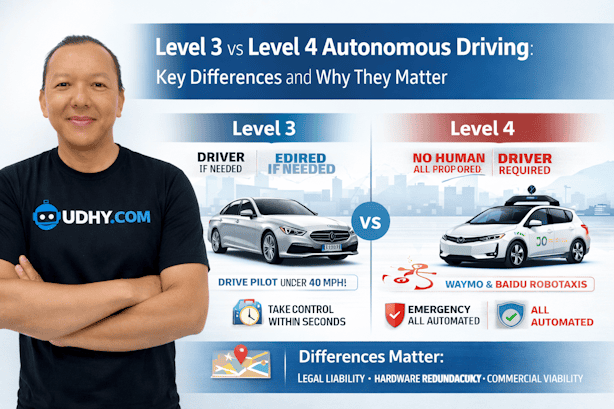
Why Level 4 architecture sidesteps the problem entirely: Level 4 vehicles have no expectation of human intervention within their operational domain. If they can’t handle a situation, they perform a minimal risk manoeuvre — pulling over safely and stopping — rather than handing off to a human. This eliminates the re-engagement time problem entirely. The tradeoff is that Level 4 vehicles must have a tightly defined operational domain (a specific city, specific weather conditions) within which they can guarantee they’ll never need a human. That’s why most commercial Level 4 deployments today (Waymo, Baidu Apollo) are geofenced to specific cities or zones.
Expert Perspective
When we engineered Moovita’s autonomous bus, Singapore’s tropical rainfall became a defining constraint. A vehicle that performs flawlessly in clear weather but falters in a thunderstorm is not a product — it’s a liability. Our sensor fusion pipeline had to actively adapt to degraded conditions in real time, ensuring safe operation rather than simply failing gracefully. This meant implementing dynamic trust weighting across sensors: radar was prioritized during heavy rain, LiDAR inputs were filtered with backscatter suppression, and camera feeds were enhanced using HDR and polarization filters. We also integrated redundant localization through IMU + GPS fusion to compensate for visual occlusion. Achieving this required meticulous calibration routines, weather‑specific datasets, and continuous regression testing in simulated and real tropical downpours. It remains one of the hardest engineering challenges in deployed AV systems — but solving it is the difference between a demo vehicle and a truly deployable product. — Dr. Dilip Kumar Limbu
Why This is Fundamentally a Data Problem
The edge case problem is not a compute problem. It is a data problem. Modern deep learning models — the neural networks that power AV perception, prediction, and planning — are extraordinarily capable at generalising from data they have seen. The challenge is that generalising to scenarios outside the training distribution is precisely what they struggle with.
This is the same fundamental challenge described in our article on the Physical AI data gap threatening humanoid robots. The pattern is identical: a system trained on available real-world data performs brilliantly within its training distribution, but fails on the long tail of scenarios that real-world deployment inevitably produces. For language models, the internet provided near-unlimited training text. For AV systems and physical robots, the real world does not come pre-labelled.
Consider the scale of the problem. Waymo’s autonomous vehicles had driven over 40 million autonomous miles by 2024 — a staggering amount of real-world data. And yet the company still reports incidents, still has scenarios requiring human intervention, and still actively develops new capabilities for edge cases. The long tail of driving scenarios is effectively infinite. You cannot drive your way out of it.
The Four Approaches Racing to Solve the Edge Case Problem
No single approach has solved this. What the industry is converging on is a combination of all four, applied simultaneously.
Table : Four Strategies Racing to Solve Autonomous Vehicle Edge Cases. Scroll right to see full details on mobile.
| More Real-World Data | Synthetic Data & Simulation | Edge Case Curation | Foundation Models |
| Accumulate billions of real-world miles to encounter rare scenarios naturally. Expensive and slow — 99.9% of data is routine. | Generate synthetic edge cases in simulation engines like CARLA and NVIDIA DRIVE Sim. Fast and safe but sim-to-real gap remains a challenge. | Deliberately identify, label, and oversample rare scenarios in training data. A structured response to the long tail problem. | Train a single large model on diverse tasks so it generalises to unseen scenarios. GPT-like approach applied to driving. Still experimental. |
Approach 1: More Real-World Data — Necessary But Not Sufficient
The instinct is correct — more diverse real-world driving data exposes the model to more scenarios, improving its distribution coverage. Waymo, Cruise, and Tesla all collect enormous amounts of fleet telemetry and use it to continuously retrain their models. Tesla’s “shadow mode” — where the system silently predicts what it would do and flags disagreements with the human driver — is one of the most sophisticated real-world data collection pipelines in the industry.
The limitation: 99.9% of real-world driving data is routine. Highway following, urban intersections, parking. The edge cases that break systems are rare by definition — a flooded road, a damaged traffic light showing two colours simultaneously, a mattress on the motorway. Even with a billion miles of fleet data, rare scenarios may appear only a handful of times. And some scenarios — a pedestrian in a full-body animal costume, a children’s parade blocking all lanes — may appear so infrequently that the model never adequately learns them.
Approach 2: Synthetic Data and Simulation — Fast but Bridging the Gap
Simulation engines like CARLA, NVIDIA DRIVE Sim, and Waymo’s CarCraft can generate edge case scenarios in unlimited volume — in any weather, at any time of day, with any combination of road conditions and actor behaviours — without a single real vehicle leaving a garage. Gartner predicts that simulation-augmented validation will be essential for AV certification across multiple jurisdictions by 2030.
Quick Notes
- CARLA is widely used in academic and industry research, fully open‑source, and integrates with ROS.
- NVIDIA DRIVE Sim is part of NVIDIA’s Omniverse ecosystem, offering photorealistic environments, sensor modeling, and closed‑loop validation.
- Waymo CarCraft is proprietary; Waymo has disclosed its existence in research papers and interviews, but it is not publicly available. Their official site provides general information about their AV technology and safety reports.
The challenge is the sim-to-real gap: the difference between how a scenario looks in simulation and how it looks in the real world. A rain shader in a rendering engine does not perfectly replicate the scattering physics of real water droplets on a LiDAR pulse. A simulated pedestrian’s gait does not exactly match the biomechanical variation of real human movement. Models trained entirely in simulation often fail when deployed to real vehicles in ways that are hard to predict.
The state of the art is simulation-augmented training — using real-world data as the foundation, and synthetic data to fill the gaps where real scenarios are underrepresented. The ratio of real to synthetic data, and the domain randomisation techniques used to bridge the gap, are among the most commercially sensitive engineering decisions in the industry.
Approach 3: Edge Case Curation — the Deliberate Response
Edge case curation is a structured, deliberate approach to the long tail problem. Rather than hoping that routine data collection will eventually encounter rare scenarios, it actively identifies what scenarios are underrepresented, designs data collection protocols specifically to capture those scenarios, and applies heavy annotation resources to label them correctly.
As of March 2026, the incidents accumulating in real AV deployments are disproportionately clustered in exactly the edge scenarios that training datasets underrepresented. This is the clearest possible signal that curation — not volume — is the right lever to pull. A dataset with 10,000 carefully curated edge case scenarios is worth more for safety than a dataset with 10 million routine highway miles.
Approach 4: Foundation Models for Driving — The Frontier
The most ambitious approach borrows from large language model (LLM) research. Just as GPT-4 can generalise to tasks it was never explicitly trained on — because it learned rich representations from extraordinarily diverse data — a driving foundation model would learn rich representations of the physical world from diverse sensorimotor data, enabling it to handle novel scenarios through generalisation rather than memorisation.
Companies like Wayve (UK autonomous driving startup), Tesla (with its end-to-end neural network architecture), and Google DeepMind (AI research lab, Gemini suite) are actively pursuing this approach. The results are promising but inconsistent. The fundamental question — whether a driving foundation model can achieve the kind of zero-shot generalisation that language models achieve for text — remains open. It is the most important unsolved research question in autonomous driving.
Quick Notes
- Wayve specializes in end‑to‑end deep learning for autonomous vehicles, focusing on mapless driving and embodied AI.
- Tesla integrates its end‑to‑end neural network architecture into Full Self‑Driving (FSD), trained on billions of miles of fleet data.
- Google DeepMind is one of the world’s leading AI labs, known for AlphaGo, AlphaFold, and the Gemini multimodal models that compete directly with OpenAI and Anthropic.
The Connection to Delivery Robots and Humanoid Robots
The edge case problem is not unique to self-driving cars. It is the defining challenge of all physical AI systems. Our autonomous delivery robots face exactly the same issue — a sidewalk robot handles 99.9% of pavements, pedestrians, and kerbs correctly. The 0.1% is a toddler running from an unexpected direction, a dog on a long lead crossing diagonally, a temporary market stall blocking the usual path.
And humanoid robots — as we explored in our analysis of the Physical AI data gap — face an even more severe version. A delivery robot operates in a constrained environment (outdoor paths, fixed destinations). A humanoid robot is expected to operate everywhere humans operate. The long tail of scenarios for a general-purpose physical robot is orders of magnitude longer than the long tail for a self-driving car.
This is why the three articles in this UDHY series should be read together: how AVs work, what is stopping humanoid robots, and why self-driving cars still fail are three perspectives on the same fundamental challenge — teaching machines to navigate the unpredictability of the real physical world.
FAQ — The Edge Case Problem in Autonomous Vehicles
Complete Your UDHY Autonomous Systems Reading List
Part 1: How Self-Driving Cars Work — AI, Sensors & the 4-Layer Stack
Part 2: Why Self-Driving Cars Still Fail — The Edge Case Problem (this article)
Part 3: The Data Gap Threatening Humanoid Robots — why Physical AI is stuck
Part 4: Autonomous Delivery Robots in Future — the edge case problem in last-mile logistics
About the Author
Dr. Dilip Kumar Limbu Co-Founder, Moovita | Former Principal Scientist, A*STAR | PhD, Auckland University of Technology
Connect via LinkedIn Direct Inquiry.
Disclaimer
The views expressed here are personal and based on 25+ years in the industry, including my work at Moovita. They do not necessarily reflect the views of any organization. [Back to Top ↑]
Enjoying this post? Subscribe to get more AI insights.