Autonomous Delivery Robots Future | How They Work & Who’s Deploying Them
In the next 60 seconds, you’ll see how Autonomous Delivery Robots is knocking your door — it’s already happening.
TL;DR — Quick Insights:
– Starship Technologies just crossed 10 million deliveries across 8 countries. This is not a pilot. It is production.
– Delivery robots cut cost-per-delivery from ~$5-8 (human courier) to as low as $0.06 at scale.
– The market is valued at $1.33B in 2026 and growing at 27-37% CAGR toward $8.57B by 2029.
– Sidewalk robots, autonomous trucks, and delivery drones each solve a different version of the last-mile problem.
– Singapore, Japan, South Korea, and China are the Asia-Pacific leaders in deployment infrastructure.
– The engineering stack — ROS 2, sensor fusion, DRL, edge AI — is teachable. The skills gap is enormous.
The solution is the AI Career Toolkit 2026 — your complete roadmap to pivot from software engineering into AI and Physical AI roles before it’s too late.
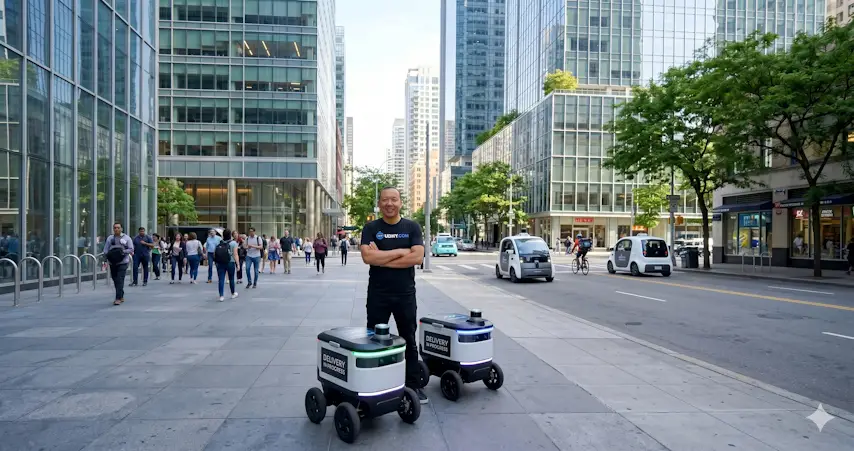
It happened quietly. According to Starship Technologies‘s website, they announced it had completed its 10 millionth autonomous delivery. Its fleet of over 3,000 sidewalk robots has now travelled more than 22 million kilometres across 8 countries, completing 200 million road crossings — roughly two every second — entirely without a human driver.
That is not a press release talking point. That is production infrastructure.
Last-mile delivery — the final leg from a distribution hub to your front door — accounts for up to 53% of total supply chain cost and is the most expensive, most labour-intensive, most inefficient part of the entire logistics chain. It is also the part that autonomous robots are most clearly positioned to solve. Not eventually. Now.
In this article, I am going to break down exactly how autonomous delivery robots work at an engineering level, who the key players are in 2026, what the technology can and cannot do yet, and what this means for engineers, businesses, and anyone interested in where robotics is heading.
| Market Size 2026 $1.33B | Projected by 2031 $3.27B | Growth CAGR ~27–37% |
What Are Autonomous Delivery Robots?
An autonomous delivery robot is a ground or aerial vehicle capable of transporting goods from a pickup point to a delivery destination without direct human operation. The category spans a surprisingly wide range of hardware, from a small 6-wheeled sidewalk bot the size of a cooler box, to a full-size autonomous delivery van, to a last-mile delivery drone operating at low altitude. What they share is a common problem: navigating a complex, dynamic environment to reliably deliver a payload to a specific address.
They are distinct from warehouse robots (which operate in structured, controlled indoor environments) and from full-size self-driving cars. The delivery robot challenge is harder in some ways than highway autonomy — sidewalks, pedestrians, kerbs, narrow gates, apartment intercoms, rain — and easier in others (low speeds, small payloads, forgiving error margins).
The Three Hardware Categories
1. Sidewalk Robots (Ground, Last-Metre)
Compact wheeled robots designed to navigate pedestrian infrastructure. Starship Technologies is the global market leader, with 3,000+ robots deployed across the US and Europe. DoorDash launched its robot “Dot” in September 2025 — specifically designed to navigate bike lanes, sidewalks, roads, and driveways. These robots are ideal for food delivery, grocery, and pharmacy last-mile in dense urban environments.
2. Autonomous Delivery Vans and Trucks
Full-vehicle platforms that handle mid-mile or high-volume last-mile delivery on roads. Nuro’s R3 vehicle, Amazon’s Scout programme, and Kroger’s driverless truck integration in Dallas are examples. These vehicles are Level 4 autonomous within defined operational zones and are most cost-effective for high-density suburban routes.
3. Delivery Drones
Aerial delivery for speed-critical, low-weight payloads. Amazon Prime Air, Wing (Alphabet), and Zipline (medical supplies in Africa) lead this space. According to Gartner, it projects over 1 million drones delivering retail goods globally by 2026 — up from approximately 20,000 just two years ago. Drones reduce delivery cost on eligible routes by up to 70% compared to traditional courier vans.
How Autonomous Delivery Robots Work: The Engineering Stack
Delivery robots are a masterclass in applied robotics. Every robot navigating your street is running a real-time engineering stack that would have been classified as cutting-edge research just five years ago. Let me break it down layer by layer.
Layer 1: Perception — Seeing the World
The robot must build a real-time model of its environment. It uses a combination of:
- Cameras — for semantic understanding: reading pedestrian signals, recognising faces of buildings, reading door numbers
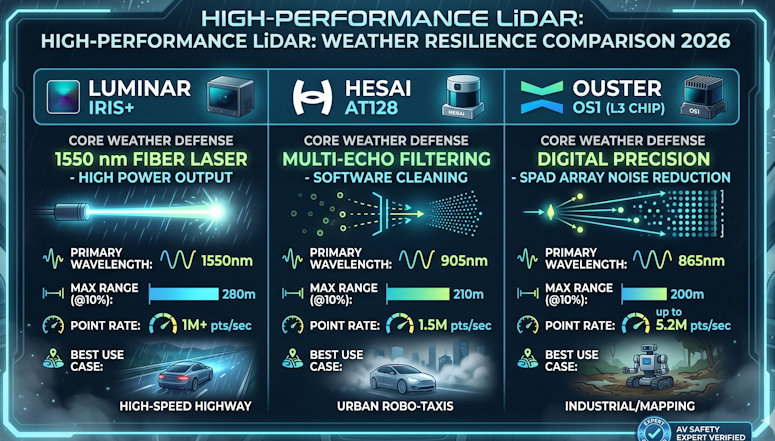
- LiDAR — for 3D spatial mapping of obstacles and terrain. Solid-state LiDAR units have now dropped below $500, making deployment at scale economically viable
- Ultrasonic sensors — for close-range obstacle detection, especially useful in low-speed kerb and doorstep navigation
- GPS / RTK GNSS — for global positioning. RTK GNSS modules now achieve centimetre-level accuracy at sub-$50 cost
These sensor streams are fused using a sensor fusion pipeline — typically running on an onboard edge AI chip such as NVIDIA’s Jetson Orin or Qualcomm RB6, which processes trillions of operations per second directly on the robot without cloud dependency.
Layer 2: Localisation — Knowing Exactly Where It Is
GPS alone is not precise enough for sidewalk navigation. Delivery robots build and maintain a high-definition local map using Simultaneous Localisation and Mapping (SLAM) — comparing real-time sensor data against a pre-built map of the delivery area to maintain centimetre-level position accuracy even in GPS-degraded environments like urban canyons or covered walkways.
Layer 3: Path Planning — Choosing Where to Go
Given a destination and an obstacle map, the robot computes a safe, legal, efficient route. This is not trivial on a pedestrian pavement. The planner must account for:
- Moving pedestrians with unpredictable trajectories
- Kerb cuts, ramps, steps, and uneven surfaces
- Other robots, cyclists, and micro-mobility vehicles
- Construction zones, temporary barriers, and street furniture
Modern delivery robots use Deep Reinforcement Learning (DRL) for path planning — training the robot’s navigation policy in simulation across millions of scenario variations, then deploying it to the real world. This allows the robot to handle situations its programmers never explicitly anticipated.
Layer 4: The Last Metre — Actually Completing the Delivery
The last metre is arguably the hardest part. Finding the right door in an apartment complex, opening a gate, communicating with a resident, and securely handing over a package involves a chain of perception, communication, and manipulation challenges that pure navigation does not address.
Most current robots solve this through a combination of computer vision (reading door numbers, recognising landmarks), app-based communication (the recipient unlocks the robot lid via smartphone), and occasional remote human supervision for edge cases — a model called “exception-based teleoperation.” The robot handles 95%+ of deliveries fully autonomously; a human operator reviews only the exceptions.
Expert Perspective — Dr. Dilip Kumar Limbu
The sensor fusion and SLAM challenges in sidewalk delivery robots are directly analogous to what we solved in full-scale autonomous vehicles at Moovita — just at a different scale and speed. The core engineering problem is identical: how do you build a system that reliably navigates a dynamic, unstructured environment using imperfect sensor data? The tools are the same: ROS 2, LiDAR pipelines, DRL-trained planners. The delivery robot space is actually a superb entry point for engineers who want to build AV-level skills with much lower hardware cost and regulatory friction.
The Business Case: Why the Economics Are So Compelling
The technology is impressive, but what is driving commercial deployment at scale is a simple economic reality: autonomous delivery is dramatically cheaper than human delivery at scale.
Table : Human Courier vs Delivery Robot comparison. Scroll right to see full details on mobile.
| Metric | Human Courier | Delivery Robot |
| Cost per delivery | ~$5–8 | ~$0.06–0.50 |
| Operating hours | 8–10 hrs/day | 24/7 |
| Carbon emissions | High (van) | Near zero (electric) |
| Speed (last mile) | 30–60 min avg | 15–25 min avg |
| Labour dependency | High | None |
According to Barclays research cited by Reuters, autonomous delivery could unlock an estimated $16 billion in annual profitability globally by replacing human couriers on eligible routes. The key phrase is “eligible routes” — dense urban areas with high order frequency are where the unit economics work first. Rural, low-density, or access-restricted areas remain human-delivery territory for now.
Starship Technologies has already demonstrated this at scale. Its robots have recorded 1.8 million kg of avoided CO2 across 10 million deliveries — a sustainability metric that is increasingly relevant for EU-regulated urban freight operators facing carbon mandates.
Cartken — a computer-vision-only robot company that skips expensive LiDAR — achieved profitability with under $25 million raised, proving that leaner hardware stacks can achieve commercial viability faster than capital-intensive sensor-heavy approaches.
Who is Deploying Delivery Robots Right Now?
Starship Technologies — Global Leader
3,000+ robots. 10 million deliveries. 8 countries. 22 million kilometres travelled. 125,000 road crossings per day. Starship operates at Level 4 autonomy in campus, residential, and business district environments across the UK, Germany, Switzerland, Sweden, Finland, Estonia, Czech Republic, and the United States. It is the most battle-tested sidewalk delivery operation on the planet.
Nuro — The Autonomous Delivery Van
Nuro’s R3 vehicle is a purpose-built autonomous delivery vehicle — no driver seat, no human controls. It carries up to 500 lbs of cargo across suburban delivery routes. Nuro has regulatory approval in California and Texas and partnership agreements with major retailers. Its partnership with Arm Limited is accelerating compute development for its third-generation vehicle.
DoorDash “Dot” — Consumer Platform Integration
DoorDash’s September 2025 launch of Dot marks the point at which mainstream consumer delivery platforms are committing to autonomous last-mile as a default capability rather than an experiment. When the largest food delivery platform in the US builds its own robot, the market signal is unambiguous.
Singapore and Asia-Pacific — The Regional Opportunity
Singapore is at the forefront of Asia-Pacific deployment, driven by its smart city infrastructure, high consumer receptivity, and supportive regulatory framework. Japan, South Korea, and Singapore lead in-building and campus deployments. South Korea legalised sidewalk robots in 2024, opening a clear regulatory path for residential deployment. China, driven by government-backed smart city programmes, is scaling delivery robot deployment through JD.com, Meituan, and local robotics champions.
The Asia-Pacific autonomous last-mile market is projected to surpass North America in total market size by the early 2030s, growing at a CAGR of 36.9% between 2026 and 2035. For robotics engineers and businesses in Singapore and Southeast Asia, this is the home market — and it is moving fast.
What Delivery Robots Still Cannot Do
Honest engineering analysis means acknowledging the genuine limitations. Three categories of challenge persist in 2026:
Access-Restricted Environments
Apartment buildings with secured entrances, multi-storey car parks, buildings without accessible kerb cuts, and rural addresses with unpaved pathways all break the current operational models. The “last metre” problem — actually getting a package inside a secure building — requires hardware and software solutions (robotic arms, smart lock integration, resident apps) that are still maturing.
Adverse Weather
Heavy rain, snow, ice, and high winds degrade camera and LiDAR performance and create slippery terrain for wheeled robots. Most current sidewalk robots are rated for light rain but not for sustained adverse weather. This limits year-round deployment in northern European and Canadian climates without significant hardware upgrades.
Regulatory Fragmentation
There is no unified global framework governing sidewalk robots. Each city, and often each borough within a city, has separate rules on permitted operating areas, maximum speeds, kerbside access, and liability. San Francisco requires a permit per robot per zone. The UK’s approach differs from Germany’s. Singapore has a national framework; Malaysia does not yet. This regulatory mosaic is the single biggest brake on rapid global scaling — not the technology itself.
The Skills That Build These Systems — And Where to Learn Them Free
Every delivery robot operating on your street runs on a software stack that engineers can learn, build, and improve. Here are the core skills:
ROS 2 — The Operating System of Modern Robotics
Robot Operating System 2 (ROS 2) is the open-source middleware used in the overwhelming majority of autonomous delivery robots in production today. It handles sensor data pipelines, inter-process communication, navigation stacks, and hardware abstraction. If you want to work in autonomous delivery, ROS 2 is not optional — it is the common language of the field.
Sensor Fusion and SLAM
Combining LiDAR, camera, and GPS data into a coherent real-time world model is the core perception engineering challenge in delivery robots. SLAM — simultaneous localisation and mapping — is the technique that lets a robot know exactly where it is using only its own sensor data.
Deep Reinforcement Learning for Navigation
DRL-trained navigation policies are replacing hand-coded rule-based planners in production systems. Training in simulation, then deploying to the real world (sim-to-real transfer), is how companies like Starship and Serve Robotics build robots that handle the unpredictable real world without explicitly programming every scenario.
Edge AI and Embedded Systems
Running perception and planning algorithms at 100ms latency on an embedded compute platform (Jetson Orin, Qualcomm RB6) requires skills at the intersection of deep learning, real-time systems, and hardware optimisation. This is a niche skill set that commands exceptional compensation in the autonomous systems industry.
Learn These Skills Free on UDHY
Every skill above is covered in UDHY’s free course tracks:
– ROS 2 + Physical AI + Sensor Fusion: Expert Robotics Track
– Deep Reinforcement Learning + Edge AI Deployment: Expert AI Track
– Start with Robotics Basics if you’re newer to the field
– Also see: How Self-Driving Cars Work — the companion article to this post.
Conclusion: The Last Mile is the First Frontier
Ten million deliveries. Twenty-two million kilometres. Two road crossings every second. Autonomous delivery robots have crossed the line from research to reality — and the economics behind them are too compelling to slow down.
The last-mile delivery problem — expensive, carbon-intensive, labour-dependent — is one of the clearest targets for autonomous robotics in the 2020s. The technology stack (ROS 2, sensor fusion, DRL, edge AI) is mature enough to deploy commercially. The market (37% CAGR, $8.57B by 2029) is growing fast enough to support entire companies and careers. And the regulatory environment, while fragmented, is moving in a permissive direction across the markets that matter most: Singapore, South Korea, the US, and the UK.
Whether you are an engineer wanting to build these systems, a business considering autonomous logistics, or simply someone curious about the robot that may soon deliver your groceries — the time to understand this technology is now. It is no longer coming. It is here — Free AI & Robotics education: www.udhy.com
Top 15 FAQs — The Last Mile is the First Frontier
Ready to Build Autonomous Robotics Skills? — [ Start Expert Robotics Track — Free ] [ Browse Robotics Kits & Hardware ]
About the Author
Dr. Dilip Kumar Limbu Co-Founder, Moovita | Former Principal Scientist, A*STAR | PhD, Auckland University of Technology
Connect via LinkedIn Direct Inquiry.
Disclaimer
The views expressed here are personal and based on 25+ years in the industry, including my work at Moovita. They do not necessarily reflect the views of any organization. [Back to Top ↑]
Enjoying this post? Subscribe to get more AI insights.