Autonomous Vehicle Safety Challenges: Sensor Limits, AI Decisions & Cybersecurity Risks
In the next 60 seconds, I’ll share insights from our latest post on Autonomous Vehicle Safety & Cybersecurity — highlighting the biggest risks, solutions, and what you need to know in 2026.
TL;DR — Quick Insights
- The 5 challenges: Sensor limitations in extreme weather, AI edge case failures, V2X communication vulnerabilities, remote hacking attack surfaces, and regulatory fragmentation across jurisdictions.
- Most underreported risk: Cybersecurity. An autonomous vehicle is a networked computer doing 70mph — remote attack surfaces include OTA update channels, V2X communications, and telematics systems.
- The AI edge case problem: AVs trained on millions of scenarios still fail on rare combinations no training data covered. These failures are unpredictable by definition.
- What’s working: Redundant sensor architecture, hardware-level security modules, and geofenced operational design domains are the three proven mitigations currently in production deployment.
- Regulatory status: No unified global AV safety standard exists as of 2026 — the US, EU, Singapore, and China each operate under different frameworks, creating deployment complexity for every OEM.
1. Introduction : Autonomous Vehicle Safety
Autonomous vehicles (AVs) promise a future of safer roads, reduced congestion, and human‑optional driving. Yet safety remains the biggest barrier to widespread adoption. To understand the road ahead, we must examine the technical, ethical, and cybersecurity challenges AVs face—and how industry leaders are working to overcome them. This post builds on the fundamentals explained in Self‑Driving Cars Explained, diving deeper into the safety dimension that will ultimately determine public trust and global deployment.
In this post, let’s explore the core systems that power self-driving cars.
🚘 New to autonomous vehicles? Start with our beginner-friendly guide:
👉 Click here to read our full beginner-friendly guide: Self-Driving Cars Explained
2. Why Safety is the Biggest Barrier?
Safety remains the primary obstacle to widespread adoption of autonomous vehicles (AVs). While the technology promises fewer accidents and greater efficiency, several critical challenges stand in the way:
- Human error vs. machine error : Traditional driving accidents are overwhelmingly caused by human error—distraction, fatigue, or impaired judgment. AVs aim to reduce these risks, but they introduce machine error: misinterpretation of sensor data, flawed AI decision-making, or software bugs. Unlike human mistakes, machine errors can be systemic, affecting entire fleets if not corrected. This raises concerns about reliability and accountability..
- AI Decision-Making Dilemmas : Autonomous systems must make split-second ethical decisions in unpredictable scenarios—choosing between collision avoidance options, interpreting ambiguous road signals, or reacting to human unpredictability. These decision-making limitations highlight the gap between AI logic and real-world complexity, fueling skepticism about safety.
- Public trust and perception issues : Even if AVs statistically outperform human drivers, public trust is fragile. High-profile accidents involving self-driving cars have amplified fears of losing control to machines. Consumers worry about cybersecurity risks, liability in crashes, and whether AVs can truly handle chaotic urban environments. Without strong public confidence, adoption will stall regardless of technical progress. [Back to Top ↑]
3. Key Safety Challenges in AVs
AVs face major safety hurdles beyond cybersecurity. Sensor limitations can reduce accuracy in poor weather or complex traffic conditions. AI decision-making struggles with unpredictable human behavior and ethical dilemmas on the road. Meanwhile, infrastructure gaps—such as outdated road markings, inconsistent signage, and lack of smart city integration—create barriers to reliable performance. Addressing these challenges is essential to ensure safe, scalable adoption of self-driving technology.
3.1. Sensor Limitations In AV (weather, blind spots)
Sensors like LiDAR, radar, and cameras detect lanes, signals, vehicles, and pedestrians in real time. While sensor industries have made massive strides in 2026, every sensor has a “kryptonite”—a specific scenario where it fails. Like, weather conditions (fog, snow, glare) and blind spots can reduce accuracy. Table below highlites soe sensor limitations in AV.
| Sensor Type | Primary Use | The “Kryptonite” (Limitations) |
| Cameras | Object Classification & Traffic Signs | Blinding & Contrast: Direct sunlight, high-beam glare, and pitch-black conditions. They also struggle with “depth perception” compared to active sensors. |
| LiDAR | Precise 3D Mapping (cm-level) | Weather Interference: Rain, fog, and snow scatter the laser pulses. It also struggles with “low-reflectivity” objects (like a black car in the rain). How to Choose the Right LiDAR for Autonomous Vehicles? |
| Radar | Velocity & Distance Tracking | Low Resolution: Radar is great at seeing that something is there, but bad at seeing what it is. It can struggle to tell a stalled car apart from a metal signpost. |
For now, the biggest hurdle for Level 4 autonomy is still Adverse Weather. Sensor Soiling: Mud, salt, and even dead bugs on a lens can render a $10,000 sensor suite useless. This is why you see 2026 models equipped with specialized sensor cleaning systems (liquid jets and air blasts).
The Scattering Effect: During heavy rain or fog, LiDAR beams hit water droplets and bounce back early, creating “noise” in the point cloud. The car might think there’s a wall of ice in front of it when it’s just a thick mist. [Back to Top ↑]
3.2. AI decision-making in autonomous driving (edge cases, ethical dilemmas)
Software-Defined Vehicle (SDV), the current buzzword for modern car architecture , that implements core functions in software instead of hardware. The main features range from update capabilities to AI control on multiple levels. The core challenge of AI decision-making lies in the transition from rigid, “if-then” programming to non-deterministic neural networks that must reason through an infinite “long tail” of unpredictable human behaviors and edge cases. In my opinion, the industry’s biggest hurdle in 2026 isn’t just detecting objects, but solving the “Black Box” problem—ensuring that an AI’s logic is explainable to regulators and that it can quantify its own uncertainty. When an AI encounters a scenario it doesn’t recognize, like a person in a strange costume or a chaotic construction zone, it must shift from “driving” to a “Safe State” protocol, prioritizing human-aligned ethics and predictable safety envelopes over mere guesswork.
3.3. Infrastructure gaps in driverless cars (roads, connectivity)
Poorly marked roads, inconsistent signage, and weak connectivity hinder AV reliability. Rural areas and developing cities pose bigger challenges than well‑mapped urban centers. As such, the “Infrastructure Gap” as the silent killer of full autonomy. While we’ve perfected the “brains” of the car, our roads are still stuck in the 20th century, plagued by faded lane markings, inconsistent signage, and “dead zones” in cellular connectivity. In 2026, the challenge isn’t just about the car seeing the road—it’s about the road “talking” back. Without universal 5G-V2X (Vehicle-to-Everything) integration and standardized “smart” intersections, even the most advanced AI struggles with uncertainty at blind corners or in rural areas. In my opinion, we cannot achieve large-scale Level 4 deployment until we treat high-definition digital mapping and edge-computing hardware as essential public utilities, rather than optional upgrades. [Back to Top ↑]
4. Cybersecurity Risks in Self-Driving Cars
As the automotive industry shifts from “driver-assisted” to “fully autonomous,” the attack surface of our vehicles has moved from the mechanical to the digital. For 2026, the conversation is no longer about if a car can be hacked, but how we secure the “Overlap Era“—where vehicle hardware, cloud APIs, and AI drivers converge into a single, vulnerable fabric.
The automotive industry is increasingly adopting ISO 21434, the international standard for automotive cybersecurity, to establish a framework for secure vehicle design, risk assessment, and lifecycle management. This standard represents a major step toward protecting autonomous vehicles from cyber threats.
However, despite ISO 21434 adoption, many challenges remain. Here is a sharp overview of the primary cybersecurity risks facing self-driving cars today.
4.1. Remote Hacking & V2X Vulnerabilities
Modern AVs rely on Vehicle-to-Everything (V2X) communication to navigate safely. However, every wireless entry point—from cellular 5G links to Wi-Fi and Bluetooth—is a potential “digital door” for attackers.
- The Risk: Hackers can exploit vulnerabilities in infotainment systems or telematics to pivot into the vehicle’s CAN bus (the internal network).
- The Impact: In 2025, cross-region incidents tripled, showing that a single breach in a cloud-based OTA (Over-the-Air) update server could potentially compromise an entire fleet of vehicles simultaneously.
- Expert opinion: Cybersecurity must be treated as safety‑critical, not an IT afterthought. [Back to Top ↑]
4.2. Malicious Takeover of Vehicle Controls
The most harrowing risk is the “kinetic” attack: gaining unauthorized access to the Electronic Control Units (ECUs) that manage steering, braking, and acceleration.
- The Risk: Through “man-in-the-middle” attacks or exploiting unpatched zero-days in the ADAS (Advanced Driver Assistance Systems), attackers can override the passenger’s input.
- The Safety Threat: Beyond simple theft, malicious takeovers pose a direct threat to life, allowing remote actors to force stops on highways or redirect vehicles to dangerous locations.
- Expert opinion: Cybersecurity must be treated as safety‑critical, not an IT afterthought.
4.3. Sensor Spoofing & AI Model Manipulation
Self-driving cars “see” the world through LiDAR, Radar, and Cameras. Since these sensors rely on physical signals, they can be “tricked” without ever touching the car’s code.
- The Risk: GPS spoofing can send a car off-course, while “adversarial attacks” (like placing specific stickers on a stop sign) can cause the AI to misinterpret traffic signals.
- The 2026 Reality: As we move toward Agentic AI in vehicles, the risk of “prompt injection” or sensor blinding becomes a primary concern for manufacturers. [Back to Top ↑]
4.4. Data Breaches & Privacy Erosion
An AV is essentially a rolling data center, collecting gigabytes of data per hour, including high-definition video of surroundings and biometric data of passengers.
- The Regulatory Shift: With the automotive cybersecurity market expected to exceed $6 billion in 2026, new regulations (like UN R155) are finally mandating “Security by Design” to protect passenger privacy.
- The Risk: Insecure cloud storage or intercepted data flows can lead to massive breaches of personal PII (Personally Identifiable Information).
Expert Opinion: in my opinion, in 2026, vehicle safety is synonymous with cyber resilience. We have reached the point where the line between “car” and “computer” has completely vanished. Because of that, the industry is undergoing a massive shift: we’re moving away from simple perimeter prevention and toward Zero Trust architectures.
In the old days, we just tried to keep hackers out. Now, we build the system to assume a breach is already happening. By isolating every sensor and subsystem, we ensure that even if an attacker manages to slip into the infotainment or the Wi-Fi, the mission-critical systems—your brakes, steering, and private data—remain locked down and secure. In this era, if it isn’t “cyber-secure,” it isn’t “road-safe.” Period. [Back to Top ↑]
5. Data Breaches & Privacy Erosion
An AV is essentially a rolling data center, collecting gigabytes of data per hour, including high-definition video of surroundings and biometric data of passengers.
The Regulatory Shift: With the automotive cybersecurity market expected to exceed $6 billion in 2026, new regulations (like UN R155) are finally mandating “Security by Design” to protect passenger privacy. Malicious Takeover of Vehicle Controls
The Risk: Insecure cloud storage or intercepted data flows can lead to massive breaches of personal PII (Personally Identifiable Information).
6. Regulatory and Ethical Considerations
Autonomous vehicles (AVs) generate and transmit massive amounts of data—location history, driving behavior, passenger biometrics, and even in-car communications. This creates unprecedented risks of data breaches and privacy erosion, raising questions of regulation, ethics, and liability.
Global Regulations: US, EU, Asia
- United States: AV data governance is fragmented, with state-level rules and federal guidelines from NHTSA. Privacy protections often lag behind innovation, leaving gaps in accountability.
- European Union: The GDPR sets strict standards for personal data use, requiring transparency, consent, and secure storage. AV manufacturers must comply with cross-border data transfer rules.
- Asia: Countries like Japan, South Korea, and Singapore are advancing AV frameworks, balancing innovation with cybersecurity mandates. China emphasizes state oversight and data localization, shaping how AV data is stored and shared.
Ethical Dilemmas in Crash Scenarios
AVs face unavoidable crash situations where algorithms must decide between competing harms. Should the car prioritize passenger safety over pedestrians? These ethical dilemmas highlight the tension between machine logic and human morality, fueling public debate and regulatory scrutiny.
Liability in Accidents
One of the biggest barriers to adoption is who is liable when accidents occur. Is it the manufacturer, the software developer, the fleet operator, or the passenger? Current laws struggle to assign responsibility in cases of machine error, leaving insurers and regulators scrambling for clarity.
7. Future of AV Safety
The next era of safety isn’t just about replacing a pair of eyes with a camera; it’s about creating a “digital sixth sense” that sees through fog, around corners, and into the future.
7.2. Advances in Sensor Fusion & AI
In my opinion, the “secret sauce” of 2026 isn’t just better cameras—it’s Multimodal Sensor Fusion (Read more Sensor Fusion Explained). Early AVs struggled when a camera was blinded by sun glare or LiDAR was muffled by heavy snow. Today, we use AI-driven fusion to cross-verify data in real-time.
- The Shift: We are moving beyond performance benchmarks to Reasoning AI. Modern systems don’t just “see” an object; they understand context.
- Reliability: By combining LiDAR (depth), Radar (velocity), and High-Def Cameras (semantics), the AI creates a “unified world model” that virtually eliminates blind spots and dramatically reduces false positives. This redundancy reduces “blind spots” to near zero. If a camera is blinded by the setting sun, the LiDAR and Radar maintain a perfect 3D model of the environment, ensuring the vehicle never loses its “situational awareness.”5.1. Role of 5G & V2X Communication
Contextual Fusion: Modern AVs use Sensor Fusion to cross-verify data from LiDAR (spatial mapping), Radar (velocity), and Vision (semantic context). By 2026, AI models have moved beyond performance benchmarks to multimodal reasoning—the car doesn’t just see a shape; it understands that a ball rolling into the street likely means a child is following it. [Back to Top ↑]
7.3. Role of 5G & V2X Communication
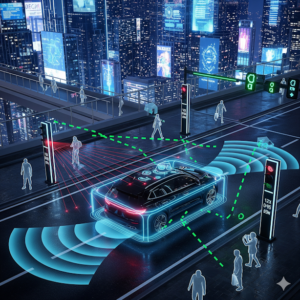
Safety is no longer confined to what the car can see; it’s about what the infrastructure can tell it. With 5G ultra-low latency (down to 1ms), cars are finally “talking” to everything around them (V2X).
- V2V (Vehicle-to-Vehicle): A car three vehicles ahead can broadcast a “hard braking” signal before your own sensors even see the brake lights.
- V2I (Vehicle-to-Infrastructure): Smart intersections alert the car to a pedestrian hidden behind a building corner or a light that is about to change.
- The Result: This massive reduction in uncertainty allows the vehicle to make smoother, predictive decisions rather than reactive ones, turning the road into a coordinated, living network. [Back to Top ↑]
7.4. Predictions for 2030: The Scale-Up
Looking ahead, I expect 2030 to be the year of Mass Market Autonomy. We are currently in the “commercial proof” phase, but the next four years will focus on hardening these systems for the public.
Here are the facts and figures driving the 2030 Scale-Up:
7.4.1. The Multi-Trillion Dollar Market Shift
The economic momentum behind AVs is staggering. In my opinion, the industry is no longer in a “research phase”; it’s in an “industrialization phase.”
- Market Growth: The global autonomous vehicle market is projected to grow from roughly $86 billion in 2025 to over $214 billion by 2030 (a 20% annual growth rate). Some broader economic estimates suggest the total value of the AV-driven ecosystem—including software, insurance, and logistics—could reach $2.1 trillion.
- Segment Leaders: While personal cars will feature more Level 2/3 tech, the commercial sector is where the scale-up happens first. Autonomous trucking is expected to grow at a 26% CAGR, driven by a desperate need to solve driver shortages and cut fuel costs by up to 14%.
7.4.2. Adoption by the Numbers
By 2030, you won’t necessarily see every neighbor with a self-driving car, but you will see them in every fleet.
- Level 4 Presence: Experts predict that Level 4 and Level 5 vehicles (high-to-full automation) will account for 15-20% of global vehicle sales by 2030.
- Consumer Standard: For the average buyer, Level 2 autonomy (like advanced lane-keeping and pilot assist) will become the “new normal,” appearing in over 60% of all new vehicles sold.
- Regional Powerhouses: China and the Asia-Pacific region are expected to be the fastest-growing markets (25% CAGR), with cities like Riyadh and Dubai already mandating that 15-25% of all transportation trips be autonomous by 2030. [Back to Top ↑]
7.4.3. The “90% Reduction” Safety Benchmark
The most important fact for 2030 is the safety impact. We are targeting a 90% reduction in accidents caused by human error.
- Eliminating the “Fatal Four”: By removing fatigue, distraction, impairment, and emotion from the driving loop, we target the causes of 94% of current crashes.
- Economic Windfall: In the US alone, this reduction in accidents is estimated to generate $936 billion in annual economic gains through saved lives, reduced medical costs, and increased productivity.
- V2X Synergy: This safety isn’t just internal to the car. By 2030, synergetic deployment of V2V (Vehicle-to-Vehicle) and intelligent roads is expected to help meet the UN’s goal of halving global road casualties.
Expert Insight: “By 2030, we stop talking about ‘self-driving cars’ as a novelty and start talking about Autonomous Freight Corridors and Smart Mobility Zones. The scale-up is driven by a simple truth: an AI driver doesn’t need to sleep, doesn’t get distracted by a phone, and costs less per mile than any human-operated fleet in history.”
Expert Opinion: Why “Firewalls” Aren’t Enough in 2026
In my years of analyzing autonomous systems, I’ve seen a fundamental shift in how we build vehicle security. We used to focus on “Perimeter Defense”—basically a digital wall to keep hackers out. But in 2026, that’s no longer sufficient.
The industry has pivoted to Zero Trust Architecture. We now design vehicles under the assumption that a breach will happen. By implementing Micro-segmentation (isolating the infotainment system from the engine controls) and Continuous Authentication, we ensure that even if a hacker gains access to the car’s Wi-Fi or Bluetooth, they are “trapped” in a non-critical zone. They can change your music, but they can’t touch your brakes.
The Bottom Line: In 2026, road safety is 100% dependent on Cyber Resilience. If the software isn’t secure, the car isn’t safe. [Back to Top ↑]
8. Conclusion – Securing the Road Ahead
Self-driving cars represent the future of mobility, blending AI, robotics, and data-driven innovation. Yet with this progress comes critical cybersecurity challenges—remote hacking, data breaches, and even malicious control of vehicle systems. Protecting autonomous vehicles is not just about safeguarding information; it’s about ensuring passenger safety and public trust. By addressing these risks with strong encryption, secure updates, and proactive defenses, we can unlock the full potential of driverless technology while keeping the road ahead safe.
9. FAQs on AV Safety
Read more on UDHY’s AI and Robotics insights.
In my next post, I’ll be diving deeper into the specific on How to Choose the Right LiDAR for Autonomous Vehicles?. Stay tuned to learn more about the “digital brain” behind the wheel!
About the Author
Dr. Dilip Kumar Limbu Co-Founder, Moovita | Former Principal Scientist, A*STAR | PhD, Auckland University of Technology
Connect via LinkedIn Direct Inquiry.
Disclaimer
The views expressed here are personal and based on 25+ years in the industry, including my work at Moovita. They do not necessarily reflect the views of any organization. [Back to Top ↑]