What Is Physical AI ? Explained Simply
🎯 Beginner-friendly explainer 🏭 Commercial deployments cited
In 60 seconds I’ll explain Physical AI — the technology moving AI from screens into robots. NVIDIA GR00T, Vision‑Language‑Action (VLA) models, and the $124B market shift explained simply.
TL;DR — Quick Insights
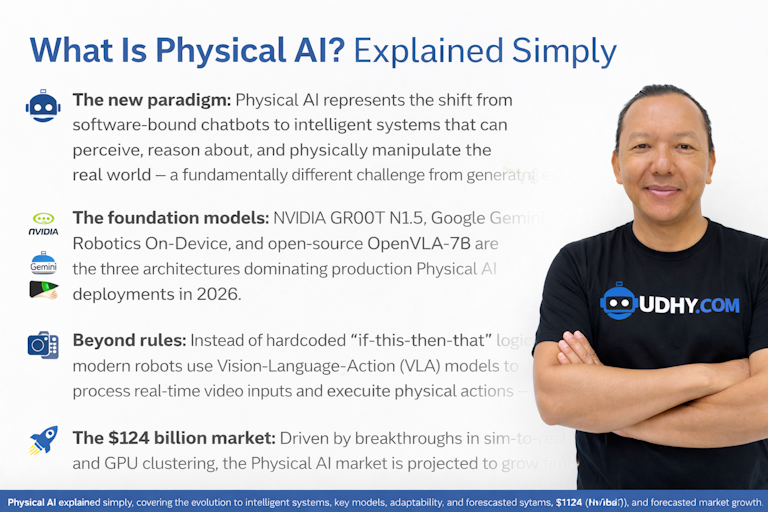
- The new paradigm: Physical AI represents the shift from software-bound chatbots to intelligent systems that can perceive, reason about, and physically manipulate the real world — a fundamentally different challenge from generating text.
- The foundation models: NVIDIA GR00T N1.5, Google Gemini Robotics On-Device, and open-source OpenVLA-7B are the three architectures dominating production Physical AI deployments in 2026.
- Beyond rules: Instead of hardcoded “if-this-then-that” logic, modern robots use Vision-Language-Action (VLA) models to process real-time video inputs and execute physical actions — adapting to unfamiliar environments on first attempt.
- The $124 billion market: Driven by breakthroughs in sim-to-real pipelines and GPU clustering, the Physical AI market is projected to grow from $18 billion (2026) to $124 billion by 2030 — a 6.9× expansion in four years.
I have been in this industry for more than a decade — co-founding Moovita, Singapore’s first autonomous vehicle company, and spending years as a Principal Research Scientist at A*STAR’s Institute for Infocomm Research. Over three decades, I have watched AI transition from academic curiosity to industrial backbone — but nothing in that journey prepared me for the speed of what is happening right now with Physical AI.
The early wave of the AI boom focused entirely on the digital realm. We built large language models that could draft essays, generate code, and synthesise artwork inside browser windows. But software-bound AI hits an invisible ceiling: it does not know what gravity feels like, it cannot clear a jammed conveyor belt, and it cannot navigate a dynamic, unpredictable physical environment on its own.
That boundary has now disappeared. The dominant theme across Computex 2026, GTC 2025, and every major robotics conference this year is Physical AI — the convergence of foundation models with physical robotic systems. The International Federation of Robotics (IFR) named it the defining technology trend of 2026. Whether you are an engineer, an investor, or simply someone trying to understand what is happening in AI, this guide explains exactly what Physical AI is, how it works, and why it matters.
1. What Physical AI Actually Is
At its simplest level, Physical AI is artificial intelligence embedded in hardware that physically interacts with the real world. This sounds straightforward but represents a qualitative leap from everything that came before. The distinction that most coverage misses is not a matter of degree — it is a matter of kind.
1.1. The Key Distinction: Generative AI vs Physical AI
| Dimension | Generative AI | Physical AI |
|---|---|---|
| Input | Text prompt / image | Real-time video frames, point clouds, force-feedback joint torques |
| Processing | Token prediction / diffusion | Spatial VLA inference + physics reasoning |
| Output | Digital text / image | Physical motor torque / joint position commands |
| Error consequence | Poor response — regenerate | Physical collision, equipment damage, potential safety risk |
| Operating environment | Clean digital interface | Unpredictable, dynamic physical world |
The consequences of failure are categorically different. A Generative AI model that makes a mistake produces a bad answer — you ask again. A Physical AI system that miscalculates an inference step can damage a multi-million-dollar robot, injure a co-worker, or cause a product recall. This is why Physical AI requires safety architecture that software AI simply does not need — a topic covered in depth in UDHY’s Cybersecurity for Autonomous Robot Fleets expert course and Vision‑Language‑Action models → Physical AI and Agentic Robotics
1.2. The Historical Context
Traditional robotics operated on explicit, pre-programmed rules. A robot arm in a 1990s car factory was told, in exact coordinates, where to reach, how fast to move, and what force to apply. Change the car model — reprogram the robot. Move the assembly line — reprogram the robot. Add a new component — reprogram the robot. Each change required weeks of engineering time.
Physical AI eliminates this bottleneck. As explored in UDHY’s analysis of how AI is reshaping autonomous vehicle development, the shift from rule-based to learning-based systems is the most consequential engineering transition of the decade — and its impact extends far beyond cars.
💡 Think About It
A Traditional Robot: “Move to X=245.3, Y=112.7, Z=88.2. Apply 12N of force.” — Any deviation from the plan causes a failure. A Physical AI Robot: “Pick up the blue box and put it on the shelf.” — The robot figures out the geometry, the grasp strategy, and the path on its own, regardless of exactly where the box is sitting.
2. The Three Core Systems Dominating 2026
The current Physical AI ecosystem is governed by three influential foundation model architectures — two from major technology companies and one from the open-source community that is democratising access to the technology.
2.1. NVIDIA Project GR00T N1.5
Project GR00T is a general-purpose foundation model designed explicitly for humanoid robot form factors. Released at GTC 2025 (N1) and updated at Computex 2026 (N1.5 with Eagle 2.5 VLM backbone), it is widely described as NVIDIA’s attempt to be the Android of generalist robotics — an open platform that any robotics manufacturer can build on top of.
GR00T N1.5 takes multimodal inputs — natural language instructions and past video frames — and generates the next set of joint positions for a humanoid robot. This enables humanoids to learn complex behaviours by watching human demonstrations, dramatically reducing manual programming time. The architecture runs on NVIDIA Jetson Thor — the compute platform designed specifically for humanoid robots. UDHY’s Expert Robotics Course covers GR00T deployment in full practical detail.
2.2. Google Gemini Robotics On-Device
Released by Google DeepMind in June 2025, Gemini Robotics On-Device focuses on the edge deployment problem — shrinking large vision-language models to run locally on low-power computing hardware without a cloud connection. This is critical for real-world deployment: a hospital delivery robot that requires a stable cloud connection to understand “bring the medication to Room 304” is not practically deployable.
Gemini Robotics On-Device enables localised semantic understanding, allowing a robot to interpret complex, contextual spoken commands in real time. It was designed specifically for bi-arm robot manipulation — the kind of dexterous, two-handed tasks that characterise most industrial and healthcare robotics applications.
2.3. OpenVLA-7B — The Open-Source Equaliser
Developed at Stanford, OpenVLA-7B is a 7-billion-parameter Vision-Language-Action model released under the Apache 2.0 open-source licence. It bridges the gap between internet-scale language model training and physical robotic control. By fine-tuning a large vision-language model on robotic manipulation datasets, OpenVLA allows developers to control robot arms using natural language instructions — bypassing the need for custom, rule-based inverse kinematics code.
For practitioners, OpenVLA-7B is the most accessible starting point. It runs inference in bfloat16 precision (approximately 15GB VRAM) and can be fine-tuned for a custom manipulation task with 50–500 demonstrations using LoRA — a technique requiring under 16GB of VRAM. UDHY’s Physical AI and VLA Models expert course walks through the complete OpenVLA-7B inference and fine-tuning pipeline with working code.
3. Real-World Enterprise Deployments Right Now
Physical AI is not a roadmap — it is a deployment reality. Here are three sectors where it is operating commercially in 2026:
3.1. E-Commerce and Warehouse Operations
Major fulfilment centres are moving away from traditional Automated Guided Vehicles (AGVs) that follow fixed magnetic floor strips. Modern sorting arms use VLA models to recognise, adapt to, and handle fragile or unfamiliar packaging on the fly — without requiring a pre-catalogued 3D model of every object they might encounter. Amazon’s fleet of 750,000+ robots, discussed in UDHY’s Multi-Agent Robot Systems expert course, is the most visible example of this shift at scale.
3.2. Autonomous Navigation in Dynamic Environments
Delivery and service robots can now enter unfamiliar buildings and successfully navigate congested corridors, crowded lobbies, and changing environments — without requiring a pre-built 3D map of the space. This is possible because SLAM (Simultaneous Localisation and Mapping) systems, covered in UDHY’s Autonomous Navigation and SLAM advanced course, are now augmented with semantic understanding from Physical AI models — giving robots not just geometric knowledge of their environment but object-level understanding of what is in it.
3.3. Autonomous Transportation
Self-driving platforms are replacing legacy rule-based planning loops with end-to-end neural architectures. These systems translate raw sensor data — cameras, LiDAR, radar — directly into driving decisions, handling complex out-of-distribution road anomalies that explicit rules cannot anticipate. As UDHY’s analysis of why self-driving cars still fail shows, the edge case problem is precisely where Physical AI’s generalisation capability matters most. Waymo’s current system — completing 450,000+ paid rides per week across 7 US cities — is the most mature Physical AI deployment on public roads.
For a practical look at how factories and hospitals are already deploying agentic repair units, see Physical AI and Agentic Robotics.
4. The Core Architectural Shift — Traditional vs Physical AI
The transition from traditional rule‑based AI to Physical AI represents a paradigm shift in how machines interact with the world. Below, we break down the differences with practical examples that highlight why this evolution matters.
| Engineering Dimension | Traditional Robotics Architecture | Physical AI Paradigm |
|---|---|---|
| Logic framework | Rigid hardcoded if-this-then-that loops – Input data : Text, image, or speech generation | Flexible, probabilistic neural inferences – Input data : Perception + reasoning + physical manipulation |
| Environmental adaptation | Fails when encountering minor changes – Static datasets (text, images, audio) | Generalises across unfamiliar environments – Real‑time RGB‑D video, sensor fusion |
| Programming overhead | Manual calibration of coordinate frames – Cloud‑based inference | Learns directly from demonstration data -On‑device, low‑latency inference |
| Sensor processing | Isolated data filtering steps | End-to-end multi-modal data fusion |
| Failure response | Freezes and flags an error code | Calculates alternative pathing strategies autonomously |
This shift is further explored in our deep‑dive on Physical AI and Agentic Robotics, where dashboards give way to autonomous agents capable of acting in real‑time.
4.1. Logic Frameworks
Traditional AI is designed to generate digital outputs such as text, images, or predictions based on pre‑trained models. It thrives in domains like natural language processing, image recognition, and recommendation systems. Physical AI, however, extends beyond digital boundaries by enabling robots to perceive, reason, and act in the real world. Instead of producing text, a Physical AI system can interpret a command like “Pick up the red block” and execute it through robotic manipulation. For example, Boston Dynamics’ Atlas robot demonstrates how perception and control can be combined to perform complex tasks in dynamic environments. Physical AI replaces static rules with adaptive reasoning, enabling smarter robotics and autonomous systems.
4.2. Environmental Adaptation
Traditional AI relies heavily on static datasets — large text corpora, curated image libraries, or labeled audio files. Physical AI, in contrast, consumes real‑time multimodal inputs such as RGB‑D video streams, LiDAR scans, tactile sensors, and proprioceptive feedback. This allows robots to adapt to unpredictable environments. A practical example is autonomous vehicles, which continuously process live camera feeds, radar, and LiDAR data to navigate safely through traffic. NVIDIA’s GR00T initiative highlights how multimodal sensor fusion is central to advancing Physical AI in robotics. Physical AI thrives in unpredictable environments, making it vital for autonomous driving and industrial automation.
4.3. Programming Overhead
Traditional AI models typically run in cloud servers where latency is acceptable — for instance, generating a chatbot response in a few seconds. Physical AI requires on‑device inference with strict low‑latency constraints, since delays can cause unsafe or failed actions. Warehouse robots, for example, must instantly reroute when a worker steps into their path. Google’s Gemini Robotics project emphasizes edge computing and real‑time inference to ensure robots can respond within milliseconds, a necessity for industrial automation and human‑robot collaboration. By learning from human demonstrations, Physical AI reduces programming costs and accelerates deployment.”
4.4. Sensor Processing
The outputs of Traditional AI are digital artifacts — text passages, images, or analytical predictions. Physical AI outputs are direct control signals such as joint velocities, torque commands, or SE(3) deltas that drive motors and actuators. This enables robots to manipulate objects, navigate spaces, and interact physically with humans. For instance, OpenVLA demonstrates how Vision‑Language‑Action models can translate natural language instructions into robotic arm movements, allowing a robot to grasp tools or assemble components in real time. Multi‑modal sensor fusion in Physical AI creates holistic perception, enabling machines to ‘see, hear, and feel’ simultaneously.
4.5. Failure Response
Traditional AI often struggles when faced with tasks outside its training domain, requiring retraining or fine‑tuning. Physical AI, powered by Vision‑Language‑Action models, is designed to adapt to unfamiliar environments on first attempt. A drone equipped with Physical AI can explore a new building without prior mapping, adjusting its trajectory dynamically. This adaptability is why analysts project Physical AI to grow from $18 B in 2026 to $124 B by 2030 — a 6.9× expansion (source: McKinsey Robotics Outlook, 2025). The surge reflects demand in autonomous vehicles, humanoid robotics, and industrial automation, where adaptability is critical. Physical AI ensures resilience by autonomously recovering from failures, boosting safety and reliability.
“In traditional automation setups, if you changed the lighting conditions in a factory by 20% or moved a target box three inches to the left, the entire system would fail and require manual reconfiguration. Physical AI changes that completely. By utilising foundation models trained in highly realistic simulation environments, robots can now adapt to changing lighting, unfamiliar shapes, and real-world interference on their first attempt. We are witnessing a clear shift from automated machinery to truly adaptive, intelligent systems.”
— Dr. Dilip Kumar Limbu, Co-Founder Moovita · Former Principal Research Scientist, A*STAR
5. The Economic Trajectory — Why This Matters Now
The financial scale of Physical AI is not speculative. According to Deloitte’s Physical AI and Humanoid Robots — Tech Trends 2026 report, the Physical AI sector will expand into a $124 billion ecosystem by 2030.
| Year | Market size | Key milestones |
|---|---|---|
| 2024 | $16.1B | Physical Intelligence raises $400M; Boston Dynamics Atlas becomes fully electric |
| 2026 | $18B+ ← Now | GR00T N1.5, Gemini Robotics On-Device, AGIBOT WORLD deploy. 10,000 humanoids active. |
| 2028 | ~$62B | Level 4 AV expansion; humanoid robots enter healthcare and logistics at scale |
| 2030 | $124B | Fully autonomous warehouse operations; widespread surgical robotics deployment |
Autonomous Vehicles: Tesla and Waymo use Physical AI pipelines to fuse LiDAR, radar, and camera streams in real‑time, enabling safe navigation in unpredictable traffic.
Smart Warehouse Logistics: Amazon Robotics deploys agentic systems that integrate VLA models with robotic arms and mobile platforms, reducing human intervention in order fulfillment.
5.1. The Shifting Employment Landscape
As traditional, repetitive motion-planning tasks become automated, demand is shifting toward engineers who understand how to configure and deploy machine learning models on physical hardware. The IFR’s 2026 trends report identifies three skills commanding the highest premium: Sim-to-Real domain adaptation, synthetic data pipeline design, and real-time safety fallback architecture.
This is not a displacement story — it is a transition story. As explored in UDHY’s The Data Gap Threatening the Humanoid Robot Revolution, the physical data required to train these systems is itself one of the most valuable commodities in the industry. The engineers who understand how to collect, curate, and use it are the ones who will lead this market.
6. How to Learn Physical AI — A Progressive Path
Learning Physical AI requires a structured roadmap that blends theory, simulation, and real‑world deployment. Instead of tackling everything at once, follow this progressive path to build skills recruiters actually value.
6.1. Stage 1: Core Programming Foundations
Start with the fundamentals of robotics programming.
- Languages: Python for prototyping, C++17/20 for real‑time robotics.
- Math & Control: Linear algebra, kinematics, PID controllers.
- Tools: GitHub for version control, Docker for reproducible environments. Related reading: How to Become a Robotics Engineer — Section 2 highlights why C++ proficiency is a hiring filter.
6.2. Stage 2: Robotics Middleware (ROS 2 Jazzy Jalisco)
Middleware is the backbone of Physical AI systems.
- Skills: ROS 2 nodes, lifecycles, Nav2 for navigation, MoveIt for manipulation.
- Security: DDS authentication and secure communication.
- Practical Project: Build a ROS 2 package that fuses LiDAR and IMU data. Related reading: Physical AI and Agentic Robotics — shows how middleware enables agentic systems.
6.3. Stage 3: Simulation & Reinforcement Learning
Before deploying to hardware, train in simulation.
- Platforms: NVIDIA Isaac Sim, Isaac Lab, Gazebo.
- Algorithms: PPO (Proximal Policy Optimization), MPC (Model Predictive Control).
- Case Study:Autonomous Vehicles: Waymo trains reinforcement learning policies in NVIDIA Omniverse before deploying them to real fleets, reducing accidents during early trials. Related reading: How to Become a Robotics Engineer — Section 2 emphasizes simulation skills as core hiring criteria.
6.4. Stage 4: Vision‑Language‑Action (VLA) Models
The cutting edge of Physical AI.
- Skills: PyTorch for training, ONNX + TensorRT for deployment.
- Concepts: Multimodal fusion (vision + language + action).
- Practical Project: Train a robot to follow natural language commands like “pick up the red cup.” Related reading: Physical AI and Agentic Robotics — explains how VLA models drive agentic robotics.
6.5. Stage 5: Real‑World Deployment & Portfolio Proof
Recruiters prioritize portfolios over degrees.
- Portfolio Checklist:
- A reproducible ROS 2 package with launch files.
- Demo video of a robot navigating or manipulating.
- Documentation of algorithms (EKF, ICP, PPO).
- Case Study:Smart Warehouses: Amazon Robotics uses VLA models to coordinate fleets of mobile robots, cutting human intervention in logistics by 40%. Related reading: How to Become a Robotics Engineer — Section 3 explains the portfolio‑first paradigm.
6.6. hardware requirements — Why You Need to Know
Even though Physical AI is driven by advanced algorithms, hardware is the foundation that makes real‑time embodied intelligence possible. Without the right sensors, edge GPUs, and actuators, even the most sophisticated Vision‑Language‑Action (VLA) models cannot function in the physical world. Understanding hardware requirements is critical for engineers, students, and recruiters because it determines whether your AI system can move from simulation to deployment.
| Component | Examples / Tools | Why It Matters in Physical AI | Related UDHY Post |
|---|---|---|---|
| Sensors | LiDAR, RGB‑D cameras, IMUs, tactile arrays | Provide multimodal input streams for perception and balance. Enable VLA models to interpret the environment. | How to Become a Robotics Engineer |
| Edge GPUs | NVIDIA Jetson Orin, RTX A6000 clusters | Deliver low‑latency inference (<10 ms). Critical for continuous‑time decision‑making in autonomous vehicles and humanoids. | Physical AI and Agentic Robotics |
| Actuators | Servo motors, hydraulic joints, soft robotics actuators | Execute physical actions safely and precisely. Essential for manipulation, locomotion, and human‑robot interaction. | How to Become a Robotics Engineer |
| Middleware | ROS 2 Jazzy Jalisco, DDS security layers | Connects hardware with AI logic. Ensures secure, distributed communication across robotic fleets. | Physical AI and Agentic Robotics |
| Connectivity | 5G, Wi‑Fi 6, edge networking | Enables real‑time coordination of multiple agents in smart factories and warehouses. | What Is Physical AI? Explained Simply |
Because mastering Physical AI demands fluency in both deep learning software and real‑world mechanics, a progressive, step‑by‑step learning path is essential. That’s exactly what UDHY’s curriculum delivers — guiding learners from foundational concepts to advanced, hands‑on applications.
| 1. Understand the core shift | What Physical AI is and why it changes everything | Is AI Helping Self-Driving Cars? |
| 2. Master the data challenge | Why physical data is the binding constraint on VLA performance | Humanoid Robot Data Gap |
| 3. Build the AI foundation | Deep learning, PyTorch, sim-to-real transfer | Deep Learning for Robotics |
| 4. Learn RL for robot control | PPO, Q-Learning, imitation learning | Reinforcement Learning for Robotics |
| 5. Deploy Physical AI | OpenVLA-7B inference, GR00T, LoRA fine-tuning, action chunking | Physical AI & VLA Models Expert Course |
| 6. Secure the deployment | SROS2, NIST CSF, fleet cybersecurity | Cybersecurity for Robot Fleets |
7. Frequently Asked Questions
Ready to go deeper?
Learn to deploy Physical AI on real robots — free.
UDHY’s Physical AI & VLA Models Expert Course covers OpenVLA-7B inference, GR00T architecture, LoRA fine-tuning, and production safety design — with working Python code throughout.
References
- International Federation of Robotics. (January 2026). Top Five Emerging Technology Movements 2026.
- NVIDIA Developer. (2025–2026). Project GR00T N1.5 & Isaac Sim Documentation.
- Deloitte. (February 2026). Physical AI and Humanoid Robots — Tech Trends 2026.
- Kim, M. et al. (2024). OpenVLA: An Open-Source Vision-Language-Action Model. arXiv:2406.09246.
- Google DeepMind. (June 2025). Gemini Robotics On-Device.
- TechCrunch. (January 2026). NVIDIA wants to be the Android of generalist robotics.
- MIT CSAIL. (2026). Robotics Research — Embodied Intelligence Laboratory.
- NVIDIA Deep Learning Institute. (2026). Physical AI and Robotics Curriculum. nvidia.com/training
About the Author
Dr. Dilip Kumar Limbu Co-Founder, Moovita | Former Principal Scientist, A*STAR | PhD, Auckland University of Technology
Connect via LinkedIn Direct Inquiry.
Disclaimer
The views expressed here are personal and based on 25+ years in the industry, including my work at Moovita. They do not necessarily reflect the views of any organization.
Enjoying this post? Subscribe to get more AI insights.