Level 3 vs Level 4 Autonomous Driving: Key Differences and Why They Matter
In 60 seconds: Level 3 vs Level 4 autonomy explained — what the SAE labels really mean, who’s liable when things go wrong, and which cars have them in 2026.
TL;DR — Quick Insights
- Level 3 means the car drives itself — but you must be ready to take back control within seconds when it asks. Level 4 means the car handles everything, including emergencies, with no human fallback required.
- That single difference — who is responsible when something goes wrong — changes the legal liability, the engineering requirements, and the commercial viability of every vehicle in between.
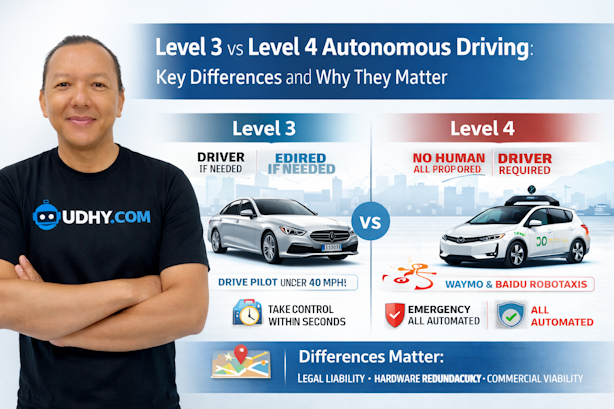
- Only one consumer vehicle currently holds genuine Level 3 certification in the US: the Mercedes-Benz S-Class and EQS with Drive Pilot, operating below 40 mph on pre-mapped highways.
- Level 4 is already on public roads — but only in commercial robotaxis (Waymo, Baidu Apollo) and autonomous freight (Aurora Innovation), not in cars you can buy.
- The gap between Level 3 and Level 4 is not incremental. It is the difference between a tool that helps a human drive and a system that replaces the human entirely.
- Introduction
- The SAE Framework: A Quick Map
- Level 3 Automation Explained: System Drives, Driver Still Responsible
- Level 4 Automation Explained: Full Autonomy, No Human Fallback
- The Six Real Differences Between Level 3 and Level 4
- Why the Gap Matters More Than You Think
- What This Means for Consumers, OEMs, and the Industry
- When Will Level 4 Be Available to Everyone?
- FAQ — Level 3 vs Level 4 Autonomy
- Related Posts on UDHY
- References
Introduction
I have been in this industry for more than a decade — co-founding Moovita, Singapore’s first autonomous vehicle company, and spending years as a Principal Research Scientist at A*STAR developing real-world perception and control systems. In that time, no question has caused more confusion — among engineers, policymakers, and the general public — than the distinction between the levels of vehicle autonomy.
The Society of Automotive Engineers (SAE) defines six levels of driving automation, ranging from Level 0 (no automation) to Level 5 (full automation). These levels classify how much control the human driver versus the automated system has in operating a vehicle.
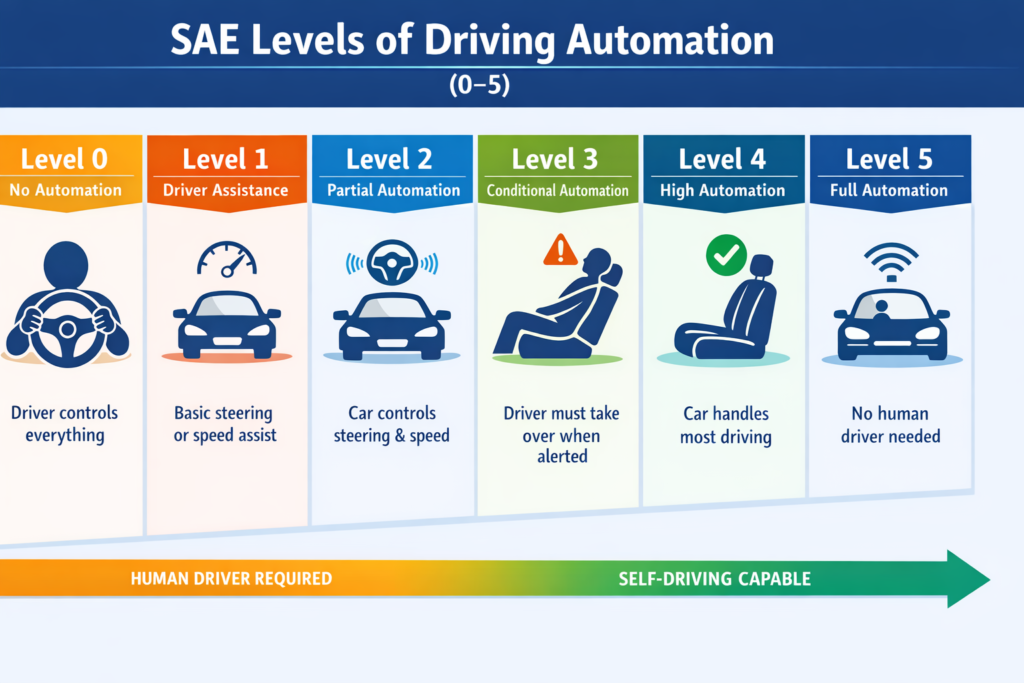
This article focuses on Level 3 vs Level 4 automation, since people often use these terms interchangeably. I’ll break down the differences clearly to show why they’re not the same. The difference between Level 3 and Level 4 is arguably the most consequential divide in the entire autonomy spectrum — more significant, in practical terms, than the gap between Level 1 and Level 3 combined.
The SAE Framework: A Quick Map
Before comparing Level 3 vs Level 4, it’s important to see where they fit in the broader framework. As shown in table below, the SAE J3016 standard defines six levels of driving automation.
Table :The SAE six levels of driving automation: A Quick Map. Scroll right to see full details on mobile.
| Level | Name | Who drives? | Eyes needed? | Real examples |
|---|---|---|---|---|
| 0 | No automation | Human always | Yes | Most cars pre-2015 |
| 1 | Driver assistance | Human with aid | Yes | Adaptive cruise control |
| 2 | Partial automation | Human supervised | Yes | Tesla Autopilot, GM SuperCruise |
| 3 | Conditional automation | System, with human standby | No — but must respond | Mercedes Drive Pilot |
| 4 | High automation | System fully | No — human not required | Waymo, Aurora |
| 5 | Full automation | System always | No — no pedals needed | Nobody yet |
Before diving deeper into Level 3 vs Level 4, it’s useful to see the bigger picture. The SAE J3016 framework defines six levels of driving automation, from Level 0 (no automation) to Level 5 (full automation in all conditions). Levels 1 and 2 introduce driver assistance and partial automation, while Level 3 and Level 4 mark the transition to conditional and high automation. Finally, Level 5 represents complete autonomy. In this article, I’ll give a quick overview of all levels, then focus on clarifying the differences between Level 3 and Level 4, which are often mistakenly used interchangeably.
Level 3 Automation Explained: System Drives, Driver Still Responsible
At Level 3 — officially called “Conditional Automation” — the automated driving system can fully manage steering, acceleration, braking, and monitoring of the environment — but only under specific conditions (like highway driving or traffic jams). The key point is that the driver must remain available and be ready to take over when the system requests. For example, in a traffic jam assist scenario, the car can handle stop‑and‑go driving, but if the situation changes (say, construction zones or unexpected hazards), the driver must immediately resume control.
This is where confusion often arises: people assume Level 3 means “hands‑off driving,” but in reality, it’s “eyes‑off sometimes, but brain‑on always.”
But here is the critical catch: when the system reaches the edge of its capability, it will ask you to take over. And you must be ready to do so — typically within 10 seconds.
That handover requirement is not a minor footnote. It is the defining engineering and legal constraint of every Level 3 system. It means:
- The driver cannot sleep, cannot be heavily distracted, cannot be impaired
- The vehicle must monitor driver readiness continuously
- If the driver fails to respond, the vehicle must execute a “minimal risk manoeuvre” — typically a controlled stop in lane — which itself is a safety risk in fast-moving traffic
What Level 3 Looks Like in the Real World: Mercedes Drive Pilot
The only consumer vehicle with certified Level 3 in the United States as of 2026 is the Mercedes-Benz S-Class and EQS Sedan with the Drive Pilot system. The conditions under which it operates reveal just how tightly constrained Level 3 currently is in practice:
- Speed: 40 mph (64 km/h) or below only
- Environment: Pre-mapped highways in California and Nevada only
- Weather: Daytime, clear conditions, no construction zones
- Traffic: Heavy traffic with a lead vehicle present
Within those conditions, Drive Pilot is genuinely impressive. The driver can watch videos on the dashboard screen. Mercedes-Benz legally assumes liability for any incident caused by a Drive Pilot fault — a landmark commercial commitment. Outside those conditions, the system disengages and returns control to the driver.
Mercedes paused Level 3 Drive Pilot on the 2026 US S-Class to prioritise a more practical urban assistance system, while planning a full Level 4 chauffeur experience targeting the next S-Class generation around 2028–2030. This is itself a signal of how challenging the Level 3 handover problem is in practice.
Honda’s Legend with Traffic Jam Pilot, available in Japan, is the other commercially certified Level 3 vehicle. It operates under similarly narrow conditions: slow-moving highway traffic jams only.
The Liability Shift at Level 3
One of the most important practical implications of Level 3 is legal liability. At Levels 0–2, the driver is always legally responsible for the vehicle. At Level 3, liability shifts to the manufacturer during the period the automated system is active — provided the driver was within the system’s approved operating conditions.
This is why Level 3 certification has been so slow to arrive. A single incident where the manufacturer’s system was active during a collision can trigger product liability exposure worth billions. Mercedes accepted this with Drive Pilot. Most other OEMs have not, choosing instead to stay at Level 2+ where driver responsibility never transfers.
Level 4 Automation Explained: Full Autonomy, No Human Fallback
At Level 4 — “High Automation” —, the vehicle can drive itself without human intervention or you can literally sit back and let the car handle everything— but only within defined conditions or geofenced areas (for example, urban ride‑hailing zones or fixed shuttle routes). Unlike Level 3, the system does not expect the driver to take over if something goes wrong inside its operational domain. If the car encounters a situation outside its limits, it will safely stop or pull over rather than hand control back.
As such, the Level 4 removes the human fallback entirely. Within its defined operational domain, a Level 4 vehicle is fully responsible for all driving tasks including emergencies. There is no takeover request. No 10-second window. No driver monitoring system ensuring you are alert.
If the system encounters a situation it cannot handle, it does not call on a human. It executes a safe stop autonomously and waits for a remote operator or service team. The human is not a safety net — the system is its own safety net.
This distinction has profound engineering implications. To reach Level 4, a system must be able to handle every failure mode within its operational domain without human intervention. That requires:
- Redundant hardware: Multiple independent sensor arrays, so no single sensor failure causes a safety issue
- Fail-operational architecture: The vehicle must continue operating safely even when one subsystem fails
- Comprehensive edge case coverage: Every scenario within the operational domain must be handled, because there is no human to catch the system’s mistakes
- Remote monitoring: Human operators who can observe but not drive — intervening only for complete system failures or exceptional situations
This is fundamentally harder engineering than Level 3. It is why Level 4 has only been commercially deployed in tightly geofenced environments where the operational domain can be exhaustively defined and tested.
What Level 4 Looks Like Today
Waymo operates Level 4 robotaxis across seven US cities — San Francisco, Phoenix, Los Angeles, Austin, Nashville, Atlanta, and Miami — completing over 450,000 paid rides per week as of early 2026. No safety driver. Passengers hail via app. The vehicles operate within mapped urban zones in approved weather conditions.
Baidu Apollo Go has delivered over 14 million autonomous rides across 16 Chinese cities. In certain Wuhan zones, fully driverless operations (no safety driver) are approved by Chinese regulators.
Aurora Innovation launched the first commercial Level 4 driverless trucking operations on US public roads in 2025. By January 2026, the Aurora Driver had surpassed 250,000 driverless miles on commercial freight routes between Dallas and Houston, with zero Aurora Driver-attributed collisions and 100% on-time performance.
Moovita autonomous shuttles operate on campuses, well defined and closed routes in multiple countries — the most quietly successful Level 4 deployment category precisely because the operational domain is the most constrained.
The Six Real Differences Between Level 3 and Level 4
Understanding the technical distinction is one thing. Here is what it means in practice:
Table :Level 3 vs Level 4 Autonomous Driving: Key Differences Explained. Scroll right to see full details on mobile.
| Aspect | Level 3 (Conditional Automation) | Level 4 (High Automation) |
|---|---|---|
| Human responsibility | Driver must remain on standby and be able to take over within seconds. | Human is a passenger with no safety responsibility. |
| Operational domain | Typically low speeds on mapped highways; system can issue takeover warnings. | Complex urban environments at normal traffic speeds; no reliance on human takeover. |
| Failure response | Requests human intervention when reaching capability limits. | Performs a minimal risk manoeuvre autonomously (e.g., controlled pull‑over and stop). |
| Legal liability | Manufacturer liable only while system is active within approved conditions. | Manufacturer/operator fully liable for autonomous decisions within operational domain. |
| Hardware requirements | Less redundancy needed since human fallback exists. | Full redundancy required: backup sensors, dual compute, fail‑operational braking/steering. |
| Commercial model | Premium feature sold to individual buyers (subscription or option on luxury vehicles). | Fleet/service model (robotaxis, shuttles, freight); economics work only at scale. |
The key takeaway is that Level 3 still relies on the human as a fallback, while Level 4 removes the driver entirely from the safety equation. Level 3 is a premium convenience feature for individual car owners, whereas Level 4 is designed for fleets and services, backed by full hardware redundancy and legal liability on the operator. In short, Level 3 enhances driving, but Level 4 replaces the driver.
Why the Gap Matters More Than You Think
Here is the insight that most coverage of autonomy levels misses: Level 3 is not a stepping stone to Level 4. It is a different product solving a different problem.
Level 3 makes highway driving more comfortable for luxury car owners. It is genuinely useful and genuinely impressive engineering. But it does not meaningfully advance the core unsolved problem of autonomous driving — which is building a system reliable enough to operate without any human fallback in complex, open-world environments.
Level 4 within a geofenced domain is the actual proof of concept for autonomous driving. Every safe mile completed by Waymo, Aurora, and Baidu without human intervention is direct evidence that the technology can eventually be trusted in more environments. Every Level 3 mile driven by a Mercedes S-Class owner is evidence of excellent ADAS engineering — but not of autonomous driving.
As we explored in Why Self-Driving Cars Still Fail, the fundamental challenge is the long tail of edge cases — the rare, unpredictable scenarios that AI systems have not been trained on. Level 3 manages this by keeping a human in the loop as the last line of defence. Level 4 must solve it in software, hardware, and operational design. That is an order of magnitude harder, and it is why Level 4 commercial deployment has taken decades of sustained engineering effort from the most well-funded technology companies in the world.
Understanding sensor fusion — how cameras, LiDAR, and radar combine to give an autonomous vehicle its perception — helps explain why Level 4 is so demanding. The system must perceive and respond correctly without any human double-checking its work. And as outlined in our AV teleoperation guide, even Level 4 systems rely on remote human operators for exceptional situations — a carefully engineered safety layer that does not violate the Level 4 standard because the remote operator monitors but does not drive.
What This Means for Consumers, OEMs, and the Industry
If you are buying a car today: Level 3 is the highest autonomy available in consumer vehicles, available only in the Mercedes-Benz S-Class and EQS in select US states. It is impressive, genuinely useful in traffic jams, and legally groundbreaking. But it is not autonomous driving. You are still the responsible operator of the vehicle.
If you are an automotive OEM: The decision of whether to pursue Level 3 or leap to Level 4 is fundamentally a liability and business model decision, not a technology one. Mercedes has shown Level 3 can work commercially. GM’s Cruise has shown that deploying premature Level 4 commercially without adequate safety architecture is catastrophic. As covered in our AI and AV development analysis, the winning strategy is owning a constrained operational domain completely before expanding.
If you are an investor or policy maker: The Level 4 commercial deployments happening right now — Waymo, Aurora, Baidu — are the actual signal to watch. Not the number of Level 3 vehicles sold to luxury car buyers. The economics of Level 4 freight autonomy in particular, following Aurora’s 250,000+ driverless commercial miles with zero accidents, are beginning to look genuinely viable.
When Will Level 4 Be Available to Everyone?
The honest answer, from someone who has spent a career in this field: not soon, and not uniformly.
McKinsey’s 2025 survey of 91 global AV industry decision-makers found the timeline has slipped 2–3 years since 2021. Limited Level 4 services — robotaxis in specific urban areas — are expected between 2026 and 2030 in leading markets. Privately owned Level 4 vehicles for general consumer use will take significantly longer, constrained by hardware costs, regulatory frameworks, and the fundamental engineering challenge of expanding operational domains beyond currently geofenced areas.
China and the United States will lead deployment timelines. Europe is constrained by fragmented regulatory frameworks, though Germany has established the world’s first national legal framework for Level 4 autonomous vehicles in defined operational areas — a significant regulatory milestone.
The core distinction lies in who holds liability during functional dropouts. This bottleneck is heavily scrutinized by regulatory committees because of black-box AI risks in autonomous vehicles.
Mercedes-Benz and NVIDIA are targeting a Level 4 chauffeur experience for the next S-Class generation around 2028–2030. Aurora continues expanding its Level 4 freight corridor coverage. Waymo has begun the expansion from US-only operations toward international markets.
The trajectory is clear. The timeline is uncertain. But the direction of travel is irreversible.
FAQ — Level 3 vs Level 4 Autonomy
Related Posts on UDHY
- Why Self-Driving Cars Still Fail — The Edge Case Problem Explained
- Sensor Fusion Explained: Cameras, LiDAR & Radar in Autonomous Vehicles
- The Complete Guide to AV Teleoperation
- Is AI Speeding Up or Slowing Down Autonomous Vehicle Development?
- Autonomous Delivery Robots: The Future of Last-Mile Logistics
References
- SAE International. (2021). SAE J3016: Taxonomy and Definitions for Terms Related to Driving Automation Systems for On-Road Motor Vehicles. sae.org
- Mercedes-Benz USA. (2026). DRIVE PILOT Automated Driving. mbusa.com
- Bike-EV / Automotive News. (January 2026). Mercedes-Benz Pauses US Drive Pilot Level 3 for 2026 S-Class. bike-ev.com
- McKinsey Center for Future Mobility. (January 2026). Where to next? Insights from autonomous-vehicle experts. mckinsey.com
- Aurora Innovation. (February 2026). Q4 2025 Shareholder Letter — 250,000 Driverless Miles. sec.gov
- CNBC. (December 2025). Waymo’s robotaxis now complete over 450,000 rides per week. cnbc.com
- Synopsys. (2025). The 6 Levels of Vehicle Autonomy Explained. synopsys.com
- ZF Group. (2024). From Level 0 to 5: The Steps to Autonomous Driving. zf.com
- Basic Vehicle Knowledge. (2025). Level 3 vs Level 4 Autonomy: What’s the Real Difference. basicvehicleknowledge.com
About the Author
Dr. Dilip Kumar Limbu Co-Founder, Moovita | Former Principal Scientist, A*STAR | PhD, Auckland University of Technology
Connect via LinkedIn Direct Inquiry.
Disclaimer
The views expressed here are personal and based on 25+ years in the industry, including my work at Moovita. They do not necessarily reflect the views of any organization. [Back to Top ↑]
Enjoying this post? Subscribe to get more AI insights.