Russia’s New Humanoid Robot: Key Takeaways
In the next 30 seconds, I’ll share highlights from our post on Russia’s Humanoid Robot — exploring its design, capabilities, and what it means for the future of robotics in 2026.
TL;DR — Quick Insights
- What was revealed: Russia’s robotics consortium unveiled a new bipedal humanoid with claimed navigation and manipulation capabilities, positioning it as a domestic alternative to US and Chinese systems.
- The credibility question: No independent third-party testing has been published. Without verifiable performance data, the announcement functions more as a geopolitical signal than a technical milestone.
- How it compares: Based on publicly available footage, the locomotion quality trails Boston Dynamics Atlas and Unitree H1 by a visible margin. Manipulation capability is undemonstrated in uncontrolled conditions.
- The strategic context: Russia’s motivation is domestic industrial autonomy — reducing dependence on Western and Chinese robotics supply chains for military and industrial applications.
- What to actually watch: Whether the system appears in verifiable commercial or industrial deployment within 18 months. Demos without deployments are not breakthroughs.
Russia’s New Humanoid Robot Demo – What It Shows About the Race for Human-Like Robots
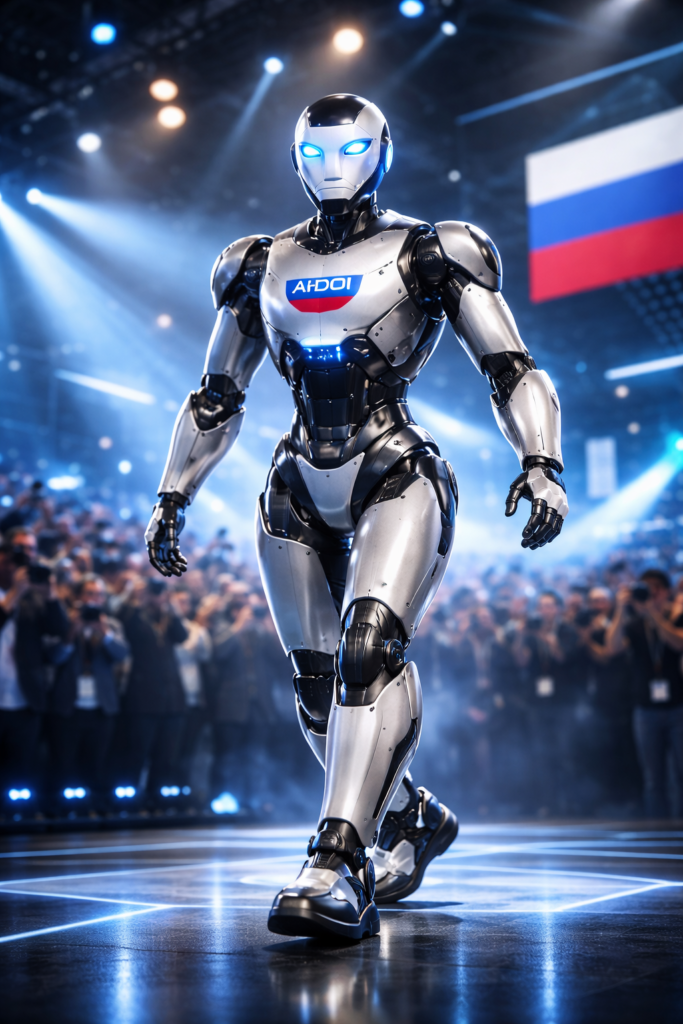
Russia recently showed off its new humanoid robot called AIdol at a tech event in Moscow — but the demo didn’t go as planned. The robot tried to walk on stage, wave to the audience, and then fell flat on its face. Engineers said the fall happened because of a balance issue and that the robot is still in testing. The team behind AIdol said most of its parts are made in Russia, and they hope to make it 90% locally built in the future.
This moment shows how hard it is to build a working humanoid robot. Even big companies face challenges when mixing hardware, sensors, and software to move like a human. Russia’s goal is clear — they want to prove they can build robots using mostly local technology — but there’s still a long way to go before they can compete with top players.
Why Humanoid Robots Struggle
- Balance & Locomotion: Walking on two legs requires constant adjustment of the center of gravity. Even milliseconds of sensor delay can cause instability.
- Sensor Fusion: Cameras, gyroscopes, and force sensors must work together in real time.
- Actuator Precision: Motors must deliver smooth, controlled movement — a major engineering hurdle.
- AI Integration: Machine learning models are increasingly used to predict motion and correct errors.
If we compare this to Tesla’s Optimus and Xpeng’s IRON, the difference is huge. Tesla’s Optimus is already walking smoothly, picking up objects, and even doing basic factory work. Xpeng’s IRON, on the other hand, looks almost human and can make lifelike movements and facial expressions. Compared to these two, AIdol is still in its early stage, learning to walk and balance properly.
Global Comparisons
Russia’s AIdol joins a growing list of humanoid projects worldwide. Here’s how it stacks up:
| Robot | Stage of Development | Key Strengths | Limitations |
|---|---|---|---|
| Russia AIdol | Early prototype | Local sourcing, national ambition | Balance issues, limited dexterity |
| Tesla Optimus | Pilot factory use | Smooth walking, object handling | Still limited autonomy |
| Xpeng IRON | Advanced prototype | Human‑like gestures, facial expressions | Commercial rollout unclear |
| Boston Dynamics Atlas | Research platform | Mobility, agility, parkour demos | Not consumer‑ready |
Future Outlook
Over the next 3–5 years, expect humanoid robots to move from prototypes to practical service roles:
- Factory assistants
- Healthcare support
- Customer service greeters
Russia’s AIdol may have stumbled, but it represents a step toward a future where humanoid robots are part of everyday life.
My personal view: this event is a good reminder that building a humanoid robot is one of the hardest challenges in tech. Tesla and Xpeng are years ahead, focusing on real-world uses like factory work, customer service, and daily help. Russia’s AIdol shows determination, but also how complex and expensive humanoid development really is.
In short, the global race for humanoid robots is heating up — and while some are already showing useful progress, others are still learning to stand tall.
Lessons for Learners
What can students, hobbyists, and professionals take away from AIdol’s debut?
- Balance algorithms are critical in robotics.
- Sensor calibration can make or break performance.
- Iteration and testing are essential — even failures teach valuable lessons.
If Russia’s AIdol inspires you to explore robotics further, don’t miss our Robotics for Beginners course — the perfect starting point for hands‑on learning. Once you’ve mastered the basics, advance to Robotics for Advanced Learners and eventually the Robotics for Experts track to build career‑ready skills. For broader context, check out our post on Self‑Driving Cars Explained and the Top 10 AI Coding Tools shaping today’s innovations. Together, these resources give you a complete view of how AI and robotics are transforming industries worldwide.
About the Author
Dr. Dilip Kumar Limbu Co-Founder, Moovita | Former Principal Scientist, A*STAR | PhD, Auckland University of Technology
Connect via LinkedIn Direct Inquiry.
Disclaimer
The views expressed here are personal and based on 25+ years in the industry, including my work at Moovita. They do not necessarily reflect the views of any organization.