Career Guide to AI, Robotics, and Autonomous Vehicles
In the next 60 seconds, I’ll share highlights from our guide on How to Build a Career in AI & Robotics— showing you the steps, tools, and kits that fit your journey in 2026.
TL;DR — Quick Insights
- The fastest entry path: You do not need a robotics PhD. The highest-demand roles in 2026 — teleoperation specialist, AI data curator, robot deployment engineer — are accessible with structured self-study and hands-on project experience.
- The 3-skill foundation: Python programming, understanding of sensor systems (cameras, LiDAR, radar), and familiarity with ROS 2 architecture will get you to interview stage at most AV and robotics companies.
- Where to look: Tesla Robotics, Waymo, Figure AI, Boston Dynamics, Amazon Robotics, and 400+ funded startups are actively hiring across engineering, operations, and data roles.
- Biggest career mistake: Waiting until you feel “ready.” The people being hired now are learning on the job — employers in physical AI want curiosity and structured thinking more than completed credentials.
- The UDHY path: AI Beginner → Robotics Beginner → Robotics Advanced → AI Career Toolkit 2026 → apply. That sequence takes 3–4 months at a reasonable pace.
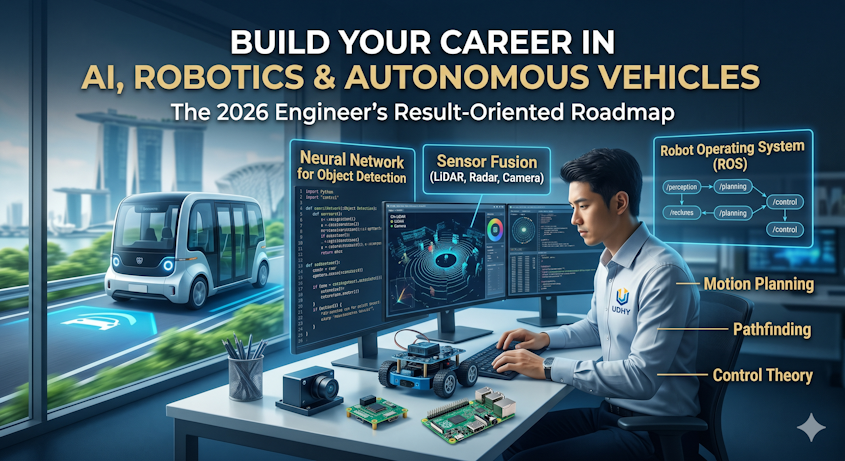
With over 25+ years in Robotics and Autonomous Vehicles, I am frequently approached by concerned parents and ambitious Computer Science/Sofware Engineering/Mechanical Engineering graduates with the same burning question: “How do I start or transition from a graduate/standard software role into the high-stakes world of AI Robotics and Autonomous Systems?”
To begin with, the shift from general software engineering or even “Deep Tech” into robotics is not just a career move—it is a pivot into the most influential industry of the decade. For example, unlike traditional web development, Embodied AI or Robotics requires a synthesis of high-level intelligence and physical-world physics. for AI or Robotics, you’ll need a mix of foundational AI software development skills, plus AI & Computer Vision (object detection, classification, and tracking using libraries like OpenCV, TensorFlow, or PyTorch), Robotics Fundamentals (Kinematics, control systems, and embedded programming), Sensor Fusion (Work with cameras, LiDAR, radar, and IMUs to build perception systems) and Mathematics (Linear algebra, probability, and calculus for algorithms and machine learning).
It might sound a bit intimidating, but after 30+ years in AI and robotics, I can tell you this: the real rewards come when you go beyond theory and master the full handshake — hardware, sensors, AI, and software working together. For some of these specific topics, UDHY has emerged as the premier training ground for AI, robotics, and autonomous vehicle engineering. Take your time to go though the contents of UDHY. Meanwhile, this post highlights high-level roadmap in this post to to Build a Career in AI, AV & Robotics.
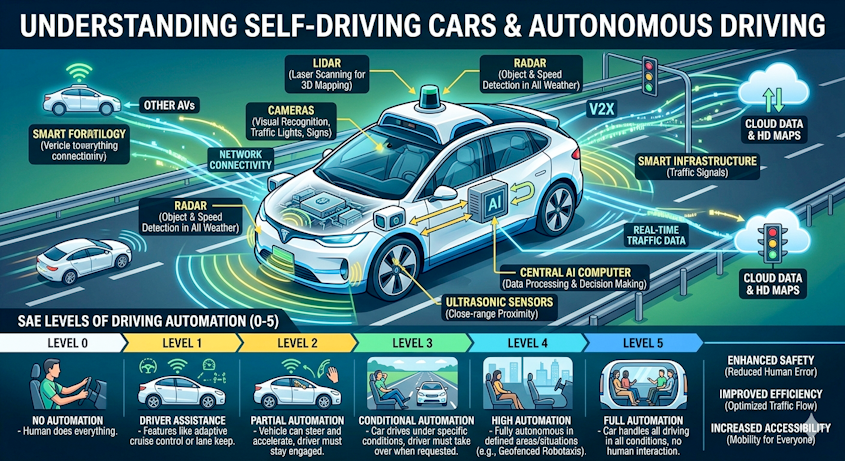
📢 Notice: Learn the Basic & Explore Self-Driving Cars
🚘 New to autonomous vehicles? Start with our beginner-friendly guide:
👉 Click here to read our full beginner-friendly guide: Self-Driving Cars Explained
1. The Engineering Shift: Building Your Technical Edge
If you are a Computer science (CS) or Software Engineering or Mechanical Engineering graduate or a professional software engineer, you already have the fundamental/advanced knowledge (depending on your background) of computer engineering to completing various software development projects. Now, you must move beyond basic algorithms to specialize in Sensor Fusion (synchronizing LiDAR and Radar), Computer Vision for environmental perception, and Control Theory for precise motion planning. Beyond that, to be competitive for roles at companies like Waymo, Tesla, or Boston Dynamics, you must master these six pillars:
“In this article, I’ll be listing key modules and many possible paths to becoming a robotics engineer. For an AI & Robotics career, I’ve highlighted some specific routes — but the choice ultimately depends on each individual’s preferences and capabilities”.
I. Programming Skills for Robotics Careers
In robotics and autonomous vehicles, AI programming is the backbone of innovation (or rather your career). To master this field, any developers must embrace the dual‑threat of C++ and Python—two languages that dominate robotics and AV systems. To succeed, developers must master both C++ and Python — the dual‑threat languages powering robotics and AV systems.
If you are new to C++ and Python, here is basic infos on what & how they are used for:
- C++ for Performance & Control: C++ is the industry standard for real‑time robotics control, embedded systems, and AV safety modules. Its speed and memory efficiency make it indispensable for mission‑critical tasks like sensor fusion, path planning, and hardware integration. Non-negotiable for production. Because it is closer to the hardware, C++ provides the execution speed necessary for a vehicle to make millisecond decisions.
- Python for AI & Flexibility : Python powers machine learning, computer vision, and rapid prototyping. With libraries like TensorFlow, PyTorch, and OpenCV, Python accelerates AI model training and deployment, making it the go‑to language for AV perception and decision‑making systems.
At this point, dual Mastery = Career Advantage: Engineers fluent in both languages can bridge low‑level robotics control with high‑level AI algorithms. [Back to Top ↑]
II. AI and Computer Vision for Job Readiness
Once you’ve got the hang of C++ and Python, the real journey begins — it’s all about mastering algorithms for AI and Computer Vision, the core of any robotics and autonomous system. AI and computer vision are among the five key modules driving innovation. For anyone aiming to get hired quickly in this field, mastering these skills is essential because they cut across domains—whether you’re working with mobile robots, industrial robots, or humanoid robots.
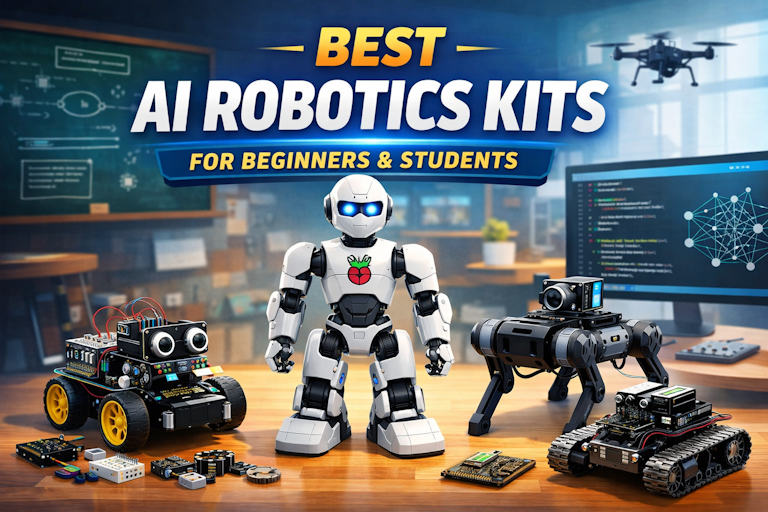
So begin with simple hardware like Arduino, Raspberry Pi, or robotics kits. Add sensors — cameras, LiDAR, radar, and IMUs — to give robots vision and awareness. Then focus on AI algorithms for computer vision: object detection, classification, and tracking using OpenCV, TensorFlow, or PyTorch. Learn step‑by‑step through free courses, YouTube tutorials, and guides at UDHY.com, and build small projects to practice.
🔑 Why It Matters
- Core Hiring Skill: Employers prioritize candidates with computer vision expertise because it directly impacts navigation, safety, and automation.
- Cross‑Domain Relevance: From warehouse automation to self‑driving cars, the same vision algorithms apply across industries.
- Career Accelerator: Even learning the basics of AI vision can help you land entry‑level roles, while advanced mastery opens doors to specialized robotics positions.
📚 What You Must Learn
To stand out, focus on practical mastery of these algorithms and sensor integrations:
- Object Detection: Identify and locate items in real time.
- Classification: Categorize objects for decision‑making.
- Tracking: Follow moving objects across frames for navigation and safety.
- Sensor Fusion: Combine data from cameras, LiDAR, and radar to build robust perception systems.
🚀 Start Today, If You
- Beginner Level: Learn basics of OpenCV and TensorFlow for image processing.
- Intermediate Level: Implement YOLO or Faster R‑CNN for object detection projects.
- Advanced Level: Integrate multi‑sensor fusion for autonomous navigation in complex environments. [Back to Top ↑]
Employers prioritize Robotics and AI candidates with computer vision expertise because it directly impacts navigation, safety, and automation. From warehouse automation to self‑driving cars, the same vision algorithms apply across industries. Even learning the basics of AI vision can help you land entry‑level roles, while advanced mastery opens doors to specialized robotics positions.
III. Control Systems in Robotics and AV Careers
Similar to AI and computer vision, Robotics and control systems are among the five key modules and form the fundamental backbone of AI robotics and autonomous vehicles. Without precise motion planning and reliable control, even the most advanced AI cannot operate safely in real‑world environments. For anyone pursuing a career in robotics, mastering these concepts is non‑negotiable.
To start in Robotics and Control Systems, begin with hardware like Arduino, Raspberry Pi, or robotics kits to practice building and control. Add sensors — cameras for vision, LiDAR for depth, radar for detection, and IMUs for motion tracking — to give robots awareness. Then focus on control algorithms such as PID controllers and Model Predictive Control to ensure smooth, safe movement. Learn step‑by‑step through free online courses, YouTube tutorials, and guides at UDHY.com, and reinforce your skills by building small projects. If you are new to Kinematics & Dynamics and Control Theory, here is basic infos on what & how they are used for:
- Kinematics & Dynamics:
Kinematics: Focuses on how joints, wheels, and robotic arms move in 3D space. It defines position, velocity, and acceleration without considering forces.
Dynamics: Adds the influence of forces and torques, enabling robots to interact with their environment safely and efficiently.
Career Impact: Engineers who understand kinematics and dynamics can design robots that move with precision—whether it’s a humanoid robot walking, a mobile robot navigating terrain, or an industrial robot assembling parts. - Control Theory:
PID Controllers (Proportional–Integral–Derivative): The most widely used method for ensuring smooth and stable movement. PID controllers correct errors in real time, making robots responsive and reliable.
Model Predictive Control (MPC): A more advanced technique that predicts future states and optimizes control actions. MPC is critical for autonomous vehicles, where safety and adaptability are paramount.
Career Impact: Mastery of control theory equips engineers to build robots that move safely, adapt to changing environments, and meet industry standards for automation. [Back to Top ↑]
Robotics companies actively seek Robotics or AI engineers skilled in kinematics, dynamics, and control systems. These skills apply to industrial robots, mobile robots, drones, and humanoid robots. Even a solid foundation in kinematics and PID control can help beginners land entry‑level roles, while advanced MPC expertise opens doors to high‑level AV and robotics positions.
IV. Sensor Fusion in AV & Robotics Careers
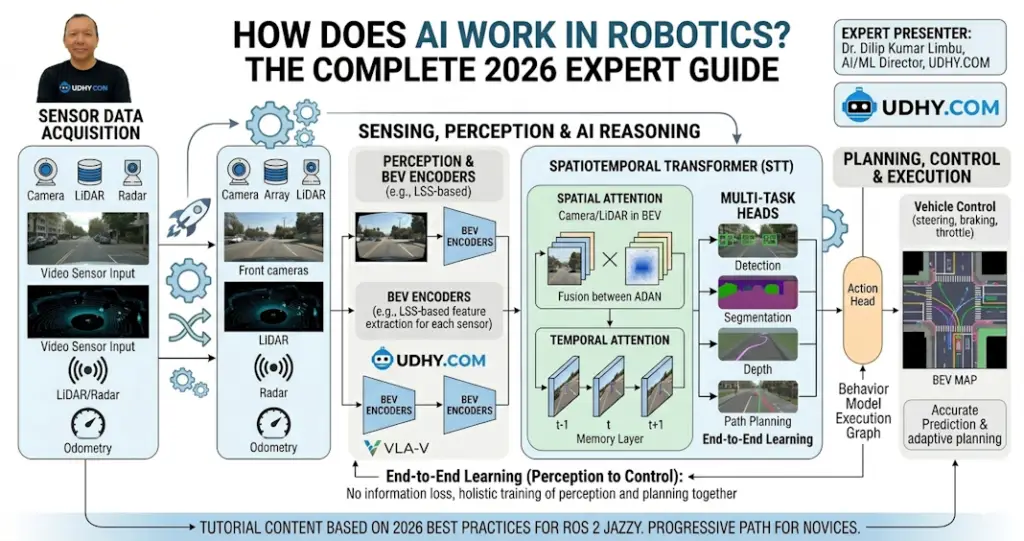
Sensor fusion is one of the most critical and highest‑paid domains in robotics and autonomous vehicles today. It combines LiDAR, radar, and cameras into a unified perception system, enabling robots and AVs to detect, classify, and track objects with accuracy and safety.
Sensor fusion is the core of the perception system in robotics and autonomous vehicles. By synchronizing data streams from multiple sensors, engineers create a single, “true” map of the world that supports navigation, obstacle avoidance, and decision‑making.
To build a career in robotics and autonomous vehicles, mastering Sensor Fusion is essential. You’ll need hardware like Arduino, Raspberry Pi, or NVIDIA Jetson boards, combined with sensors such as cameras for vision, LiDAR for 3D mapping, radar for velocity detection, and IMUs for motion tracking. The next step is learning AI algorithms that fuse these data streams into one reliable “map of the world,” using tools like ROS, OpenCV, TensorFlow, or PyTorch. You can start with free online courses, YouTube tutorials, and detailed guides at UDHY.com to gain hands‑on skills and progress toward industry‑ready expertise. Here some infos on key sensors and how it works;
📡 Key Sensors
- LiDAR: Provides precise 3D mapping of surroundings, essential for object localization.
- Radar: Detects velocity and distance in all weather conditions, making it reliable in rain or fog.
- Cameras: Capture color, texture, and sign recognition, critical for traffic signals and lane markings.
🧩 How Sensor Fusion Works
- Architecture: Sensor fusion can occur at different levels:
- Data‑level fusion: Raw sensor data combined for accuracy.
- Feature‑level fusion: Extracted features merged for richer perception.
- Decision‑level fusion: Independent sensor decisions combined for robust outputs.
- Synchronization: Aligning sensor data streams in time and space is vital to avoid mismatches.
- Pros: Increased accuracy, redundancy, and resilience.
- Cons: High computational cost, complex calibration, and potential latency issues.
Mastering sensor fusion can lead to roles like Perception Engineer, one of the highest‑paid jobs in AV. [Back to Top ↑]
Robotics jobs, like Sensor fusion engineers are among the highest‑paid professionals in robotics and AV, due to the complexity and safety‑critical nature of their work. Skills apply to mobile robots, industrial automation, drones, and humanoid robots. Even basic knowledge of LiDAR, radar, and camera fusion can land entry‑level roles, while advanced expertise in deep learning fusion architectures leads to senior positions.
V. Software Tools and Simulation for Robotics Engineers
In robotics and autonomous vehicles, software tools and simulation environments are the backbone of safe, scalable innovation. Before a robot or AV ever touches the real world, engineers rely on simulation platforms to design, test, and validate algorithms in a controlled digital environment. This reduces risk, accelerates development, and ensures systems are job‑ready.
🔑 Why It Matters
- Safety First: Testing in simulation prevents costly accidents and hardware damage.
- Rapid Prototyping: Engineers can iterate designs quickly without waiting for physical builds.
- Scalability: Simulations allow thousands of scenarios—traffic jams, weather changes, sensor failures—to be tested in hours instead of months.
🛠️ How It Works
- Simulation Platforms: Tools like Gazebo, Webots, CARLA, and ROS (Robot Operating System) provide realistic environments for robotics and AV testing.
- Digital Twins: Create virtual replicas of robots or vehicles to test performance under real‑world conditions.
- Integration: Simulations connect with AI algorithms, sensor fusion modules, and control systems to validate end‑to‑end workflows.
📚 What You Must Learn
- ROS (Robot Operating System): The industry standard for robotics middleware.
- Gazebo/Webots: For physics‑based simulation of robots in 3D environments.
- CARLA: Specialized for autonomous vehicle simulation, including traffic and weather scenarios.
- MATLAB/Simulink: For modeling control systems and kinematics. [Back to Top ↑]
💼 Career Impact
Employers value Robotics or AI engineers who can simulate, test, and validate robotics systems before deployment. Skills apply to industrial robots, drones, humanoid robots, and AV fleets. Mastery of simulation tools signals to recruiters that you can deliver safe, efficient, and scalable robotics solutions.
VI. Embedded for Robotics Engineers
Embedded systems are the hidden backbone of robotics and autonomous vehicles, enabling real‑time control, safety, and efficiency. Mastering them is critical for career growth, as embedded engineers are in high demand and command strong salaries.
To become a robotics engineer, you need strong embedded skills. Start with hardware like Arduino, Raspberry Pi, or STM32 boards to learn microcontroller programming. Add sensors such as cameras, LiDAR, radar, and IMUs to connect real‑world inputs. Then focus on embedded software — C++ for control, Python for AI integration, and real‑time operating systems (RTOS) for scheduling tasks. Students can learn step‑by‑step through free online courses, YouTube tutorials, and detailed guides at UDHY.com, while building small projects to practice hardware‑sensor‑software integration. Here some infos on why and what one should start learning to become Embeded Robotics Engineer:
Why Embedded Systems Are Important
- Core of Robotics & AV: Embedded systems integrate sensors, actuators, and processors to manage real‑time operations in robots and autonomous vehicles.
- Safety & Reliability: They ensure precise control of navigation, braking, and decision‑making in AVs.
- Efficiency: Embedded platforms optimize limited resources, making robots faster and more energy‑efficient.
- Industry Adoption: From healthcare robots to industrial automation, embedded systems are the “brains” behind modern robotics.
🛠️ How to Start Learning
- Foundations: Begin with C/C++ programming and microcontroller basics (Arduino, STM32, Raspberry Pi).
- Real‑Time Operating Systems (RTOS): Learn scheduling, interrupts, and task management.
- Hardware Integration: Practice connecting sensors (LiDAR, radar, cameras) and actuators.
- Simulation Tools: Use MATLAB/Simulink or ROS to model embedded control systems.
- Projects: Build small robots or IoT devices to apply embedded concepts practically. [Back to Top ↑]
Embedded engineers are essential in autonomous vehicles, robotics, aerospace, and IoT, making this one of the most secure career paths. Specialized embedded system roles in AVs and robotics are among the highest‑paid engineering jobs. Skills transfer to consumer electronics, medical devices, drones, and industrial automation. Even entry‑level embedded knowledge can land roles in robotics startups, while advanced expertise leads to senior AV engineering positions.
Quick Comparison: Embedded Systems Career Path
| Level | Skills to Learn | Career Roles |
|---|---|---|
| Beginner | C/C++, Arduino, sensor basics | Junior Embedded Engineer, IoT Dev |
| Intermediate | Operating System (RTOS) is a specialized operating system designed for embedded systems to process data and events with precise, predictable timing constraints, hardware integration, ROS basics | Robotics Engineer, AV Developer |
| Advanced | Multi‑sensor fusion, safety systems, AI | Senior AV Engineer, Systems Architect |
2. Where and What to Do For Careers in Robotics and AV
There are many places to learn AI and Robotics, but at UDHY.com you can get it all for free. Start with UDHY’s step‑by‑step guides, then explore other trusted platforms like Coursera, edX, Udacity, MIT OpenCourseWare, and YouTube tutorials. These sites offer courses on programming, robotics kits, sensors, and AI algorithms — giving students the skills to move from theory into hands‑on projects and career‑ready expertise
| Milestone | Actionable Task | Recommended Platform |
| Foundation | Master Linear Algebra & Deep Learning | Coursera (DeepLearning.AI) |
| Specialization | Enroll in Autonomous Vehicle Engineer Track | UDHY |
| Specialization | Master SLAM & Path Planning | UDHY |
| Simulation | Build a navigation agent in a virtual city | CARLA Simulator |
| Validation | Contribute to an Open Source ROS 2 project | GitHub |
Why I Recommend UDHY for Robotics
For parents and students seeking the most direct route, UDHY stands out because its curriculum is built for real‑world robotics. While many platforms teach general AI, UDHY offers specialized courses for FREE. With over 25+ years in Robotics and Autonomous Vehicles, I know learners need clear, trusted guidance. UDHY.com delivers step‑by‑step resources that connect hardware, sensors, AI, and control systems into one practical path — from beginner kits to advanced algorithms — so students can build projects, gain confidence, and prepare for careers without barriers
3. Advice for Parents and “Deep Tech” Aspirants
AI careers are a marathon of daily gains. Focus on projects, not just certificates — recruiters want to see your algorithms working, not just PDFs. Start with simulation: tools like CARLA let students build a full autonomous driving stack on a laptop before touching a real car. Success comes from discipline: pick your niche (Vision, Planning, or Control), code 90 minutes a day, and follow a structured path like UDHY to avoid “tutorial hell.
4. The Bottom Line
📌 Final Thoughts
To the best of my knowledge, I’ve briefly shared how careers in robotics and autonomous vehicles are shaped by core modules like programming, AI and computer vision, control systems, sensor fusion, simulation, and embedded systems. These domains are not only fundamental to building intelligent machines but also represent some of the highest‑demand and highest‑paid career paths in today’s technology landscape.
I hope you found this overview insightful and motivating. For more detailed guides, tutorials, and expert comparisons, continue visiting UDHY.com—your trusted hub for AI and robotics learning.
👉 If you’d like to connect directly for collaboration, mentorship, or tailored advice, feel free to contact me anytime. Together, we can accelerate your journey into the world of robotics and autonomous systems.
The transition to AI, robotics, and autonomous vehicles is the most rewarding path available to modern engineers. It requires a unique blend of C++, physics, and machine learning. By utilizing specialized platforms like UDHY and building a public portfolio of simulated projects, you can position yourself at the forefront of the autonomous revolution. [Back to Top ↑]
Read more on UDHY’s AI and Robotics insights.
In my next post, I’ll be diving deeper into the Autonomous Vehicle Safety: Challenges, Cybersecurity, and the Road Ahead.
[Read more… ]
About the Author
Dr. Dilip Kumar Limbu Co-Founder, Moovita | Former Principal Scientist, A*STAR | PhD, Auckland University of Technology
Connect via LinkedIn Direct Inquiry.
Disclaimer
The views expressed here are personal and based on 25+ years in the industry, including my work at Moovita. They do not necessarily reflect the views of any organization. [Back to Top ↑]