Humanoid Robot Half‑Marathon Shows Real AI Progress !
In the next 60 seconds, I’ll share highlights from our post on the Humanoid Robot Half‑Marathon in Beijing — covering the record run, the tech behind it, and what it means for the future of robotics.
TL;DR — Quick Insights
- What happened: In April 2026, a humanoid robot completed the Beijing half-marathon course — 21km — making it the first humanoid to finish a public road race alongside human runners.
- What it actually proves: Sustained bipedal locomotion over varied terrain is now solved at a basic level. Battery endurance and thermal management under sustained load are the next engineering frontier.
- What it does NOT prove: That humanoids are ready for unstructured real-world tasks. Running a predetermined road course is far simpler than navigating a kitchen, warehouse, or construction site.
- China’s strategic signal: This event was not just a tech demo — it was a deliberate statement about China’s humanoid robotics capabilities ahead of the US-China physical AI race.
- The useful insight: Focus less on the headline and more on the energy consumption data. A robot that can run 21km is impressive. A robot that can run 21km on a battery pack that fits inside a commercial product is the real breakthrough to watch for.
1. Introduction : Why the Humanoid Marathon Matters for AI
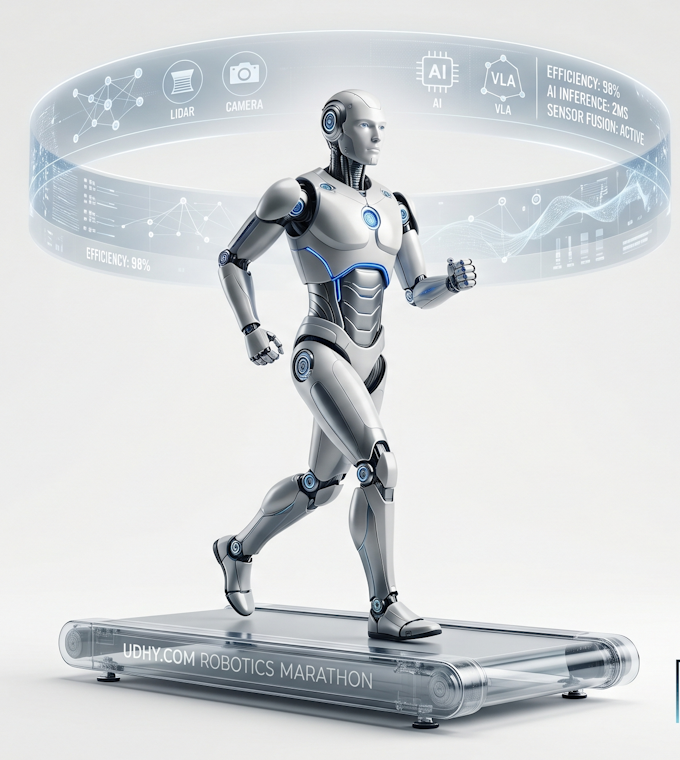
Humanoid robot “Lightning” by Honor stunned the world in Beijing by completing the half‑marathon in 50:26—beating the human world record of 57:20. Analysts hailed it as a breakthrough in robotics, AI, and autonomous vehicles, while also debating its broader significance. Based on my decades in AI, robotics, and AV, I see this as more than speed: it’s a milestone in cooling, locomotion, and autonomy that signals where robotics is heading. it was a race against System-Wide Resilience.
2. Event Overview
- Date & Place: April 19, 2026, Beijing E‑Town Half‑Marathon.
- Winner: Honor’s humanoid robot Lightning, autonomous navigation, time 50:26.
- Comparison: Human world record (Jacob Kiplimo, 57:20) was surpassed by nearly 7 minutes.
- Scale: Over 300 robots from 26 brands, up from 21 teams in 2025.
As shown in table below, key participants included Honor, Unitree, Xiaomi, and Tiangong Ultra, with Honor’s “Lightning” sweeping the podium.
| Company / Brand | Notable Robot(s) | Highlights |
|---|---|---|
| Honor (China) | Lightning | Won the race in 50:26, beating human world record. Honor swept the top 3 positions. |
| Unitree Robotics (China) | H1 | Focused on sprint milestones; used ice‑filled backpacks for cooling. |
| Xiaomi (China) | Humanoid prototypes | Competed among the 26 brands, showcasing consumer‑tech crossover. |
| Tiangong Ultra (China) | Tiangong Ultra 2026 | Featured prominently; drew media attention as a flagship humanoid. |
| Other Chinese Robotics Firms | Multiple entries | Expanded participation compared to 2025, reflecting national push in humanoid R&D. |
| International Teams (5 overseas) | Various models | Represented global interest, though Chinese firms dominated results. |
Key Observations
- Scale: The event grew nearly 5× from 2025, with 300+ robots vs. 21 teams last year.
- Autonomy: About 40% of robots navigated autonomously, a major leap in SLAM and navigation.
- Cooling Innovation: Honor’s liquid cooling and Unitree’s ice backpacks highlight thermal management as a frontier.
- Global Divide: Analysts noted China’s aggressive racing vs. Tesla’s Optimus mascot role in Boston, underscoring different strategies.
As someone who has spent decades troubleshooting actuator failures, I can tell you that the Beijing race proved a breakthrough in Thermal Equilibrium. In traditional humanoids, continuous high-torque output leads to ‘Thermal Throttling,’ where the robot must slow down to prevent motor burnout. Lightning’s liquid-cooled infrastructure suggests we can now run high-power density motors at 100% duty cycles for hours—a prerequisite for 24/7 autonomous logistics.
3. What the Industry is Saying
- Rapid Progress: Analysts at Yahoo and Forbes noted robots improved from 2h40m in 2025 to 50m in 20261, a 3× leap in one year.
- Cooling Innovation: Honor used liquid cooling adapted from smartphones, while Unitree tested “ice backpacks” for thermal management2.
- Autonomy Gains: About 40% of robots navigated autonomously, showing advances in SLAM and obstacle avoidance.
- Global Divide: Commentators contrasted China’s aggressive racing with Tesla’s use of Optimus as a mascot in Boston, highlighting different strategic approaches3.
- Skepticism: CNBC and Straits Times noted that while athletic feats are impressive, industrial dexterity and economic viability remain unsolved challenges4.
4. My Opinion
The 2026 Beijing marathon was not a victory of hardware or software. It was a victory of Cohesive Orchestration. These above views are all valid and here I see three critical takeaways:
- Locomotion as Stress Test: Running 21 km at record pace is not about racing—it’s about proving joint durability, actuator endurance, and balance under repetitive stress. This is invaluable for industrial robots that must withstand millions of cycles.
- Thermal Management Breakthrough: The liquid cooling system is the real victory. Heat dissipation is the Achilles’ heel of humanoid robots. Honor’s adaptation from consumer electronics shows how cross‑industry innovation accelerates robotics.
- Autonomy Matters More Than Speed: The fact that nearly half the robots ran without remote control is the true milestone. In AV systems, autonomy under unpredictable conditions is the hardest frontier. Beijing’s race was a real‑world SLAM test at scale.
Navigating at 5km/h (walking) is a solved problem. Navigating at 25km/h (Lightning’s pace) is an entirely different beast. At these speeds, the ‘Latency Gap’ between LiDAR scanning and motion planning becomes critical. My experience tells me that Honor likely utilized a Predictive Temporal Alignment algorithm—essentially allowing the robot to ‘hallucinate’ the next 10 meters of terrain based on sparse sensor data to compensate for processing lag.
5. Risks & Challenges
- Generalization Gap: Robots trained for a marathon course may not adapt to factory floors or disaster zones.
- Dexterity Deficit: Fine motor control (handling tools, fragile objects) remains unsolved.
- Economic ROI: Until humanoids reach $50k–$80k price parity with industrial cobots, commercialization is limited.
6. Conclusion
The Beijing humanoid half‑marathon was not just a spectacle—it was a stress test for robotics innovation. Analysts celebrated speed, but the deeper story is about autonomy, cooling, and durability. From my decades in AI and AV, I believe this event marks a turning point: humanoid robots are moving from lab prototypes to real‑world utility, with implications for manufacturing, logistics, and emergency response.
7. The Humanoid Robot Half‑Marathon in Beijing: 10 Frequent Questions
Footnote :
- Beijing’s Humanoid Robot Marathon: What It Means For Robots … And Us ↩︎
- Beijing Humanoid Half-Marathon: Honor Sweeps Podium as Robots Shatter Human World Record ↩︎
- Beijing Humanoid Half-Marathon: Honor Sweeps Podium as Robots Shatter Human World Record ↩︎
- A non-human race: Beijing half-marathon shows how far robots have come ↩︎
Read more on UDHY’s AI and Robotics insights.
In my next post, I’ll be diving deeper into the specific on 10 Best AI Coding Tools in 2026: The Ultimate Developer’s Guide. Stay tuned to learn more about the “digital brain” behind the wheel!
About the Author
Dr. Dilip Kumar Limbu Co-Founder, Moovita | Former Principal Scientist, A*STAR | PhD, Auckland University of Technology
Connect via LinkedIn Direct Inquiry.
Disclaimer
The views expressed here are personal and based on 25+ years in the industry, including my work at Moovita. They do not necessarily reflect the views of any organization.