Humanoid Robots 2026: Figure vs Atlas vs Optimus vs Unitree G1
About the Author
I am Dr. Dilip Kumar Limbu — former Principal Investigator and Research Scientist at ASTAR’s Institute for Infocomm Research (I²R), Singapore, where I spent over 16 years developing AI, robotics, and autonomous vehicle systems from the ground up. I co‑founded Moovita Pte. Ltd., Singapore’s first autonomous vehicle company.
With 25+ years of hands‑on experience in AI, robotics, and autonomous vehicle deployment — from sensor fusion and SLAM to edge AI inference on real hardware — I’ve seen humanoid robots move from university labs to BMW factory floors in just three years.
In this post, I’ll share what the specifications don’t tell you is often more important than the specifications themselves: the real engineering differences between platforms, and which robots matter most depending on your goals.
Last updated: August 2026
Humanoid robot specifications, pricing and deployments are changing rapidly. This comparison is updated as new information becomes publicly available.
In 60 seconds — what this post will tell you : Humanoid robots have moved from science fiction to factory floors faster than the iPhone’s development cycle. Figure AI’s robot works at BMW, Boston Dynamics’ Atlas at Hyundai, Tesla’s Optimus at Fremont, and Unitree’s G1 — one of the few commercially available humanoid robots that researchers and developers can purchase directly — runs half‑marathons. Yet behind the headlines, each tackles different engineering problems, bets on different AI approaches, and targets different markets. Choosing where to build, research, or invest requires understanding those engineering differences — not just the press releases. This is that breakdown, drawn from 25+ years of building autonomous systems.
TL;DR — Quick Insights
- Figure AI is among the most advanced platforms in publicly demonstrated AI-driven manipulation and language-guided task execution — its Helix VLA architecture (co-developed with OpenAI) gives it natural language instruction-following that no other humanoid platform can match in 2026.
- Boston Dynamics Atlas remains one of the strongest publicly demonstrated platforms for dynamic locomotion and whole-body control — 20+ years of legged robotics research produces movement that is genuinely human-like in ways that camera demos simply do not convey.
- Tesla Optimus Gen 3 has the largest scale potential — Tesla’s manufacturing capacity means it can produce robots at a volume no other company can approach, which matters enormously for the economics of humanoid deployment.
- Unitree G1/ G1 EDU is one of the few commercially available humanoid robots that researchers and developers can purchase directly at estimated ~$$13,500 USD (industry estimate; not publicly confirmed) — making it the default platform for researchers, universities, and developers who need hands-on hardware access.
- All four face the same fundamental bottleneck: the Physical AI data gap. There is not enough robot training data in existence to make any of them general-purpose. The company that solves this first wins the decade.
- The skills that matter for working with these platforms: ROS 2, VLA model fine-tuning, sim-to-real transfer, and edge AI deployment. All covered free at UDHY.com.
Which humanoid robot is best?
| AI & manipulation | Figure AI |
| Dynamic locomotion | Boston Dynamics Atlas |
| Manufacturing scale | Tesla Optimus |
| Research & affordability | Unitree G1 |
| Buying a robot today | Unitree G1 |
| Heavy industrial tasks | Atlas |
| Academic research | Unitree G1 |
| Long-term mass-market potential | Tesla Optimus |
Important: These are engineering judgments, not manufacturer rankings. Performance varies by software version, hardware configuration, task and operating environment.
1. Why 2026 Is the Year That Changes Everything for Humanoid Robots
Three years ago, humanoid robots were expensive, fragile, laboratory curiosities. Today they are assembling vehicles at BMW’s Spartanburg plant, sorting packages at logistics hubs, and — in the case of Unitree’s G1 — running a half-marathon in Beijing’s E-Town district at 3:37 per kilometre. The transition from research to production has been faster than almost anyone in the field predicted.
Having spent 25+ years building robots and autonomous systems — from the early days of computer vision research at A*STAR to deploying full-scale autonomous bus systems at MooVita — I can tell you that what is happening in humanoid robotics right now is not hype. It is a genuine inflection point driven by three converging developments: Vision-Language-Action (VLA) models that give robots the ability to interpret natural language instructions and translate them into physical actions; massive investment that has put billions of dollars into hardware iteration that previously would have taken decades; and real factory deployments that are generating the kind of operational data that actually improves these systems faster than any simulation can.
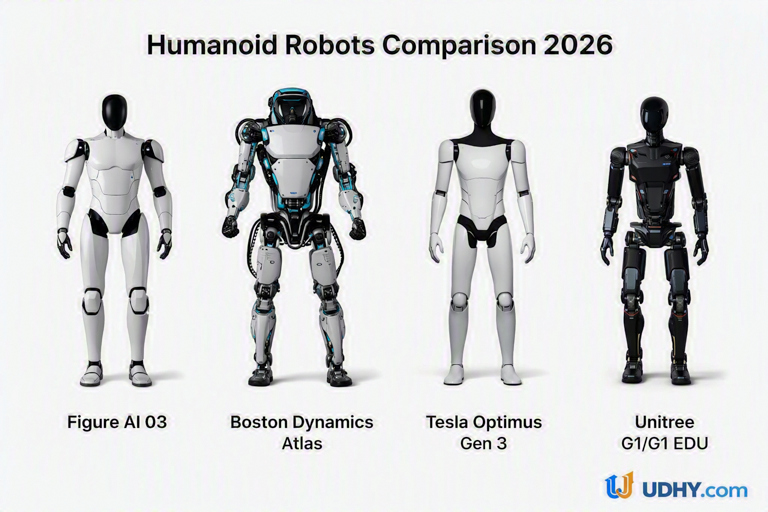
But not all humanoid robots are created equal. The four platforms I will analyse in this post — Figure AI 03, Boston Dynamics Atlas, Tesla Optimus Gen 3, and Unitree G1/ G1 EDU — are making fundamentally different engineering and commercial bets. Understanding those bets is the foundation of everything else in this space.
2. The 2026 Comparison: Full Specifications
Let me start with the data. The following table summarizes publicly disclosed specifications and UDHY engineering estimates available in mid-2026. Where manufacturers have not published a specification, the figure is identified as an estimate.
Why trust this comparison?
This analysis is written from more than 25 years of hands-on experience in AI, robotics and autonomous systems, including research at A*STAR and autonomous vehicle deployment through Moovita. Rather than comparing marketing specifications alone, this article evaluates the engineering trade-offs behind perception, sensing, locomotion, manipulation, AI and real-world deployment. Want to understand how these systems actually work — perception, AI decision-making, locomotion, manipulation, and power — before diving into the comparison? Read our companion breakdown: Figure vs Tesla vs Atlas: Which Robot Actually Works? (5-System Architecture Explained)
Table : The Ultimate 2026 Humanoid Robot Comparison: Figure 03 vs. Atlas vs. Optimus Gen 3 vs. Unitree G1
| Specification | Figure AI 03 | Boston Dynamics Atlas | Tesla Optimus Gen 3 | Unitree G1 / G1 EDU |
| Height | 1.68 m (5’6″) | 1.9 m (6’2″) | 1.73 m (5’8″) | 1.32 m (4’4″) |
| Weight | 61 kg (134 lbs) | 90 kg (198 lbs) | 57 kg (125 lbs) | 35 kg (77 lbs) |
| Degrees of Freedom | 48+ full-body DoF with dexterous palm-camera hands | 56 DoF with 360° continuous rotational joints | 28 full-body DoF + 22 DoF per hand (50 hand/forearm actuators total) | 28 full-body DoF + 22 DoF per hand (50 hand/forearm actuators total) |
| Walking Speed | ~1.2 m/s (4.3 km/h) | 2.5 m/s (9 km/h) (demonstrated operation) | ~1.4 m/s (5 km/h) | 2.0 m/s (7.2 km/h) |
| Payload Capacity | ~20 kg (44 lbs) | 50 kg (110 lbs) instant / 30 kg sustained | ~20 kg (45 lbs) close to torso | 2 kg per arm (3 kg for EDU); 40+ kg leg load |
| Battery / Runtime | ~5 hours | 4 hours standard (Features a 3-min autonomous hot-swap mechanism) | ~2 to 4 hours (Powered by 4680 cylindrical cell packs) | ~2 hours max |
| AI Architecture | Proprietary Helix 2 “Three-Brain” neural system + OpenAI integration | Orbit software suite + NVIDIA Jetson Thor physical intelligence computing | End-to-end Vision-Language-Action (VLA) networks running on Tesla AI5 Chips | Open-source SDK supporting NVIDIA LeRobot, Reinforcement Learning frameworks |
| Primary Sensors | 6 onboard cameras + microphone array + high-res palm cameras | 360° depth cameras, LiDAR, and integrated hand/palm tactile arrays | 2D/3D visual cameras, millimeter-level fingertip tactile arrays | 3D LiDAR, depth cameras, and high-frequency force-control joints |
| Current Deployment | 40-unit active commercial fleet deployed at the BMW Spartanburg Plant | In-production pilot testing across Hyundai Automotive and Google DeepMind lines | Preparing for initial production and factory deployment at Tesla Fremont and Giga Texas | Active commercial trials (e.g., Haneda Airport baggage handling) and law enforcement |
| Commercial Availability | Commercial enterprise leasing only; billed at ~$25/operating hour | Restricted to enterprise partners via Boston Dynamics Sales; no retail pricing | Internal corporate fleet only; public enterprise sales targeted for 2027 | Publicly purchasable: Base model is estimated ~$13,500 USD; full programmable EDU developer kit is $43,900 (industry estimate; not publicly confirmed) |
| Best For | High-precision dexterous assembly and multi-step complex warehouse picking | Heavy-duty, high-payload factory logistics requiring 24/7 autonomous uptime | Large-scale mass production lines utilizing existing visual AI driving tech | Academic research, low-budget embodied AI software training, and rapid prototyping |
| Verdict | Most capable AI – Holds the gold standard for conversational speech-to-action factory work | Best locomotion – Unrivaled in structural ruggedness, pure mechanical torque, and continuous operational agility | Largest scale potential – Possesses the highest ultimate roof for cost reduction due to automotive supply chains | The most accessible commercially listed humanoid platform in this comparison that successfully democratized global robotics research |
Before I go deeper into each platform, one number in that table deserves immediate attention: only the Unitree G1 is available for open purchase, starting at approximately ~$13,500 USD (industry estimate; not publicly confirmed). Every other platform in this comparison requires a closed enterprise agreement, a major automotive manufacturing partnership, or an internal corporate deployment relationship.
This is not a minor footnote — it is the defining commercial reality of humanoid robotics. While Unitree actively sells its hardware to global universities, academic research labs, and software developers, the broader industry is not yet selling units to individual consumers or small companies
2.1. Figure AI 03 — The AI-First Platform
What makes it different
Following the success of Figure 02’s initial deployment at BMW’s Spartanburg, South Carolina facility, Figure AI introduced Figure 03. This production-ready upgrade scales operations, representing a massive milestone for startup-led humanoid deployment in heavy manufacturing. The defining technical decision behind this platform is the Helix 2 “Three-Brain” Vision-Language-Action (VLA) model, co-developed with OpenAI and running entirely on the robot’s onboard compute. Complemented by high-resolution palm cameras, Helix 2 allows the robot to process natural language instructions—such as “pick up the red component and place it in the bin to your left”—and execute them seamlessly without pre-programmed task definitions.
From an autonomous systems engineering perspective, this is the correct long-term architectural bet. The critical limitation of every previous generation of industrial robot was its reliance on explicit, hardcoded programming for every distinct motion profile. VLA models completely remove that ceiling by mapping language and visual perception directly into physical motor actions. A robot that inherently understands language can, in principle, be retasked with a single spoken sentence. This shifts the humanoid robot from a piece of specialized, single-purpose machinery into a highly adaptable, general-purpose labor asset unlike any product that came before.
Engineering strengths
- True Vision-Language-Action Integration — Operates without brittle, pre-programmed waypoints by translating real-time sensory data and spoken language directly into physical motor control.
- Exceptional Dexterity and Coordination — High-resolution palm-integrated cameras combined with advanced tactile fingers allow for delicate handling of varying objects on active factory lines.
- Helix 02 Full-Body Autonomy — Figure’s unified Vision-Language-Action system connects perception, movement and reasoning across the entire robot, enabling whole-body loco-manipulation.
- Seamless Human-Robot Collaboration — Features low-latency, OpenAI-driven verbal communication, making it highly intuitive for factory floor workers to interact with and supervise.
Honest limitations
- Restricted Weight Capacity — A payload limit of approximately 20 kg (44 lbs) restricts the platform from handling heavy industrial parts, chassis elements, or large crates.
- High Environmental Novelty Penalty — Suffers performance drops or slower execution speeds when introduced to unmapped factory layouts or unfamiliar object shapes without prior training data.
- Prohibitive Unit Economics — High manufacturing and sensor costs limit its viability to wealthy, Tier-1 enterprise leasing agreements, keeping it out of reach for smaller operations.
- Thermal and Compute Bottlenecks — Running massive VLA models locally on onboard hardware generates immense heat and drains battery life rapidly during intensive, multi-step manipulation tasks.
My expert assessment: Figure AI’s 03 platform demonstrates advanced capabilities through the Helix 2 onboard system for direct natural language motor control and superior hand-eye coordination for complex manipulation tasks. However, the system faces limitations regarding a roughly 20kg payload capacity, significant data dependency for new environments, and high operational costs.
Figure AI 03 has made the right long-term architectural bet with Helix 2 as the most sophisticated AI system in a commercial humanoid platform, but closing the data gap for universal application remains a challenge. The Figure AI 03 fleet is the platform to watch for AI sophistication and cognitive flexibility.
2.2. Boston Dynamics Atlas — The Locomotion Standard
Two decades of accumulated expertise
Boston Dynamics has been building legged robots since 2005. The original BigDog, Spot, Handle, and the early Atlas iterations represent 20+ years of direct engineering iteration on the hardest problem in humanoid robotics: making a biped move reliably through an unpredictable physical world. The 2024 fully electric Atlas (retiring the hydraulic version) is the culmination of that accumulated expertise, and the locomotion it demonstrates — backwards walking, precise foot placement on complex terrain, standing after being knocked down — is still the best in the industry.
Having worked on autonomous navigation systems at A*STAR and MooVita, I can tell you that locomotion is harder than it looks in the demos. The physics of bipedal balance, the latency between sensor input and actuator response, the mechanical tolerances that allow fluid movement — these are not engineering problems you solve by writing better software. They require physical iteration over years. Boston Dynamics has done that iteration. The other platforms have not, yet.
Engineering strengths
- Unmatched Physical Intelligence — Features 56 degrees of freedom with continuous 360° rotational joints, giving it unmatched range of motion and mechanical agility.
- Heavy-Duty Industrial Payload — Easily handles a 50 kg (110 lbs) instantaneous payload, making it particularly well suited to heavy industrial material handling and automotive manufacturing tasks.
- Continuous 24/7 Fleet Runtime — Utilizes a 3-minute autonomous, hot-swappable battery system that allows fleets to run continuously without docking downtime.
- Extreme Environmental Ruggedness — Features a fully sealed IP67-rated chassis built to withstand harsh, dusty, and damp industrial environments that would short-circuit other humanoids.
Honest limitations
- Developing AI stack — Atlas is increasingly incorporating learned behaviors and foundation-model-based capabilities, but its commercial AI stack remains more enterprise-controlled than open developer platforms.
- No Direct Public API — The platform is strictly locked behind exclusive enterprise partnerships, meaning independent developers cannot access its hardware or software.
- High Acoustic Signature — The extreme-torque custom actuators generate significant mechanical noise compared to the near-silent operation of its competitors.
- Overengineered for Simple Tasks — Its massive strength and weight make it an inefficient, expensive choice for basic tasks like light bin-picking or barcode scanning.
My expert assessment: Boston Dynamics remains the undisputed king of raw kinetic intelligence and structural engineering. While startups scramble to teach robots how to chat, Atlas is solving the brutal physics of continuous, high-payload industrial labor. Its 360-degree joint mechanics and autonomous hot-swap capabilities make it a true 24/7 industrial tool. However, its heavy reliance on structured spatial trajectories means it lacks the loose, adaptive cognitive reasoning seen in VLA-first platforms. Atlas is the definitive choice if your bottleneck is moving heavy steel on a rugged factory floor, but it is not a platform designed for open-ended semantic reasoning.
2.3. Tesla Optimus Gen 3 — The Scale Play
Why scale changes everything
Tesla’s entry into humanoid robotics is not primarily an engineering story. It is a manufacturing story. Tesla produces approximately 1.8 million vehicles per year. Its Gigafactories are among the most advanced automated manufacturing facilities on earth. When Tesla says it plans to produce 1,000 Optimus units by the end of 2025 and millions by 2030, the credential behind that claim is not a robotics research history — it is a proven track record of manufacturing at volume.
Tesla Optimus Gen 3 uses the same camera-only, vision-first AI philosophy that powers Tesla’s Full Self-Driving system — a deliberate architectural decision that eliminates the cost and complexity of LiDAR while betting on end-to-end neural network learning to compensate. The FSD neural stack, combined with a VLA-inspired manipulation layer, gives Optimus a unique advantage: it can learn from the fleet. Every Optimus unit operating in a Tesla factory generates training data that improves every other unit. This is the same data flywheel that makes Tesla’s FSD system improve over time.
Engineering strengths
- Industry-Leading Dexterity — Features a 22-DoF hand mechanism driven by high-speed fore-arm actuators, allowing it to mimic human finger precision flawlessly.
- Massive Manufacturing Scalability — Leverages Tesla’s existing automotive supply chains, battery cell manufacturing, and custom AI5 inference chips to aggressively lower per-unit costs.
- Unified Visual AI Ecosystem — Runs on the same end-to-end Vision-Language-Action (VLA) networks used in Tesla’s Full Self-Driving vehicle fleet, bypassing the need for expensive LiDAR sensors.
- Optimized Weight-to-Power Ratio — Weighs a highly efficient 57 kg (125 lbs) while maintaining human-like walking speeds and structural balance
Honest limitations
- Data Island Bottleneck — The platform is trained almost exclusively on internal Tesla factory data, creating unknown performance gaps when deployed in non-automotive environments.
- Purely Internal Distribution — Zero public or external commercial availability; units are strictly reserved for Tesla’s internal factory lines until at least 2027.
- High Tactile Sensor Wear — The hyper-delicate millimeter-level fingertip sensor arrays require frequent maintenance and calibration under repetitive factory strain.
- Complete Vision Dependency — Lacks secondary sensor redundancies like LiDAR, leaving the robot vulnerable to tracking failures in low-light or smoke-filled environments.
My expert assessment: Tesla is playing a massive scaling game that no other robotics company can match. With the Gen 3 hand mechanism, they have achieved near-human mechanical dexterity, and by running on the AI5 silicon and FSD infrastructure, they bypass the need for expensive sensor suites. The true genius here isn’t just the hardware—it is the underlying automotive supply chain that will allow Tesla to manufacture these at a fraction of the competitor’s cost. But do not mistake factory testing for a finished product; Optimus is heavily over-fit to Tesla’s own production lines, and its absolute reliance on pure vision makes its adaptability in chaotic, unmapped third-party environments a major unproven variable.
2.4. Unitree G1/ G1 EDU — The Platform You Can Actually Use
Among the most accessible full-size humanoid platforms available for direct purchase by researchers and developers. Unitree Robotics is a Chinese robotics company that has done something none of its better-funded competitors have managed: made a humanoid robot available for purchase at a price researchers and developers can actually justify.
The Unitree G1 at approximately ~$13,500 USD (industry estimate; not publicly confirmed) is not the most capable humanoid in this comparison on any single specification. It does not have Figure’s AI sophistication, Atlas’s locomotion quality, or Tesla’s scale potential. But it has something none of those platforms offer: you can order one, receive it, and start building on it. For the robotics research community, that is not a minor advantage. That is the entire game.
The G1’s technical headline in 2026 was its half-marathon completion at the Beijing E-Town Humanoid Robot Half Marathon Competition — covering 21.0975 km with a pace of approximately 3:37 per kilometre. For a platform at this price point, that locomotion durability is genuinely impressive and demonstrates that Unitree’s hardware reliability has matured.
Engineering strengths
- Unbeatable Cost-to-Performance Ratio — At a starting estimated price of ~$13,500 USD (manufacturer-listed starting price; configuration dependent), it has completely democratized the humanoid robotics market for universities and startups.
- Ultra-Compact and Safe Form Factor — Standing at just 1.32 m (4’4″) and weighing 35 kg, it is incredibly easy to transport, reset, and operate safely in small labs.
- Fully Open-Source Software Stack — The EDU version fully supports open SDKs like NVIDIA LeRobot, allowing developers to write custom reinforcement learning models natively.
- High Leg Structural Resilience — Capable of high-speed 2.0 m/s walking speeds and deep-squatting maneuvers that outperform many full-sized robots.
Honest limitations
- Severely Limited Upper-Body Payload — A meager 2-3 kg arm capacity makes it entirely unviable for meaningful industrial material handling or manufacturing.
- Short Battery Endurance — The compact frame limits battery capacity to a strict 2-hour maximum, requiring frequent manual battery swaps.
- No Out-of-the-Box General Intelligence — The base model ships with minimal native operational software, forcing the buyer to build or source their own AI vision and navigation pipelines
My expert assessment: Do not let the small stature or the estimated sub-$15,000 price tag fool you—the Unitree G1 is the most disruptive platform in the humanoid ecosystem. By sacrificing heavy payload capabilities, Unitree has successfully democratized humanoid hardware, giving thousands of academic labs and independent developers an open-source sandbox to train embodied AI. It is completely unsuited for heavy industrial labor, and you will spend a lot of time writing your own baseline software. Yet, because it lowers the financial barrier to entry by an order of magnitude, the G1 is where the next breakthrough in reinforcement learning and open-source control models is actually going to be discovered.
3. The One Problem All Four Share — and Why It Matters
Every platform in this comparison — from Figure’s Helix VLA to Atlas’s RL locomotion stack to Optimus’s camera-only neural network — is constrained by the same fundamental bottleneck: the Physical AI data gap.
GPT-4 trained on approximately 13 trillion tokens of text — data that already existed on the internet. The world’s available physical robot interaction data remains tiny compared with the enormous datasets used to train modern language and vision models. You cannot scrape robot training data from a website. Every interaction a robot needs to learn from requires a real robot, in a real environment, physically doing something, with that interaction recorded and labelled.
This is why even the most sophisticated humanoid platforms in 2026 — platforms with hundreds of millions of dollars of engineering behind them — still fail on tasks that a human child masters in months. Folding laundry, opening a novel door handle, recovering from an unexpected object placement — these require training data diversity that does not yet exist at the scale these systems need.
Three approaches are being raced simultaneously to close this gap: teleoperation at scale (humans teaching robots by remote control, generating labelled training data at the pace of human demonstration); simulation and digital twins (generating synthetic training data in physically accurate virtual environments); and foundation models for robotics (training large models on diverse sensorimotor data to generalise to new tasks). None has fully solved the problem yet. The company that does will define the next decade of physical AI.
Expert Perspective — The data gap is not a software problem. It is not something you solve by hiring more engineers or raising more money. It is a fundamental physics problem: generating diverse, high-quality physical interaction data at the scale neural networks require takes time and physical hardware, and no amount of compute budget changes that. What changes the timeline is the right combination of simulation quality (closing the sim-to-real gap) and structured teleoperation data collection. The labs making the most progress in 2026 are the ones treating data collection as the primary engineering challenge, not the secondary one.
4. The Skills You Need to Work With These Platforms
Whether you are a researcher wanting to contribute to humanoid robotics, an engineer looking to transition into the field, or a company evaluating deployment options, the technical skills required are consistent across all four platforms. From 25+ years of building these systems, here are the capabilities that matter most in 2026:
4.1. ROS 2 — the universal middleware
ROS 2 (Robot Operating System 2) is widely used across humanoid robotics research and development, particularly in open and academic platforms. Commercial platforms may use proprietary middleware and internal software stacks. For researchers and developers, ROS 2 remains one of the most valuable robotics middleware skills to learn.
4.2. VLA model fine-tuning
OpenVLA-7B is open source and runs on Unitree G1 hardware. Fine-tuning a VLA model for a specific manipulation task — using LoRA adapters on domain-specific demonstration data — is now the standard approach for deploying natural language-controllable robots. Understanding the full pipeline from data collection to model fine-tuning to edge deployment is a rare and extremely valuable skill.
4.3. Sim-to-real transfer
NVIDIA Isaac Sim and Gazebo are the two dominant simulation environments for humanoid robot development in 2026. The ability to design, train, and validate a policy in simulation before deploying on physical hardware reduces development time and hardware damage dramatically. The engineering skill of closing the sim-to-real gap — making a simulated policy work on a real robot — is one of the most sought-after capabilities in the industry.
4.4. Edge AI deployment
All four platforms in this comparison run their AI inference on-device. Quantization (AWQ INT4, GPTQ), model optimisation for NVIDIA Jetson-class hardware, and real-time inference pipeline design are practical skills that translate directly to building deployable humanoid AI systems.
Want to Build Humanoid Robots?
Learn the engineering foundations behind modern robotics — ROS 2, SLAM, perception, reinforcement learning, VLA models, simulation and edge AI.
Start learning with UDHY’s Robotics & AI courses →
– ROS 2 Jazzy Tutorial for Beginners 2026
– Vision-Language-Action (VLA) Models: Production Guide
– What Is Physical AI?
– AI Robotics Engineer Salary 2026
– Expert Robotics Track (ROS 2, SLAM, RL)
5. Conclusion — What the Next 3 Years Look Like
Humanoid robots are no longer a research curiosity. They are rapidly becoming active production infrastructure—as seen across the factory floors of BMW, Hyundai, and Tesla. The platforms that dominate the remainder of this decade will not necessarily be the ones boasting the highest peak hardware specifications today. Instead, the winners will be determined by three critical pillars: who solves the real-world data gap first, who builds the most vibrant developer ecosystem, and who achieves the manufacturing scale required to make broad commercial deployment economically rational for tier-two industries.
Based on my years of experience building autonomous systems, the landscape is clearly stratified. Figure AI 03 holds the lead in multi-step cognitive AI sophistication, Boston Dynamics remains unmatched in raw mechanical locomotion and ruggedness, Tesla possesses an unassailable vertical integration and manufacturing scale advantage, and Unitree completely dominates the accessibility and rapid prototyping market.
Yet, all four titans face the exact same fundamental bottleneck: the data wall. The company that successfully closes this gap first—whether through hyper-realistic simulation-to-real transfer, massive teleoperation datasets, or breakthrough architectural generalisation in foundation models—will dictate the next decade of physical AI.
The engineers who truly understand this landscape at the technical level are among the most valuable assets in tech right now. The industry is starving for talent that can orchestrate ROS 2 networks, fine-tune massive Vision-Language-Action (VLA) models, build robust sim-to-real pipelines, and optimize edge AI directly on Jetson Thor or custom ASIC hardware. Fortunately, these highly sought-after skills are entirely learnable, and the foundations can be accessed for free at UDHY.com.
6. FAQs — Humanoid Robots 2026
About the Author
Dr. Dilip Kumar Limbu Co-Founder, Moovita | Former Principal Scientist, A*STAR | PhD, Auckland University of Technology
Connect via LinkedIn Direct Inquiry.
Disclaimer
The views expressed here are personal and based on 25+ years in the industry, including my work at Moovita. They do not necessarily reflect the views of any organization.
Enjoying this post? Subscribe to get more AI insights.