Beyond RoboTaxi : The Rise of Micro-Autonomous Zones are the $2 Trillion Winner of 2026
In 30 seconds: This article explains The Rise of Micro‑Autonomous Zones—a new mindset for AV deployment. The message is simple: Don’t try to solve the world. Solve the Zone.
TL;DR — Quick Insights
- The big idea: The $2 trillion AV opportunity in 2026 is not full city-wide self-driving — it is Micro-Autonomous Zones (MAZs): defined, controllable environments where AV deployment is economically viable right now.
- Why MAZs win: Airports, university campuses, industrial parks, and port terminals are already controlled enough for AVs to operate reliably without city-scale mapping or regulation.
- The Moovita lesson: Deploying narrow and deep — specific geographies, maximum reliability — beats broad and shallow every time in commercial AV.
- Who’s doing it: Singapore’s Sentosa, Dubai’s Expo City, and dozens of global campuses are live MAZ deployments proving the model works today.
- Investment signal: MAZ infrastructure — HD mapping, kerb management, V2X — will attract more capital in 2026–2028 than full Level 5 robotaxi projects.
The Vision vs. The Reality
In 2014, I was standing on a humid strip of asphalt in Singapore, clutching a laptop and watching a modified electric cart crawl at 5 km/h. At that time, “Autonomous Vehicles” (AVs) weren’t a Silicon Valley buzzword; they were a series of expensive, crashing prototypes.
I’ve spent the last 18 years in the trenches of this industry. I was part of the first team to put an AV on the public roads of Singapore and Malaysia. I’ve seen the transition from academic curiosity to the founding of Moovita, where we now deploy commercial autonomous fleets.
But if you want the truth about why you aren’t seeing a RoboTaxi on every street corner in 2026, we have to talk about the things the glossy brochures hide: The failures. Before we dive into the wreckage, let’s define the two players in this $2 trillion war:
- Robotaxi: A fully autonomous (Level 4/5) ride-hailing vehicle designed to operate anywhere a human can drive. Think of it as an “Uber without a driver”—an AI that must handle everything from San Francisco fog to unpredictable pedestrians.
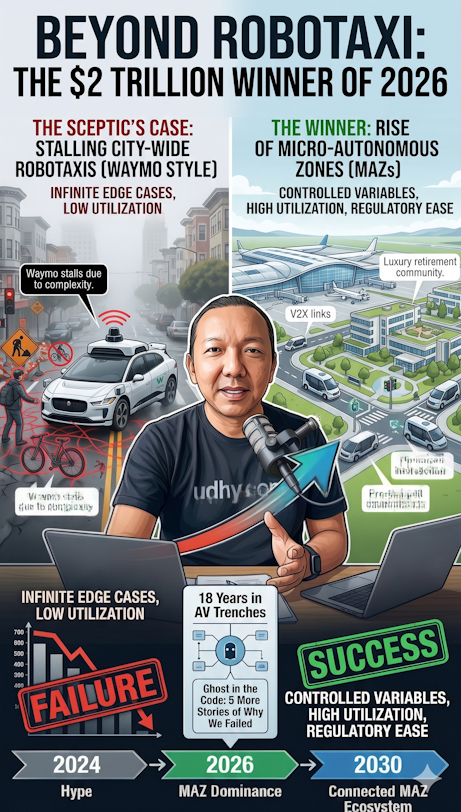
- Micro-Autonomous Zones (MAZs): Specialized, geofenced “islands” of autonomy. Instead of trying to master the entire world, MAZs optimize a specific environment—like an airport, a corporate campus, or a luxury retirement community—where the infrastructure is “smart” and the variables are controlled.
In this guide, I will cover:
- The “Ghost in the Code”: 5 more stories of why we failed (and the hard lessons learned).
- Why Robotaxis are “Stalling” in 2026: An expert’s post-mortem on the “drive everywhere” dream.
- The Winner: Why Micro-Autonomous Zones (MAZs) are the true $2 trillion breakthrough of this decade.
1. The “Ghost in the Code” : 5 More Stories of Why We Failed
“Ghost in the Code” refers to hidden, often unpredictable failures in autonomous vehicle (AV) systems—bugs, vulnerabilities, or adversarial manipulations that cause cars to misinterpret reality. These incidents are very real, documented in both technical research and real-world security demonstrations, and they highlight why full autonomy remains elusive
Below is a verification of the five most significant ‘Ghost in the Code’ incidents—documented failures and attacks that prove autonomy is still a work in progress.
1.1. The “False Positive” Tragedy (Uber ATG, 2018)
- The Incident: An Uber autonomous test vehicle struck and killed a pedestrian, Elaine Herzberg, in Tempe, Arizona.
- The “Ghost” in the Code: The system actually detected her 6 seconds before impact. However, it toggled between classifying her as an “unknown object,” a “vehicle,” and then a “bicycle.” Because she was walking a bike across a road (not at a crosswalk), the software’s classification logic failed to predict her path, and the emergency braking system had been disabled to reduce “jerky” rides.
- Accuracy: High. This is the most cited failure in AV history.
- Source: National Transportation Safety Board (NTSB) Report HWY18MH010.
1.2. The “Motorcycle Blind Spot” (Tesla Autopilot, 2022)
- The Incident: Multiple incidents in Utah and California where Teslas on Autopilot rear-ended motorcyclists at night.
- The “Ghost” in the Code: Motorcyclists are a “long-tail” edge case for vision-only systems. Their small profile and single taillight can sometimes be misinterpreted by AI as a distant car or a static road light, especially when the system lacks LiDAR to confirm the physical depth of the object.
- Accuracy: High. These incidents led to a specific NHTSA investigation into Tesla’s ability to detect smaller vehicles.
- Source: NHTSA Investigation (PE22-002) and Associated Press reporting (August 2022).
1.3. The “Emergency Vehicle Standoff” (Cruise, 2023)
- The Incident: In San Francisco, multiple Cruise vehicles blocked fire trucks and even drove into active fire scenes, once running over a fire hose.
- The “Ghost” in the Code: The AI followed a “strict” safety protocol: when confused, stop and wait. While “stopping” is safe in a normal drive, it is a failure in an emergency where “getting out of the way” is the priority. The code lacked the “social intelligence” to prioritize an ambulance’s siren over a red light.
- Accuracy: High. This eventually led to the temporary suspension of Cruise’s operations in California.
- Source: San Francisco Fire Department (SFFD) Incident Reports; California DMV suspension notice (Oct 2023).
1.4. The “Paralympic Village Confusion” (Toyota e-Palette, 2021)
- The Incident: A Toyota e-Palette autonomous shuttle struck a visually impaired athlete at the Tokyo 2020 Paralympics.
- The “Ghost” in the Code: This was a failure of the Human-Machine Interface (HMI). The vehicle sensed the pedestrian and slowed down, but the human safety operator assumed the car would stop and manually overrode it to continue, not realizing the pedestrian (who was visually impaired) hadn’t seen the shuttle. It was a “collaboration failure.”
- Accuracy: High.
- Source: Official Toyota Press Statement (August 2021); Reuters.
1.5. The “Fog/Weather Blindness” (Waymo/Cruise various)
- The Incident: Multiple instances where sudden heavy fog or rain in San Francisco caused robotaxis to simply “give up” and pull over (or stop in the middle of the road), creating “autonomous traffic jams.”
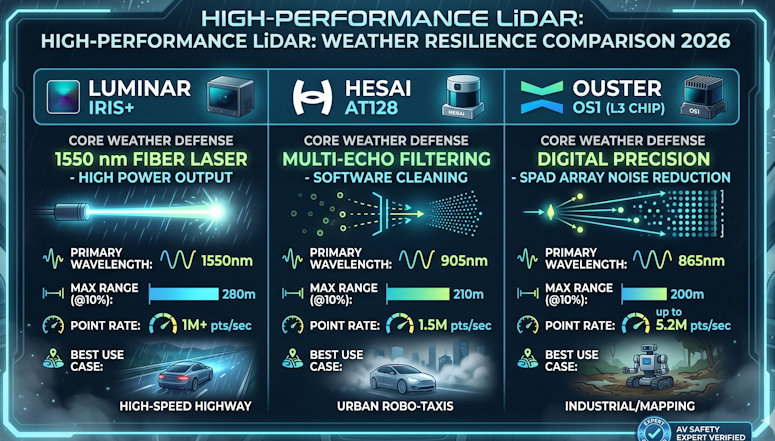
- The “Ghost” in the Code: Sensor “noise.” Fog creates millions of data points that LiDAR interprets as physical obstacles. The “ghost” is the AI seeing a wall of obstacles where there is only moisture, leading to a “fail-safe” state that paralyzes the city.
- Accuracy: High. * Source: Waymo/Cruise internal blog posts regarding “operational design domain” (ODD) limits and local SF news (e.g., San Francisco Chronicle, May 2023).
These “Ghost in the Code” taught us that the world is too “unstructured” for a single AI to handle everything. So, what is truly missing? It isn’t just “more data”—it’s Reliability in Chaos.
As such, before we can put a robotaxi on every street, we must prove the tech in MAZs. These zones aren’t just a “smaller version” of a city; they are the “Training Grounds” where we solve the 5 failures above without the risk of a headline-grabbing tragedy.
Lesson Learned: Don’t try to solve the world. Solve the Zone.
— Dr. Dilip Limbu, Founder of UDHY.com.
2. Why Robotaxis are “Stalling” in 2026: An Expert’s Post-Mortem
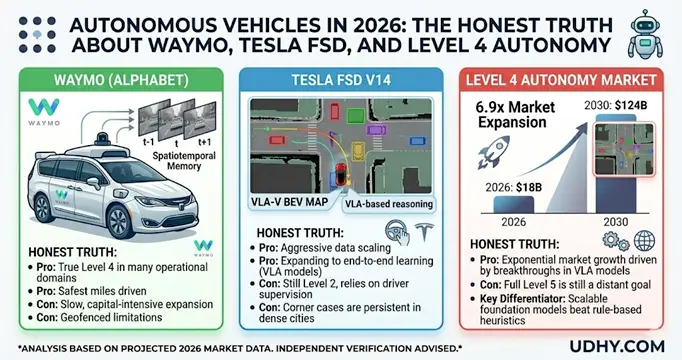
I remember a meeting in 2016 where the consensus was: “By 2025, no one will own a car; we’ll all just summon a robot.” Yet, here we are in April 2026, and while Waymo is doing 400,000 rides a week in select cities, the “anywhere, anytime” taxi is still a ghost.
Why? It isn’t because the AI “can’t drive.” It’s because the world is far more chaotic than a laboratory. As an AV expert, I can tell you that the distance between a successful pilot and a million-unit RoboTaxi rollout is paved with technical paradoxes.Find out more about these technical paradoxes in my post The Invisible Driver: Solving the 5 Technical Paradoxes of Autonomous Vehicle Deployment.
To understand why robotaxis are “stalling” while other robots are thriving, we have to look past the marketing. As someone who has been in the driver’s seat of this industry since 2008, I’ve seen that the “Robotaxi Dream” is hitting a wall made of four very real, very technical bricks.
2.1. The “Human Social Game” (Technical Reasoning)
Driving isn’t just about physics; it’s about social negotiation. When you arrive at a four-way stop, you make eye contact with the other driver. You see a slight nod or a wave.
- The Failure: Current AI lacks Semantic Reasoning. In a 2026 study from arXiv, researchers noted that while AI can manage structured roads, it falters in “social-game reasoning.” If a human driver is being aggressive or a pedestrian is “testing” the robot by standing in the road, the robotaxi’s only safe move is to stop dead.
- The Result: This “hyper-caution” causes traffic jams and public frustration. We taught robots the rules, but we couldn’t teach them the intuition of human behavior.
2.2. The “Brittle Map” Trap (Operational Scaling)
To make a robotaxi safe, companies like Waymo create a Digital Twin of the city—mapping every curb and traffic light to the centimeter.
- The Problem: This makes the vehicle an “expert” only in its tiny geofence. If a city puts up a new stop sign and hasn’t updated the central map, the car might ignore it. According to BCG, it costs between $15M and $30M just to launch in one new city.
- The Result: Scaling is slow and expensive. While Micro-Autonomous Zones (like a warehouse) stay the same for years, a city changes every day.
2.3. The “Insurance & Liability” Knot
In 2026, the legal world is still arguing over who pays for a “Robotic Oops.”
- The Shift: Liability is moving from “Driver Fault” to “Product Liability.” If a robotaxi crashes, the lawyer doesn’t sue a driver; they sue the software company, the sensor maker, and the chip manufacturer.
- The Result: Fitch Ratings (Feb 2026) pointed out that while AVs reduce accident frequency, the repair costs are astronomical. A single LiDAR-equipped bumper can cost $15,000. Insurers are hiking premiums so high that the “taxi” model is struggling to stay profitable.
2.4. The “Edge Case” Long Tail
We have solved 99% of driving. But that last 1%—the “Long Tail”—is where the danger lives.
- The Tech Gap: To solve the 1%, we need World Models (like Google’s Genie 3 or PonyWorld 2.0). This is AI that doesn’t just predict where a car will go, but understands why things happen. It needs to know that a ball rolling into the street is usually followed by a child.
- The Result: Without this “General Intelligence,” robotaxis require Remote Teleoperators—humans sitting in a dark room ready to “rescue” the car when it gets confused. If you need one human to monitor every three cars, the “driverless” economy falls apart.
The Pivot: Why Other Robots are Winning
While the Robotaxi is stuck in traffic, Micro-Autonomous Zones (MAZs) are sprinting ahead. Why? Because they took the “Path of Least Resistance.”
- Removing the “Passenger” (Lower Risk): In a port or a mine, if a robot stops suddenly, no one gets whiplash. There is no “Headline Risk” of a passenger being injured.
- Controlled Environments (No Chaos): In a Micro-Zone, you don’t have to deal with traffic wardens, cyclists, or “Sun-Blind” cameras. You control the lighting, the signs, and the actors.
- Real ROI: A 2026 report from Pony.ai shows that autonomous light trucks in urban logistics reduce freight costs by 40% to 50%. They aren’t trying to solve the city; they are solving the delivery route.
The industry chased human‑like driving robots and hit technical and commercial walls. The pragmatic path forward is to deploy autonomy in Micro‑Zones—controlled environments where the business case is strong and technical risk is contained. Full human‑level autonomy remains a long‑term goal, but Zones are where autonomy works today.
Are you ready to build the next Zone? If you want to master the “World Models” and “Edge-Native” tech that powers these thriving Micro-Zones, our Robotics for Experts intro can be found here.
3. The Winner: The Rise of Micro-Autonomous Zones (MAZs)
What is an MAZ? It’s a geofenced, controlled environment: a shipping port, a warehouse, a university campus, or a private business park. A MAZ is a defined Operational Design Domain (ODD) where the chaos of the world is reduced through three pillars:
- Infrastructure Synergy: Unlike a standard Robotaxi, MAZ vehicles “talk” to the zone. Smart intersections and V2X (Vehicle-to-Everything) sensors provide a “God’s-eye view” that overcomes on-board sensor blind spots.
- High-Frequency Repeatability: Vehicles run the same loops thousands of times, allowing the AI to “over-learn” the specific physics and social patterns of that one area.
- Regulatory Speed-running: Because MAZs are often on private land or specific transit corridors, they bypass the legislative gridlock of “public road” autonomy.
Table. The “Comparison: Robotaxis vs. Micro-Autonomous Zones (MAZ)” Comparison. Scroll right to see full details on mobile.
| Feature | Robotaxis (Public Roads) | Micro-Autonomous Zones (Industrial) |
| Environmental Complexity | High Chaos: Unpredictable pedestrians, social signaling, and construction. | Structured: Geofenced areas with controlled access and predictable actors. |
| Safety Logic | Rules + Intuition: Must read hand signals and human intent. | Deterministic: Follows precise digital coordinates and hive-mind logic. |
| Main Barrier | The “Social Game”: AI cannot yet negotiate a busy 4-way stop with humans. | Cost: High initial setup for infrastructure (private 5G/V2X). |
| Regulation | Public/Political: Slow, complex, and prone to “Headline Risk.” | Private/Corporate: Safety protocols set by the operator (e.g., ISO 21448). |
| Primary Goal | Passenger Comfort & Efficiency. | Operational ROI: Speed, Cargo Flow, and Labor Optimization. |
| Status (2026) | Stalling: Limited to high-mapping-cost “sunshine states.” | Exploding: 24/7 deployment in ports, warehouses, and campuses. |
Why MAZs are the $2 Trillion Opportunity:
- Zero Pedestrian Chaos: In a “Micro-Zone,” you control the environment. You can tell humans where to walk, removing the most unpredictable variable from the equation.
- Predictable Physics: AMRs (Autonomous Mobile Robots) in a warehouse don’t have to worry about sun glare or 80 km/h speed limits. They move at 10 km/h, making accidents low-energy and manageable.
- Concrete ROI: A robotaxi is a luxury service. A micro-shuttle moving pallets in a FairPrice distribution center (a real 2026 success story) is a necessity. It saves 27 tons of CO2 and thousands in labor costs every year.
Below is a verification of the four most significant real-world MAZ deployments.
3.1. The “Industrial Island”: Gatik & Walmart (USA)
Gatik has abandoned the “drive everywhere” dream to master the “B2B Middle Mile.” * Deployment: As of January 2026, Gatik operates fully driverless (no safety driver) Class 6 trucks on short, repeatable routes between distribution centers and retail stores for Fortune 50 retailers like Walmart and Kroger.
- The Win: They have completed over 60,000 driverless orders without incident by strictly geofencing their trucks to fixed surface streets and highways.
- Source: Gatik Press Release (Jan 2026)
3.2. The “Tourism & Transit Loop”: WeRide & Resorts World Sentosa (Singapore)
Singapore is currently the world’s leading “laboratory” for MAZs.
- Deployment: In July 2025, WeRide launched its Robobus (an 8-seater driverless shuttle) at Resorts World Sentosa. It operates in a fully driverless mode within the closed-loop resort environment, moving tourists between attractions.
- Expansion: By the second half of 2026, Singapore is rolling out “Bus 400” and “Bus 191” as autonomous pilots in Marina Bay and one-north, effectively turning entire residential and business districts into MAZs.
- Source: Ministry of Transport (MOT) Singapore; New Fortune Times (April 2026)
3.3. The “Transit Island”: May Mobility (Japan & USA)
May Mobility uses Multi-Policy Decision Making (MPDM) to master specific city grids rather than entire countries.
- Deployment: In February 2026, they launched a pilot in Saito City, Japan, connecting the city center to the Saitobaru Burial Mounds. This follows their successful deployment across nine Japanese cities (including Tokyo and Nagoya) where they operate within tight, high-density zones.
- The Win: By focusing on “micro-shuttles” in fixed zones, they have secured massive investment from Toyota and NTT.
- Source: Future Transport-News (March 2026)
3.4. The “Airport Micro-Zone”: Changi Airport (Singapore)
Airports are the perfect MAZ because they are private, weather-protected, and highly structured.
- Deployment: Changi Airport has fully integrated autonomous baggage tractors to move luggage between aircraft and handling areas. They are also trialling autonomous shuttles for airside worker transport.
- Source: Singapore Ministry of Transport
The MAZ Success Formula:
Predictability + V2X Infrastructure + High-Frequency Loops = Commercial ROI. > If a vehicle doesn’t have to learn how to drive in a blizzard in Maine to pick up a passenger in a sunny Singapore resort, the path to $0.00 driver cost is 10x faster.
4. What is Missing? The “Final Bridge”
People want to see Reliability over Flashiness. They don’t want a car that can do a “cool trick”; they want a vehicle that can perform 1,000 trips with 0.0 disengagements.
To achieve this, we need to move beyond “Real Data” and into World Models. We need AI that understands the laws of physics—friction, gravity, and momentum—so it can “imagine” a dangerous situation before it happens.
5. Conclusion: The Era of the Specialist
If you are still waiting for a RoboTaxi to pick you up in a small town, you might be waiting another decade. But if you look inside the world’s smartest factories and ports, the “Invisible Driver” is already there, working 24/7.
For now, the future of AV isn’t “Anywhere, Anytime.” It’s “Right Here, Right Now” in the Micro-Zone.
By Q4 2026, we expect 40% of major SE Asian ports to operate as MAZs. This gives the “$2 Trillion Winner” title more “teeth.
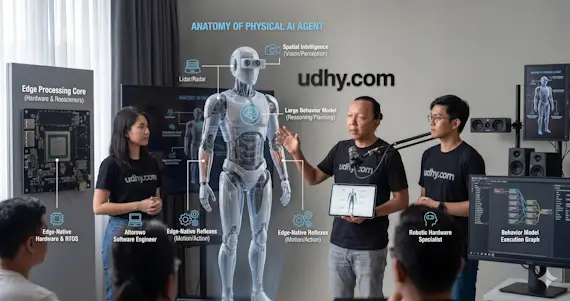
Ready to dive into the technical stack that makes these zones possible? Whether it’s LiDAR fusion or Edge-computing, our intro can be found here.
📢 Notice: Learn the Basic & Explore Self-Driving Cars
🚘 New to autonomous vehicles? Start with our beginner-friendly guide:
👉 Click here to read our full beginner-friendly guide: Self-Driving Cars Explained
Read more on UDHY’s AI and Robotics insights.
In my next post, I’ll be diving deeper into The Death of the Dashboard: Why 2026 is the Year AI Agents Gained Hands.
[Read more… ]
About the Author
Dr. Dilip Kumar Limbu Co-Founder, Moovita | Former Principal Scientist, A*STAR | PhD, Auckland University of Technology
Connect via LinkedIn Direct Inquiry.
Disclaimer
The views expressed here are personal and based on 25+ years in the industry, including my work at Moovita. They do not necessarily reflect the views of any organization. [Back to Top ↑]