
Introduction to AI: A Complete 2026 Beginner’s Guide
At UDHY – Learn AI fundamentals — how it works, key types, real-world examples, and what you can do next. Perfect for beginners.
Home › AI Courses › AI for Beginners › Introduction to AI
There are many AI courses available online, but we’ve designed this to give you a clear introduction and prepare you for advanced learning.
⏱ 60–90 minutes · Self-paced📋 · 6 sections 💡· 8 FAQ answers ·✅ No prerequisites
Designed by Dr. Dilip Kumar Limbu — Former Principal Research Scientist, A*STAR · Co-Founder, Moovita, Singapore’s first autonomous vehicle company · 30 years building real-world autonomous systems. UDHY.com.
TL;DR — Quick Insights
- Demystifying AI: Artificial Intelligence isn’t about sentient sci-fi robots; it is a branch of computer science focused on building systems capable of performing tasks that traditionally require human intelligence (such as learning, reasoning, problem-solving, and visual perception).
- The Core Driver (Data): Modern AI operates like a pattern-recognition engine. It relies heavily on computing power and vast datasets to recognize relationships and predict outcomes, making data the “fuel” of the ecosystem.
- Narrow vs. General AI: * Artificial Narrow AI (ANI): Weak AI designed to excel at a single, specific task (e.g., Siri, Google Maps, or email spam filters). This is the only type of AI that currently exists.
- Artificial General AI (AGI): Strong AI that possesses human-like intellectual capabilities across a broad range of disciplines. This remains entirely theoretical.
- Why it Matters Now: A combination of cloud computing infrastructure, explosive digital data creation, and breakthrough model architectures (like Transformers) has shifted AI from an academic experiment into a mainstream economic driver.
- Mindset Shift: To succeed as a beginner, you do not need a computer science degree. The key shift is moving from a builder mindset (coding instructions manually) to an orchestrator mindset (learning how to direct and prompt AI tools to execute work for you).
1. What is Artificial Intelligence (AI)?
Artificial Intelligence (AI) is no longer just a subfield of computer science—it is now a foundational technology driving modern digital and physical systems. At its core, AI refers to the design of computational systems capable of performing tasks that traditionally require human intelligence, including reasoning, perception, learning from data, and autonomous decision-making.
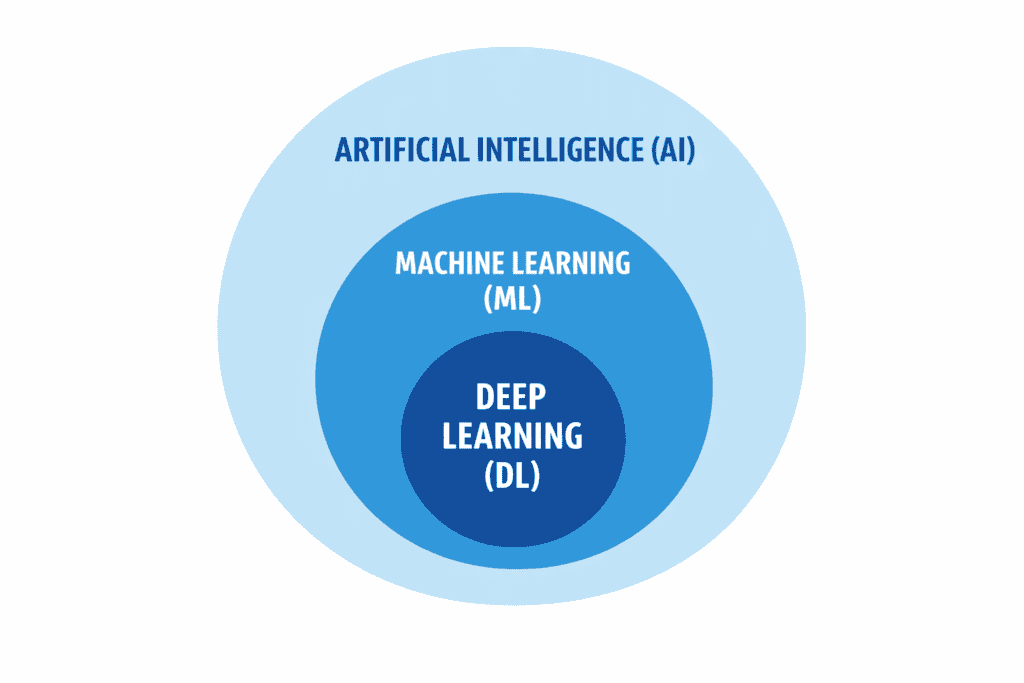
This simple image above shows how Artificial Intelligence (AI) forms the broad field, with Machine Learning (ML) as a subset within it, and Deep Learning (DL) nested inside ML. It helps beginners quickly grasp how these core concepts connect. For clarity, ML and DL will be covered in detail in other UDHY courses.
As of 2026, AI has evolved far beyond rule-based systems and basic chatbots. We are now in the era of Agentic AI—intelligent systems that not only generate responses but can plan, execute, and adapt actions in real time. These systems are capable of performing complex, goal-oriented tasks such as scheduling operations, optimizing workflows, interacting with digital environments, and even diagnosing technical issues without continuous human intervention.
“Then vs. Now” example.
2023 AI: You ask for a travel itinerary, and it gives you a list.
2026 Agentic AI: You tell it to book a trip, and it researches flights, compares prices, and drafts the calendar invites.
Unlike traditional software, which operates on predefined “if-then” logic, modern AI systems are built on Machine Learning (ML) and data-driven models. This allows them to continuously improve their performance by learning from patterns, feedback, and new data. In essence, AI systems are not explicitly programmed for every scenario—they learn, generalize, and evolve. From an engineering perspective, AI enables machines to:
- Perceive the world (via vision, speech, and sensors)
- Interpret and reason over complex data
- Make informed decisions under uncertainty
- Adapt and improve over time
However, it is critical to emphasize that AI does not emerge independently. Human expertise remains central—engineers design the models, curate the data, and define the objectives. AI systems extend human capability, but they are ultimately guided, trained, and constrained by human intent.
In practical terms, AI is what makes machines “intelligent”—but it is the combination of data, algorithms, and human insight that makes them truly effective.
There are many AI powers many tools we use every day — from your smartphone’s voice assistant to self-driving cars and recommendation systems that suggest what to watch or buy next. Here are some Real-World Examples of AI:
🤖 ChatGPT – understands and answers questions like a human tutor.
🗺️ Google Maps – predicts the fastest route using live traffic data.
🎬 Netflix – suggests shows or movies based on what you’ve watched.
📷 Face ID – uses AI vision to recognize your face securely.
🚗 Autonomous Cars/Self-Driving Cars – sense surroundings, detect objects, and drive safely.
AI is all around us — making our lives easier, faster, and smarter. [more examples] [ Go to Top ]
Students can buy specialized AI-compatible robotics kits at your Robotics Store.
Students can buy specialized AI-compatible robotics kits at your Robotics Store.
2. Why Learn AI?
AI is changing the world faster than any technology before it and learning AI is crucial for future-proofing your career. From healthcare to finance, education to entertainment — AI is now at the heart of every innovation. No matter the industry, learning AI as new skills gives you the power to adapt, innovate, and stay ahead. Knowledge opens doors, fuels your career growth, and prepares you for the opportunities of tomorrow. Learning is the AI is key to turning challenges into achievements. As such learning AI isn’t just about coding or math — it’s about understanding the language of the future. Basically, learning AI offers strong career prospects (at least for the next decade), valuable technical and analytical skills, and opportunities to work on groundbreaking advancements in various sectors.
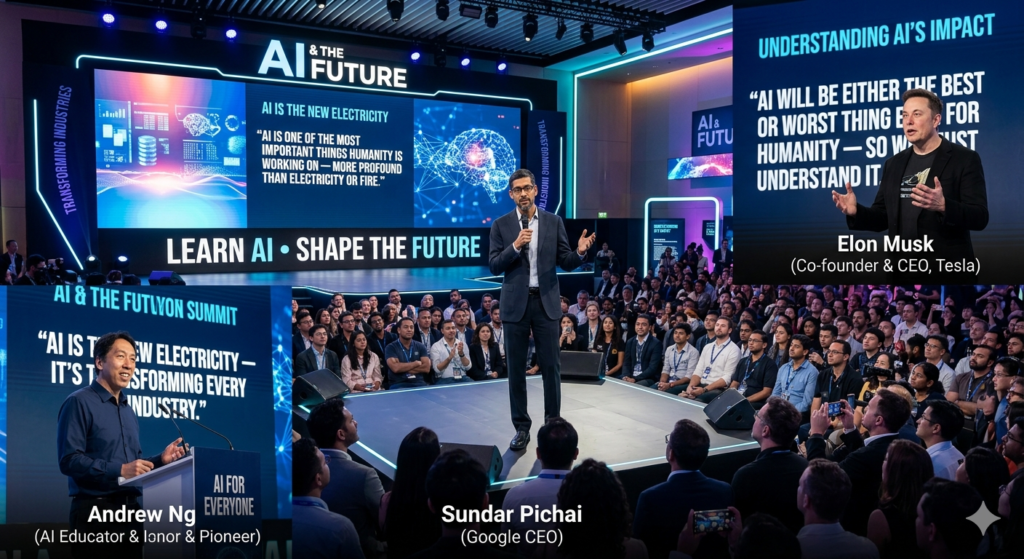
Top AI leaders believe that learning AI is essential because it is changing the world as we know it. Here is why they think everyone should understand it:
Sundar Pichai (Google CEO) says it’s a massive shift and, “AI is one of the most important things humanity is working on — more profound than electricity or fire.”
Elon Musk (co-founder and CEO of Tesla) believes or rather warns, “AI will be either the best or worst thing ever for humanity — so we must understand it.”
And Andrew Ng, one of the world’s top AI educators, says, It’s everywhere and “AI is the new electricity — it’s transforming every industry.”
The image above shows that world leaders believe AI will change everything. Here is a simple look at the future of AI and what we must think about: The Future of AI.
- A “New Electricity”: AI is becoming a part of every job, from medicine to farming. It will power our world just like electricity does today.
- A Huge Step for Humanity: Experts believe AI is as important as the discovery of fire. It will help us solve very big problems that humans cannot solve alone.
- New Kinds of Work: In the future, most people will work alongside AI tools to be faster and more creative.
In short, learning AI helps you prepare for the future and understand the technology that will power everything we do. We’ve carefully selected a variety of AI tools for different industries, listed here for you to explore – AI Tools & Applications. The following paragraph explains how AI works. [ Go to Top ]
3. How AI works explained simply?
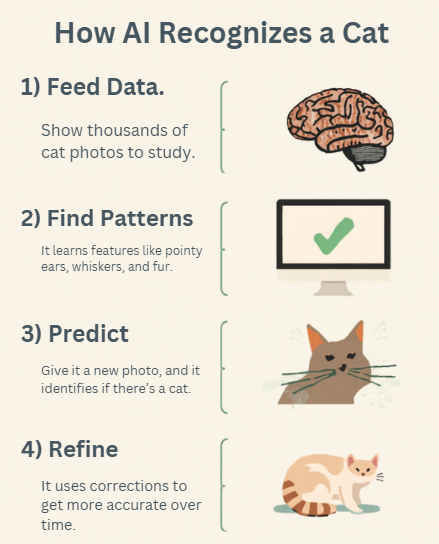
AI works by mimicking how humans learn to solve problems. It doesn’t just follow a list of rules; it learns from experience. Basically, AI learns from data, finds patterns, and makes smart decisions. For example, it can recognize photos, suggest videos, or help self-driving cars navigate. It looks at lots of data, finds patterns, and makes smart decisions. The more it learns, the smarter it gets! Artificial Intelligence (AI) is like teaching a computer to think, learn, and make decisions—almost like a human brain, but in a machine.
- Collect Data – AI needs examples to learn from. Example: To teach an AI to recognize cats, you show it thousands of cat pictures.
- Learn Patterns (Training) – The AI looks at all the data and learns patterns. Example: It notices cats usually have pointy ears, whiskers, and fur.
- Make Predictions or Decisions – Once trained, AI can make guesses about new situations. Example: You show it a new picture, and it says, “This is a cat!”
- Improve Over Time – AI gets better with more data and feedback. Example: If it mistakes a dog for a cat, you correct it, and it learns from the mistake.
AI can be categorized in different ways. The following paragraphs explain the main types of AI and how they work. [ Go to Top ]
4. Main Types of AI
Quick AI Quiz : Which of these is Narrow AI? A) A calculator, B) Siri, C) A robot that thinks for itself. To get the full answer and deeper insights, continue reading.
There are many ways to categorize AI, but at its core, it can be divided into three main types: Narrow AI (Weak AI), General AI (Strong AI), and Super intelligent AI. Understanding these types helps you see how AI works today, what’s coming in the future, and the possibilities it holds for our world.
The first type is Narrow AI (Weak AI) – does one thing well, which is exists today and designed to do one specific task really well. For example, Siri or Alexa can understand your voice commands, YouTube suggests videos you might like, and spam filters block unwanted emails.
The second type is General AI (Strong AI) – does many things like a human, hypothetical AI with human-level intelligence, which can think and learn like a human and handle many different tasks. Although we don’t have it yet, one day it might be able to plan your day, drive a car safely in any situation, or even solve complex problems on its own.
The third type is Super intelligent AI – smarter than humans, hypothetical future AI, which would be smarter than humans in almost every way. While it’s still only theoretical, it could potentially invent new technologies, make scientific discoveries, or solve global problems faster than people can. [ Go to Top ]
5. Real-World AI Applications in Daily Life
AI has been around for years and AI is no longer just for scientists; it is part of our daily lives. We’re already using it in many areas of our daily lives. From making our phones smarter to helping businesses work faster, AI is everywhere. AI is already used by millions of people every day, making life smarter and easier. Here are some real-world applications of AI you should know about. AI is already used by millions and is shaping the future, but it comes with important considerations.
Here are some real-world applications of AI that show how it impacts the world today.
- Siri & Alexa: Understanding your voice commands.
- Netflix & Spotify: Suggesting shows and songs you’ll like.
- Google Maps: Finding the fastest route and avoiding traffic.
- Online Shopping: Recommending products based on what you view.
- Healthcare: Helping doctors find diseases faster.
- Self-Driving Cars: Guiding vehicles safely down the road.
6. The Future of AI & Key Considerations
AI is incredibly promising and has the potential to transform how we live, work, and solve problems. From self-driving cars to advanced healthcare solutions, the possibilities are endless. However, AI also comes with its own challenges, such as ethical concerns, privacy issues, job impacts, and the need for responsible use. To make the most of AI, we must prepare, learn, and use it wisely, ensuring it benefits everyone while minimizing risks.
As such AI gets smarter, we need to be careful about a few important challenges:
- Staying Safe: We have to be absolutely sure that AI controlling things like self-driving cars or hospital machines won’t make dangerous mistakes. It needs to be reliable.
- Our Jobs: AI is learning to do many human jobs. We need to plan for this so people can find new types of work and our economy stays strong.
- Keeping Secrets Safe: AI learns by looking at lots of private information. We must protect this data and make sure no one uses it wrongly.
- Being Fair: AI systems can sometimes be unfair if the information they learn from is biased. We need to teach AI to be fair to everyone.
- Who is in Charge?: We need clear rules to make sure humans are always in control of powerful AI, and that AI is always used to help people, not hurt them.
- Knowing the “How”: Sometimes, an advanced AI makes a choice, and we don’t know why. We need AI to explain its thinking so we can trust its decisions.
7. Getting Started with AI
It’s never too late to start learning AI! There are many AI tools available today that can make your life easier and boost productivity. From writing and designing to organizing tasks and automating routine work, AI can help you work smarter, save time, and focus on what matters most. By exploring these tools and practicing regularly, you can start small and gradually build your skills to tackle bigger AI projects.
Ready to begin? Here are three simple steps:
Step 1: Use AI Tools, build your foundation — learn about what AI is and how it works. Experiment with ChatGPT (writing), DALL-E (images), or similar tools. See what they can do and use them to help with schoolwork (summaries, grammar checks).
Step 2: Learn to Code (Optional), try a hands-on project — create a simple chatbot or a recommendation system by learning the programming language Python, which is key for AI.
Step 3: Build Projects, choose a specialization — such as natural language processing, computer vision, or business AI, such try making a basic AI that can identify simple images (like distinguishing cats from dogs).
We’ve carefully selected a variety of AI tools for different industries, listed here for you to explore – AI Tools & Applications and Best AI Coding Tools 2026
At UDHY, we offer beginner-to-expert learning paths that guide you every step of the way. Start your AI journey today and unlock new digital horizons. [ Go to Top. ]
In my next post, I’ll be diving deeper into the Best AI Tools & How They’re Used (Beginner‑Friendly Guide).
[Read more… ]
