How to Become a Robotics Engineer: The Ultimate Career Guide
🎯 Career guide ✅ 500+ job postings analysed
In 60 seconds I’ll explain exactly how to become a robotics engineer — real salary data, the 3 fastest paths, and what NVIDIA actually hires for.
TL;DR — Quick Insights
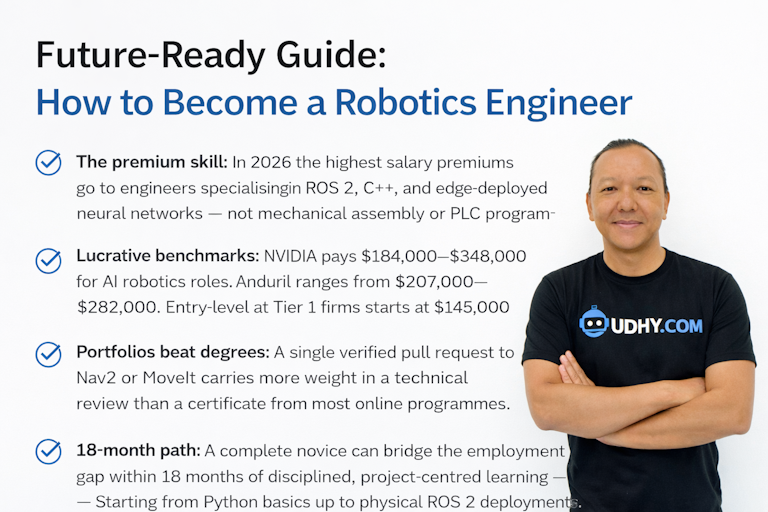
- The premium skill: In 2026 the highest salary premiums go to engineers specialising in ROS 2, C++, and edge-deployed neural networks — not mechanical assembly or PLC programming.
- Lucrative benchmarks: NVIDIA pays $184,000–$348,000 for AI robotics roles. Anduril (Industries builds advanced autonomous systems and defense technology) ranges from $207,000–$282,000. Entry-level at Tier 1 firms starts at $145,000.
- Portfolios beat degrees: A single verified pull request to Nav2 or MoveIt carries more weight in a technical review than a certificate from most online programmes.
- 18-month path: A complete novice can bridge the employment gap within 18 months of disciplined, project-centred learning — starting from Python basics up to physical ROS 2 deployments.
I have been in this industry for more than a decade — co-founding Moovita, Singapore’s first autonomous vehicle company, and spending years as a Principal Research Scientist at A*STAR’s Institute for Infocomm Research. During that time, I have audited hundreds of candidates, watched hiring criteria shift dramatically, and personally screened engineers for roles that most online career guides have never described accurately.
The classic advice on entering robotics is outdated. Most university marketing pages still tell you to study mechanical assembly, analogue circuits, and traditional PLC programming. While those foundations matter for industrial production lines, the advanced, high-paying robotics domain of 2026 operates like a software-defined ecosystem. Companies like NVIDIA, Boston Dynamics, Tesla, and Anduril are not looking for pure hardware designers — they are looking for software engineers who understand physics, and AI practitioners who know how to build code that safety-checks itself on the edge.
Whether you are a university student, a computer science graduate looking to leave web development, or a self-taught enthusiast, this guide lays out the verified, unvarnished roadmap to getting hired as a robotics engineer in 2026 — based on real hiring data and my own experience leading technical teams.
1. What Robotics Engineers Do: Roles, Skills, and Real‑World Impact
Robotics engineers can specialize in hardware or software, and most career paths fall into one of these two tracks. Splitting them explicitly at the beginning helps learners and recruiters understand the different skill sets required:
- Software Track: Focuses on algorithms for Perception, Controls and Localisation, Physical AI and Embodied Intelligence, Systems and Middleware and Physical AI and Embodied Intelligence . These engineers design the logic that allows robots to interpret sensor data, build maps, and make autonomous decisions.
- Hardware Track: Concentrates on kinematics, sensor integration, PCB design, and actuators. These engineers build the physical systems — from robotic arms to embedded controllers — that execute the commands generated by software.
This post focuses primarily on the Software Track, which covers algorithms for Perception, Controls and Localisation, Physical AI and Embodied Intelligence, and Systems and Middleware. Engineers in this track design the logic that allows robots to interpret sensor data, build maps, and make autonomous decisions. For example, perception engineers develop computer vision pipelines, controls engineers design motion controllers, and systems engineers build middleware like ROS 2 to connect hardware and software seamlessly. The rise of Physical AI and embodied intelligence means software engineers are increasingly responsible for bridging high‑level reasoning with low‑level robotic actions.
Table : Robotics Career Tracks Comparison (2026)
| Career Track | Typical Salary Range (USD) | Core Technical Skills | Difficulty Level | Industry Demand (2026) |
|---|---|---|---|---|
| Perception Engineer | $145 K – $260 K | Computer Vision · LiDAR · Sensor Fusion · PyTorch · ROS 2 | ★★★★☆ (High) | Autonomous Vehicles · Drones · Industrial Robots |
| Controls & Localization Engineer | $138 K – $245 K | Kinematics · SLAM · PID · Trajectory Planning · C++ | ★★★★☆ (High) | Mobile Robotics · Manipulators · Navigation Systems |
| Systems & Middleware Engineer | $115 K – $210 K | ROS 2 Nodes · DDS · C++ · Real‑Time OS · Microcontrollers | ★★★☆☆ (Medium) | Robotics Startups · Automation Firms · R&D Labs |
| Physical AI Engineer | $184 K – $348 K + | Vision‑Language‑Action (VLA) Models · Simulation · Reinforcement Learning · TensorRT | ★★★★★ (Very High) | Humanoids · Autonomous Vehicles · AI Research |
| AI Product & Safety Engineer | $150 K – $282 K | ISO 26262 · SROS2 · Cybersecurity · Risk Modeling · Python | ★★★★☆ (High) | Defense · Automotive · Regulated AI Systems |
For ongoing coverage of where these roles are heading industry-wide, IEEE Spectrum’s Robotics section is the most consistently rigorous source tracking deployment trends across these five tracks.
We also briefly touch on the Hardware Track, which concentrates on kinematics, sensor integration, PCB design, and actuators. Hardware engineers build the physical systems that software controls — from robotic arms and embedded controllers to the actuators that power humanoid robots. While hardware remains essential, the fastest‑growing demand in 2026 is for software engineers who can integrate perception, control, and embodied intelligence into adaptive robotics systems.
1.1. Perception Engineers
Perception Engineers or Specialists who enable machines to perceive their environments. They build pipelines that take noisy, unstructured outputs from high-resolution cameras, ultrasonic arrays, and LiDAR sensors — processing them using deep computer vision models to track objects in real time. For a detailed breakdown of how these sensor pipelines work in production AV systems, read UDHY’s Sensor Fusion Explained: Cameras, LiDAR & Radar.
1.2. Controls and Localisation Engineers
These Controls and Localisation engineers focus on state estimation, kinematics, and motion planning. They answer two foundational questions: where is the robot located right now? Simultaneous Localization and Mapping (SLAM) and what is the exact mathematical trajectory needed to move the end-effector smoothly without hitting an obstacle? The mathematics covered in UDHY’s Advanced Robotics Course — rotation matrices, DH parameters, PID control — is the daily toolkit of this role. Find more on a real-world technical breakdown of this exact problem in GPS-Denied Localization in Autonomous Vehicles.
1.3. Systems and Middleware Engineers
The Systems and Middleware Engineers manage underlying communication buses, optimise compute constraints on microcontrollers, write clean C++ nodes, and ensure the ROS 2 (Robot Operating System) graph passes messages with minimal latency. The ROS 2 Jazzy Jalisco documentation is their primary technical reference.
1.4. Physical AI and Embodied Intelligence Engineers
The newest and fastest-growing track in 2026. These engineers work directly with Vision-Language-Action (VLA) models — training large neural networks in simulation environments before deployment onto physical humanoid or autonomous platforms. UDHY’s Physical AI and VLA Models Expert Course covers this track in full production depth.
1.5 AI Product and Safety Engineers
As autonomous systems move into regulated, safety-critical environments, demand has surged for engineers who combine AI expertise with formal safety architecture — ISO 26262 (automotive functional safety), NIST Cybersecurity Framework compliance, and SROS2 implementation. UDHY’s Cybersecurity for Autonomous Robot Fleets expert course addresses this directly.
1.6 Hardware Engineers
Robotics engineers working on the hardware track often specialize in areas such as kinematics, sensor integration, PCB design, and actuators. Each of these domains plays a critical role in building robots that can move, perceive, and interact with the physical world.
Kinematics deals with how robotic joints, arms, and wheels move in three‑dimensional space. Engineers in this area design motion models and solve inverse kinematics problems to ensure robots can reach, grasp, and manipulate objects with precision. Strong skills in linear algebra, CAD modeling, and simulation tools like MATLAB or Gazebo are essential. The real‑world impact of kinematics is seen in surgical robots performing delicate procedures and industrial arms assembling electronics with micron‑level accuracy.
Sensor integration ensures that robots can perceive their environment through cameras, LiDAR, IMUs, ultrasonic sensors, and tactile feedback. Engineers fuse these inputs into a coherent stream that supports decision‑making and navigation. This requires expertise in embedded systems programming, ROS 2 drivers, and signal processing. In practice, autonomous vehicles rely on integrated sensors to detect pedestrians and obstacles, while drones use IMUs and GPS fusion to maintain stable flight in unpredictable conditions.
PCB design provides the nervous system of a robot, connecting sensors, controllers, and actuators. Engineers design custom printed circuit boards to optimize power distribution and signal integrity. Skills in electronics design software such as Altium or KiCad, microcontroller integration, and compliance with EMI/EMC standards are crucial. The impact of PCB design is evident in wearable robotics like exoskeletons, where compact and efficient boards enable lightweight systems that support patient rehabilitation.
Actuators serve as the muscles of robots, converting electrical signals into mechanical motion. These can include DC motors, servos, hydraulics, or advanced soft actuators. Engineers in this domain need knowledge of control theory, mechanical design, motor driver programming, and materials science. Actuators make humanoid robots capable of walking, grasping, and balancing, and they power robotic arms in factories to handle repetitive tasks with speed and precision.
2. The Core Robotics Skills That Gets You Hired
Recruiters in 2026 consistently filter candidates based on a handful of core robotics skills. Analysis of 500+ postings shows that mastering these skills is the difference between passing technical loops and being rejected. Below is the skill stack that actually gets you hired.
2.1. The Language Split: C++ vs Python
| Language | Use in robotics | Priority level |
|---|---|---|
| C++ (14/17/20) | Mandatory for production code, real‑time control loops, and ROS 2 nodes. | Mandatory |
| Python | ML pipelines, simulation scripting, rapid prototyping | Essential |
Recruiters often list “C++14/17/20” in robotics job descriptions because modern C++ standards are the backbone of production‑level robotics software. Unlike legacy C++98/03, these newer versions introduce features such as structured bindings, std::optional, coroutines, and concepts — all of which make robotic codebases safer, faster, and easier to maintain. In practice, this means a perception engineer can handle missing sensor data with optional, a controls engineer can write non‑blocking loops using coroutines, and a systems engineer can enforce type safety with concepts. Companies like NVIDIA, Boston Dynamics, and Tesla explicitly require candidates to demonstrate fluency in modern C++ because ROS 2 (the industry’s middleware standard) is written in it. For recruiters, “C++14/17/20” is shorthand for candidates who can write efficient, real‑time code that scales across embedded controllers and cloud robotics systems — a skill set that directly translates into being hired.
If you cannot handle manual memory management, pointer manipulation, and real-time thread safety in C++, you will fail technical screening loops at firms like Boston Dynamics. Start with UDHY’s Machine Learning Fundamentals to build the Python foundation before transitioning to C++.
2.2. The Middleware Standard: ROS 2 Jazzy Jalisco
Do not waste time learning ROS 1 — it is end-of-life. You must understand ROS 2 nodes, lifecycles, actions, services, and DDS Security layers. The UDHY Advanced Robotics Course covers ROS 2 Jazzy setup from scratch, including Turtlesim, RViz2, Gazebo, and Colcon build systems. For real-world troubleshooting and community-vetted answers on ROS 2 implementation issues, ROS Discourse is the primary technical forum used by working engineers — far more current than most Stack Overflow threads on this topic.
Recruiters expect candidates to be fluent in ROS 2, the industry’s middleware standard. ROS 1 is deprecated, so job postings now explicitly mention ROS 2 Jazzy. Engineers must show they can build nodes, manage lifecycles, and implement secure DDS communication. Recruiters look for GitHub repos with working ROS 2 packages — a clear signal that you can integrate perception, control, and navigation into production systems.
2.3. Machine Learning Foundations for Robotics
While TensorFlow is largely legacy in robotics, PyTorch has become the absolute standard for robotic deep learning optimisation. Knowing how to compress a PyTorch model into an ONNX runtime or deploy it using NVIDIA’s TensorRT on an embedded Jetson Orin chip is a massive competitive advantage. UDHY’s Deep Learning for Robotics advanced course covers this pipeline end-to-end.
Modern robotics roles demand experience with PyTorch for training perception models and TensorRT/ONNX for deployment on NVIDIA Jetson hardware. Recruiters filter resumes for candidates who can compress and optimize models without losing accuracy. A practical proof is showing a YOLOv8 model trained in PyTorch, exported to ONNX, and deployed with TensorRT — exactly the workflow hiring managers want to see.
3. The Portfolio-First Paradigm — Degrees vs Code
In robotics and AI engineering, proof of capability now outweighs academic credentials. Recruiters may skim résumés, but Lead Robotics Architects evaluate repositories — they look for reproducible code, algorithmic clarity, and integration depth.
If you don’t hold a master’s from a top research institution, your open‑source footprint becomes your credential. A well‑structured GitHub repository demonstrates not only technical skill but also collaboration, documentation discipline, and version control maturity — all traits valued in production robotics teams.
In simple words, an HR recruiter cannot easily judge your code quality, but a Lead Robotics Architect can. If you do not have a Master’s degree from a top research institution, your open-source software presence is your primary credential. The Winning Portfolio — Three Non-Negotiable Elements
- Reproducible ROS 2 Package – A clean, reproducible GitHub repository detailing a working ROS 2 package with proper documentation
- Demonstration Video (Physical or Simulated) – A video showing a physical or simulated robot executing a real task — navigation, manipulation, or inspection
- Mathematical Explanation of Algorithms – A written explanation of the mathematical algorithms used — EKF, ICP, MPC, PPO — not just the code
3.1. A Reproducible ROS 2 Package
- Include launch files, parameter YAMLs, and clear README instructions.
- Example: a ROS 2 node implementing Extended Kalman Filter (EKF) for sensor fusion between LiDAR and IMU.
3.2. A Demonstration Video (Physical or Simulated)
- Show a robot performing navigation, manipulation, or inspection.
- Example: a TurtleBot 4 navigating a dynamic environment using Nav2 with obstacle avoidance.
- UDHY.com’s Autonomous Navigation module can guide learners through simulation setup using Gazebo or Isaac Sim.
3.3. Mathematical Explanation of Algorithms
- Don’t just post code — explain the math behind it.
- Example:
- ICP (Iterative Closest Point) for scan matching in SLAM.
- MPC (Model Predictive Control) for trajectory optimization.
- PPO (Proximal Policy Optimization) for reinforcement learning in robotic arms.
- UDHY.com’s Robotics Mathematics Fundamentals course provides step‑by‑step derivations of these algorithms.
A highly successful strategy to break into top-tier firms is documenting verified contributions to foundational repositories. A single merged pull request fixing an edge case in Nav2 (the ROS 2 navigation stack) or MoveIt 2 (the manipulation framework) carries more weight during a team review than a generic online certificate.
“When I audited prospective candidates during our scaling phase at Moovita, the single fastest way an applicant failed their technical screening was presenting a portfolio of generic, un-forked projects. If your GitHub profile contains nothing but standard tutorials, you tell me you can follow instructions — but not solve problems. I looked for candidates who deliberately broke things in simulation. Engineers who could explain precisely why an EKF (Extended Kalman Filter) failed to localise when an autonomous vehicle entered a concrete tunnel layout.”
— Dr. Dilip Kumar Limbu, Co-Founder Moovita · Former Principal Research Scientist, A*STAR
4. The 3 Fastest Path Blueprints
Route A: The Computer Science / Electrical Engineer Pivot
⏱ Timeline: 6 months
Skip basic coding loops — you already have them. Spend 2 months mastering physical kinematics and spatial coordinate transforms (quaternions, rotation matrices). Devote 4 months to deep-diving into ROS 2 hardware packages and Nav2 navigation setups in Gazebo simulation. Target: first job application at 6 months.
Goal: Build core robotics and AI fundamentals.
| Week | Focus | What to Read | What to Build | GitHub Submission |
|---|---|---|---|---|
| 1–2 | Python + Math for Robotics | Python Crash Course, Linear Algebra for Engineers | Simple kinematics calculator | robotics-basics.py |
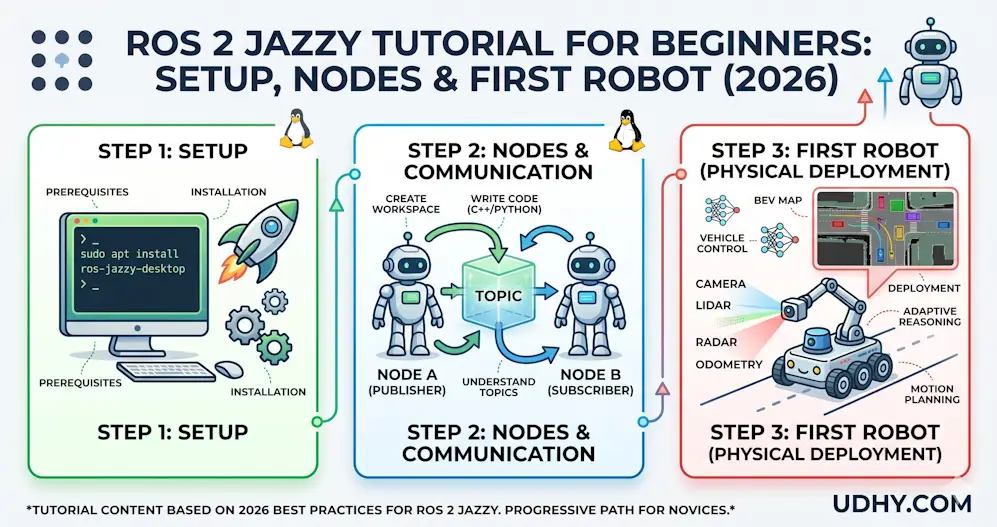
| 3–4 | ROS 2 Setup + Linux Basics | ROS 2 Docs, Ubuntu Guide | ROS 2 publisher/subscriber demo | ros2-hello-world |
Route B: The Mechanical Engineer Transition
⏱ Timeline: 9 months
Your structural physics intuition is already strong — pivot aggressively into software. Spend 3 months mastering object-oriented C++ design, followed by 6 months building localised embedded software projects. Build a full kinematic simulation of a 6-DOF robot arm. Pair with UDHY’s Advanced Robotics Course.
Goal: Learn perception, control, and simulation.
| Week | Focus | What to Read | What to Build | GitHub Submission |
|---|---|---|---|---|
| 1–4 | Computer Vision + OpenCV | OpenCV Python Tutorials | Object detection pipeline | vision-module |
| 5–8 | SLAM + Localization | ROS Navigation Stack | 2D mapping demo using RPLIDAR | slam-demo |
| 9–12 | Gazebo Simulation | Gazebo Docs, URDF Tutorials | Simulated mobile robot | gazebo-robot |
Route C: The Self-Taught Novice Blueprint
⏱ Timeline: 18 months
- Months 1–6: Python, basic mathematics (linear algebra, calculus), Linux/Bash. Start with UDHY’s Introduction to AI and Robotics for Beginners.
- Months 7–12: C++ programming, microelectronics basics, foundational ROS 2 — UDHY’s Advanced Robotics Course.
- Months 13–18: Capstone simulation project in Gazebo or NVIDIA Isaac Sim. Deploy on physical hardware. Apply.
Goal: Integrate AI models and publish a portfolio.
| Week | Focus | What to Read | What to Build | GitHub Submission |
|---|---|---|---|---|
| 1–4 | Reinforcement Learning for Robotics | Spinning Up in Deep RL | RL agent for path planning | rl-path-planner |
| 5–8 | Vision‑Language‑Action (VLA) Models | Transformers for Robotics Paper | VLA demo with RGB‑D input | vla-demo |
| 9–12 | Portfolio & LinkedIn Optimization | UDHY Career Guide | Publish GitHub repo + demo video | portfolio-final |
5. Average Salaries and Career Outlook (2026 Data)
Compensation packages in 2026 reflect the high demand for engineers who bridge the gap between AI code and physical hardware. Data compiled from Levels.fyi, RoboticsEngineerJobs.com analysis of 500+ live postings, and regional tech hiring reports:
| Company class | Entry (0–2 yrs) | Mid (3–5 yrs) | Senior / Principal (6+ yrs) |
|---|---|---|---|
| Tier 1 Tech (NVIDIA, Tesla) | $145,000–$180,000 | $184,000–$240,000 | $260,000–$348,000+ |
| Defence / Advanced (Anduril) | $138,000–$165,000 | $207,000–$245,000 | $255,000–$282,000+ |
| Enterprise / R&D (Amazon) | $115,000–$140,000 | $150,000–$185,000 | $210,000–$260,000 |
For a full breakdown of total compensation, equity, and regional pay bands across 40+ companies, see UDHY’s AI & Robotics Salary Guide 2026.
Geography factor: The United States (Silicon Valley, Boston, Austin) leads global compensation. Singapore’s advanced deep-tech hubs follow closely. European markets offer slightly lower nominal salaries but emphasise robust social benefit allocations.
6. The UDHY Learning Path — From Zero to Job-Ready
To transition systematically from curious enthusiast to deployable corporate asset, follow this progressive UDHY track:
| 1. Foundation | Introduction to AI + ML Fundamentals | 3–5 hrs | Python + ML context |
| 2. Physical sandbox | Robotics for Beginners | 8–12 hrs | First physical project |
| 3. Core engineering | Robotics for Advanced | 25–35 hrs | ROS 2 + YOLO + kinematics |
| 4. Deep learning | Deep Learning for Robotics | 10–14 hrs | PyTorch + TensorRT deployment |
| 5. Navigation | Autonomous Navigation & SLAM | 12–16 hrs | Nav2 + SLAM + A* planning |
| 6. Frontier | Expert Robotics + Physical AI | 30–40 hrs | VLA models + production deployment |
7. Frequently Asked Questions
8. References
- International Federation of Robotics. (January 2026). Top 5 Global Robotics Trends 2026.
- RoboticsEngineerJobs.com. (2026). Database analysis of 500+ robotics engineering job postings (2025–2026).
- Levels.fyi. (2026). Advanced Technology Compensation Metrics 2026.
- NVIDIA Developer. (2026). Isaac Sim — Robot Learning in Simulation.
- Open Robotics. (2026). ROS 2 Jazzy Jalisco Documentation.
- apollotechnical.com. (May 2026). Is Robotics Engineering a Good Career in 2026?
- MIT CSAIL. (2026). Robotics Research — Autonomous Systems Laboratory.
About the Author
Dr. Dilip Kumar Limbu Co-Founder, Moovita | Former Principal Scientist, A*STAR | PhD, Auckland University of Technology
Connect via LinkedIn Direct Inquiry.
Disclaimer
The views expressed here are personal and based on 25+ years in the industry, including my work at Moovita. They do not necessarily reflect the views of any organization.
Enjoying this post? Subscribe to get more AI insights.