Galgotias Robot Dog Scandal: What It Teaches About AI Credibility
In the next 30 seconds, I’ll share highlights from our post on the India Robot Dog Controversy — unpacking the debate, ethics, and what this means for robotics in 2026.
TL;DR — Quick Insights
- What happened: A robot dog demo at a major India AI event malfunctioned publicly — falling and failing to recover — in front of media, investors, and government officials.
- Why it matters beyond the embarrassment: It exposed the gap between demo-optimised robotics and deployment-ready robotics. The industry stages demos in controlled conditions. Real deployment is different.
- The credibility cost: Events like this set back public trust in robotics by months. Trust, once lost in a live demo, takes years of reliable field deployment to rebuild.
- The silver lining: Failures in public accelerate honest conversation about where the technology actually is — which is healthier for the industry than unchallenged hype.
1. Background: Global Robot Dog Platforms
Before diving into the robot dog showcased at the India AI Summit, it’s important to recognize the many global platforms that have already set benchmarks in quadruped robotics. Industry leaders such as Boston Dynamics’ Spot and Unitree’s Go 2 demonstrate advanced locomotion, perception, and autonomy, establishing global standards for robot dogs. These systems are widely referenced in academia and industry, making them the credibility benchmark for innovation. When Galgotias University presented its robot dog at the India AI Summit, the similarities to Unitree’s design were immediately apparent to the robotics community.
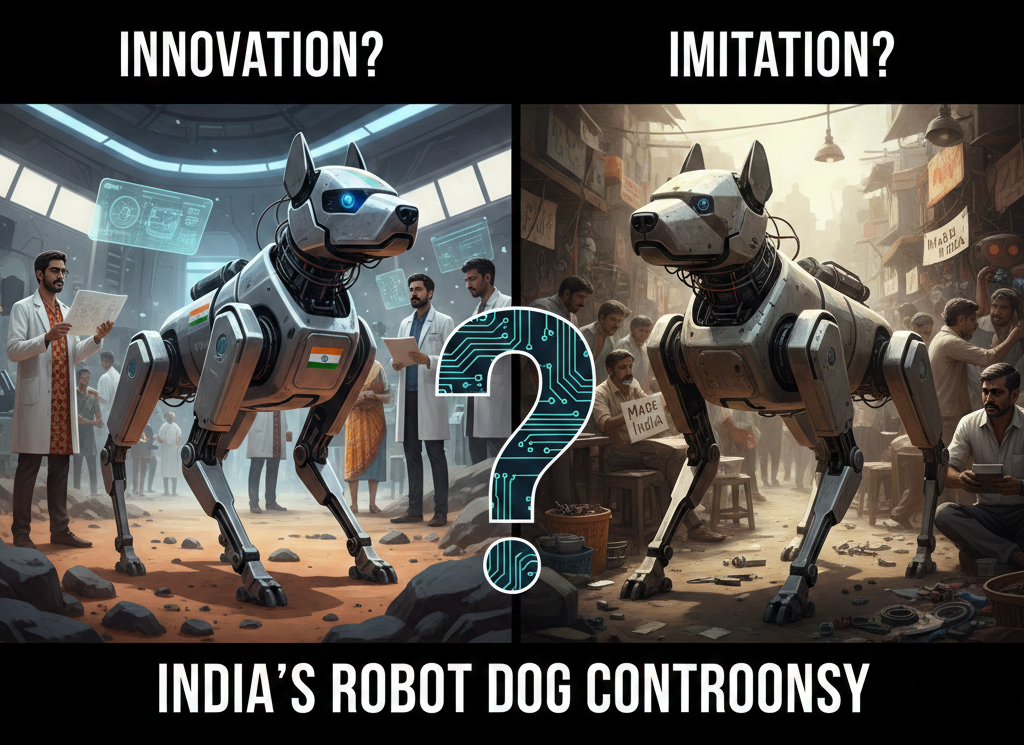
Reports suggested that Galgotias University presented a Chinese-made robotic dog as its own innovation — an episode many observers described as an “embarrassment” for the host nation.
In a global AI race where perception matters almost as much as performance, such incidents carry consequences beyond headlines. AI and robotics are technical fields — experts can quickly identify hardware origins. A quadruped robot platform is not a trivial invention; it represents years of mechanical design, control systems engineering, and supply chain integration. Claiming ownership without clear attribution risks undermining institutional and national credibility.
That said, the issue is not about using foreign hardware. In robotics, it’s common to build on established platforms and focus innovation on autonomy software, perception systems, edge AI, or applications. The problem arises when integration work is presented as original invention without transparent acknowledgment.
This episode should not be seen as a national failure, but as a strategic lesson in how emerging AI ecosystems must position themselves globally.
2. Technical Analysis: Why Experts Spotted the Origin
From a technical standpoint, robotics engineers quickly identified the origin of the showcased robot dog by analyzing gait algorithms, servo configurations, and mechanical build patterns. These subtle design markers are unique to specific manufacturers, making it clear that the robot was not an indigenous innovation. Transparency in hardware and software attribution is critical in robotics demonstrations.
3. Ethics & Research Integrity in Robotics
In robotics research, ethics and integrity are as important as technical skill. Misrepresentation or plagiarism damages credibility and undermines trust in the ecosystem. Proper attribution, open collaboration, and transparent sourcing are essential for building a sustainable AI future. This controversy serves as a reminder that universities must enforce strict research integrity policies.
4. Key Takeaways (Personal Reflections)
4.1. Credibility Is the Foundation of AI Leadership
In robotics and deep tech, credibility is the foundation of sustainable leadership. Investors, global partners, and research institutions evaluate not just the technology, but the reputation behind it. A flashy demo may capture short‑term attention, but long‑term recognition comes from authentic capability, peer‑reviewed validation, and consistent innovation. Without credibility, even groundbreaking prototypes risk being overlooked. For aspiring engineers and startups, this means building trust through transparency, rigorous testing, and verifiable results.
4.2. Transparency Is Strength, Not Weakness
In robotics, acknowledging the foundations you build upon is a mark of maturity. Saying “We used an established robotic platform and developed our own AI stack on top” demonstrates professionalism and earns respect. Globally, leaders like Boston Dynamics and Unitree Robotics often combine proven hardware with innovative software, algorithms, and deployment models. Clear attribution signals confidence, integrity, and collaboration readiness. Transparency is not a weakness — it is a strategic strength that builds credibility and accelerates partnerships.
4.3. Ecosystems Grow Through Depth, Not Optics
AI leadership is not built at summits or conferences — it is cultivated in labs, test tracks, pilot deployments, and sustained R&D investment. Nations and institutions that succeed in robotics focus on depth rather than optics. They invest in:
- Talent development through structured education and hands‑on training.
- Strong research culture that values originality and peer‑reviewed contributions.
- Real‑world validation via prototypes, pilots, and industrial applications.
- Ethical standards that ensure trust and accountability.
- Consistent execution over years, not just one‑off showcases.
For India’s AI ecosystem, this controversy is a reminder that credibility comes from depth, discipline, and sustained innovation, not from optics alone.
The lessons are clear: credibility, transparency, and depth are the pillars of AI leadership. Universities, startups, and aspiring engineers must embrace these values to build trust, attract investment, and position themselves as global leaders in robotics.
5. Want to Become a Robotics Engineer?
If your goal is to build a career in robotics, UDHY.com is the place to start. Our courses are designed by industry experts who have spent decades in autonomous vehicles, AI research, and robotics engineering. You’ll learn the exact skills recruiters look for — from mastering ROS 2 Jazzy, C++17/20, and Isaac Sim, to understanding Physical AI and Agentic Robotics.
At UDHY.com, we don’t just teach theory. We prepare you with hands‑on projects, portfolio‑ready code, and real‑world case studies so you can stand out in interviews and land high‑impact roles. Whether you’re a student, a professional switching careers, or an entrepreneur exploring robotics, our structured learning path gives you the tools to succeed.
To transition systematically from curious enthusiast to deployable corporate asset, follow this progressive UDHY track:
| 1. Foundation | Introduction to AI + ML Fundamentals | 3–5 hrs | Python + ML context |
| 2. Physical sandbox | Robotics for Beginners | 8–12 hrs | First physical project |
| 3. Core engineering | Robotics for Advanced | 25–35 hrs | ROS 2 + YOLO + kinematics |
| 4. Deep learning | Deep Learning for Robotics | 10–14 hrs | PyTorch + TensorRT deployment |
| 5. Navigation | Autonomous Navigation & SLAM | 12–16 hrs | Nav2 + SLAM + A* planning |
| 6. Frontier | Expert Robotics + Physical AI | 30–40 hrs | VLA models + production deployment |
6. Conclusion
The India Robot Dog Controversy serves as a powerful reminder that robotics innovation cannot thrive without transparency, originality, and integrity. Global platforms such as Boston Dynamics’ Spot and Unitree’s Go2 have already set high standards in quadruped robotics, and any attempt to replicate or misrepresent these technologies is quickly exposed by the expert community. The incident at the India AI Summit highlights the urgent need for Indian universities and startups to embrace ethical research practices, proper attribution, and collaborative ecosystems.
For India’s AI ecosystem to gain credibility and attract global partnerships, it must prioritize innovation over imitation. Students, researchers, and entrepreneurs should see this controversy not as a setback, but as a turning point — an opportunity to build trust, strengthen technical expertise, and position India as a leader in robotics. By learning from this episode and aligning with best practices, India can transform challenges into growth and ensure its robotics future is both respected and sustainable.
7. FAQs on India Robot Dog controversy
About the Author
Dr. Dilip Kumar Limbu Co-Founder, Moovita | Former Principal Scientist, A*STAR | PhD, Auckland University of Technology
Connect via LinkedIn Direct Inquiry.
Disclaimer
The views expressed here are personal and based on 25+ years in the industry, including my work at Moovita. They do not necessarily reflect the views of any organization.