China’s Humanoid Robots Steal the Show With Kung Fu Performance at Lunar New Year Gala
In the next 30 seconds, I’ll share highlights from our post Humanoid Kung Fu Takes Center Stage — showcasing how robots wowed audiences with martial arts at the Lunar New Year Gala.
TL;DR — Quick Insights
- What happened: Multiple humanoid robots performed synchronised Kung Fu routines live at the 2026 China Spring Festival Gala — the most-watched television event on earth, with over 1 billion viewers.
- Why China chose this moment: The Spring Festival Gala is China’s most powerful cultural platform. Placing humanoid robots at its centre was a deliberate national statement — China is positioning Physical AI as a source of cultural pride, not just industrial output.
- The technical achievement: Synchronised multi-robot choreography at this scale requires sub-millisecond timing coordination, precise joint control, and robust wireless communication under broadcast conditions. It is genuinely difficult engineering.
- What it is NOT: Evidence that humanoid robots can perform useful, generalised work in real environments. Choreographed performance in controlled lighting is a very different problem from autonomous task completion.
- The bigger signal: China’s Spring Festival Gala appearance confirms humanoid robotics has crossed from research into national strategy. Budget, talent, and manufacturing scale will follow.
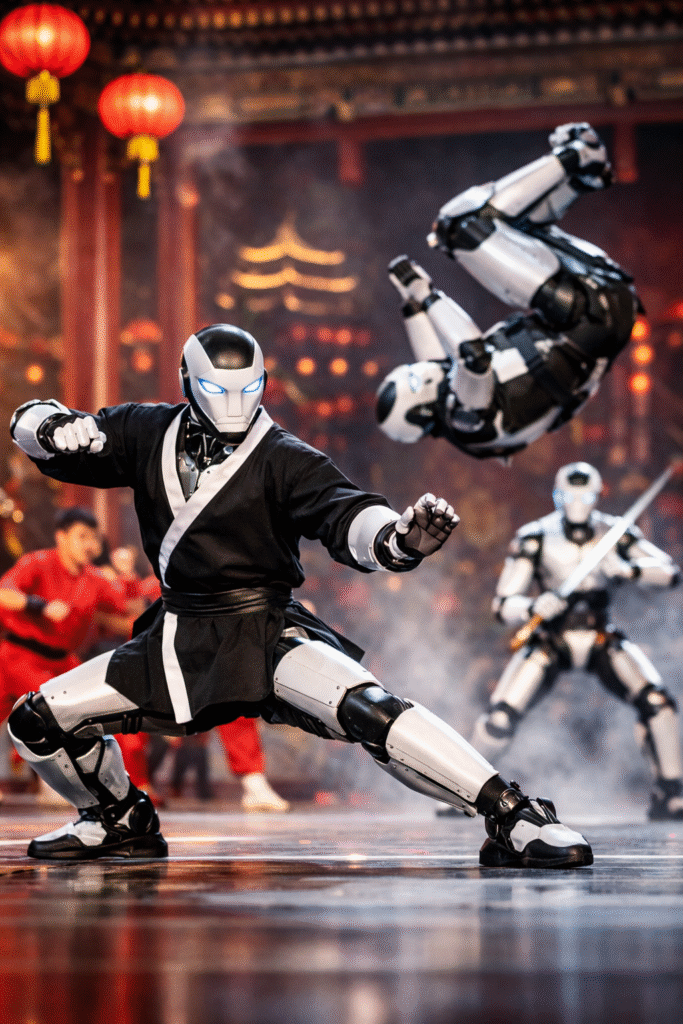
China’s 2026 Spring Festival Gala — the most watched television event in the world — has become the unlikely stage for a high-tech spectacle: humanoid robots performing kung fu, parkour and acrobatic martial arts movements, captivating millions of viewers and drawing global attention to the rapid advancement of Chinese robotics.
On the night of February 16, 2026, robots developed primarily by Unitree Robotics — notably the G1 and H2 models — executed a series of highly technical movements that go far beyond simple programmed motions. These included continuous freestyle parkour, wall-assisted backflips, aerial rotations exceeding three meters in height, rapid formation changes, and even coordinated kung fu routines inspired by traditional styles such as “drunken boxing.”
The performance integrated martial arts with cultural resonance, as robots wielded sword props and synchronized with young human performers in martial arts sequences. Beyond entertainment, the display was framed as a symbol of China’s ambitions in artificial intelligence, robotics, and next-generation manufacturing
In addition to Unitree, several Chinese robotics startups — including Galbot, Noetix, and MagicLab — showcased their humanoid machines during the gala, reflecting broader industry momentum. Local media and global commentators highlighted that this year’s robot performances represented a significant leap from prior exhibitions, where robots were limited to dancing or simple gestures.
While the gala show offered an impressive visual spectacle, it also underscored China’s strategic focus on advancing humanoid robot capabilities and publicizing technological progress on a gigantic cultural stage.
My personal view: 3 Key Takeaways
1️⃣ Humanoid Robots Are Entering the Spotlight With Martial Arts Skills
What once looked like choreographed robot dance routines has evolved into agile, martial-arts-inspired performances combining kung fu movements, acrobatics and dynamic balance. Robots demonstrated freestyle parkour, multi-axis flips and synchronized formations, showcasing advanced motion control systems that are beginning to rival human athletic coordination.
Why it matters: These capabilities hint at real progress in robot mobility, balance and coordination, which are also critical for future applications outside entertainment — such as disaster response, logistics and industrial tasks.
2️⃣ China Is Using Cultural Icons to Showcase Robotics
Bringing kung fu — a globally recognized symbol of Chinese culture — into humanoid robot performances was not accidental. It allowed complex technical advancements to be translated into a universally understood and shareable narrative.
Why it matters: Using culture to promote tech harbors soft power implications — linking national heritage with cutting-edge innovation — which can shape global perceptions of China’s robotics leadership.
3️⃣ Public Displays May Precede Practical Deployment
Although the performances were impressive, experts caution that there remain hurdles before humanoid robots are widely deployed in everyday environments due to complexity in unstructured spaces and real-world interactions.
Why it matters: Advances showcased on stage demonstrate what’s possible but don’t guarantee immediate real-world robot adoption in homes, factories or healthcare — yet they signal direction, investment and the speed of R&D.
About the Author
Dr. Dilip Kumar Limbu COO, Autonomous Vehicle Industry & Robotics Veteran
Connect via LinkedIn Direct Inquiry.
Disclaimer
The views expressed here are personal and based on 25+ years in the industry, including my work at Moovita. They do not necessarily reflect the views of any organization.