BEV Sensor Fusion (Bird’s-Eye-View) With Spatiotemporal Transformers: A Production AV Guide (2026)
In Just 60 Seconds: learn the End‑to‑End Autonomous Vehicle Pipeline With Bird’s‑Eye‑View Sensor Fusion and Spatiotemporal Transformers for Real‑Time Perception and Velocity Estimation
TL;DR — Quick Insights
- Late fusion is obsolete: Merging bounding boxes from separate camera and LiDAR detectors downstream fails at occlusions, cross-sensor misalignments, and novel object types. Modern Level 4 systems fuse raw sensor features early — in a unified Bird’s-Eye-View (BEV) coordinate space.
- Two projection methods in production: Lift-Splat-Shoot (LSS) estimates per-pixel depth distributions explicitly — faster, lower Video random-access memory (VRAM). BEVFormer uses cross-attention to query a 3D grid implicitly — better at long range and more tolerant of calibration errors.
- Temporal fusion enables velocity from geometry: A single BEV frame gives zero velocity information — a parked and a moving car look identical in one snapshot. Spatiotemporal Transformers maintain a motion-corrected history queue, enabling velocity estimation accurate to 0.1 m/s for highway lane-change decisions.
- Occupancy networks are safer than bounding boxes: A detector trained on known classes misses fallen cargo, unusual construction, and novel obstacle types. A 4D Predictive Occupancy Network flags any occupied voxel — regardless of object class — making it the correct safety architecture for Level 4.
- Singapore matters here: Tropical humidity, aggressive rainfall, tunnel, and dense pedestrian environments create sensor degradation patterns that standard AV training datasets do not cover. UDHY covers two main deployment realities because Moovita operated there for years.
What Three Years on Singapore’s Public Roads Reveal About Sensor Fusion Challenges
Since 2018, Moovita has been operating autonomous shuttles in Singapore, accumulating tens of thousands of kilometers of real‑world data in one of the most challenging urban environments for autonomous vehicle scaling. Singapore presents conditions that standard AV test datasets rarely capture: equatorial sun angles shifting faster than temperate‑zone shadow models, monsoon rainfall saturating LiDAR point clouds with droplet returns, and pedestrian crossing densities that make Boston or Phoenix resemble suburban test tracks.
Our early perception stack relied on a late‑fusion architecture — separate camera and LiDAR pipelines cross‑referenced by a heuristic fusion module. While this setup performed adequately in controlled tests, it consistently underperformed in real‑world deployments. The failure signature was always the same: the two pipelines disagreed on object existence, the fusion module could not resolve the conflict confidently, and the system defaulted to the less conservative branch of a false dichotomy. This exposed critical safety risks and underscored the need for a more robust approach. The same systems also depend on knowing exactly where the ego-vehicle is — see GPS-Denied Localization: Solving the Urban Canyon Problem for how positioning failures compound perception failures.
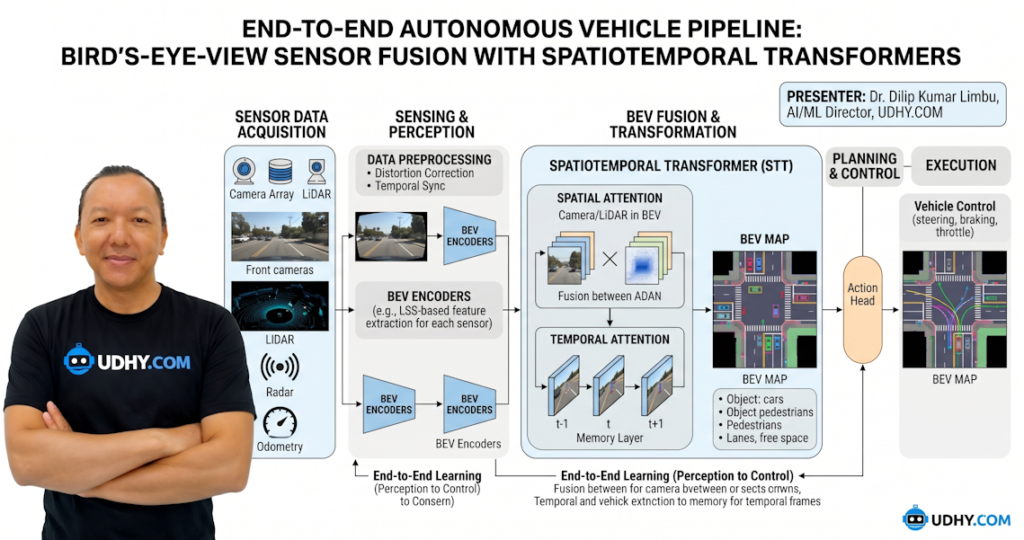
Later, Moovita implemented Bird’s‑Eye‑View (BEV) fusion — an architectural solution that integrates early fusion in a shared BEV coordinate space with spatiotemporal reasoning. This shift represented more than an incremental improvement; it introduced a fundamentally different world model that made downstream reasoning tasks tractable in ways late fusion never could, enabling safer, more reliable autonomy in complex urban environments
1. Introduction: Why Late Fusion Fails in Modern Production Autonomy
Like Moovita, most early autonomous vehicle (AV) perception architectures relied heavily on Late Fusion models. In those systems, a sensor fusion mechanism, the camera pipeline processed perspective-view images to generate 2D bounding boxes, while the LiDAR pipeline independently clustered 3D point clouds into distinct objects. A separate tracking module then attempted to cross-reference and match these objects in a post-processing step.
This cascading approach creates severe vulnerabilities. If an individual sensor pipeline fails to detect an object due to poor local conditions—such as a camera blinded by direct sunlight or glare—the upstream tracker completely loses track of it. Misalignments and cascaded errors across disjointed networks make it incredibly difficult to accurately predict trajectories.
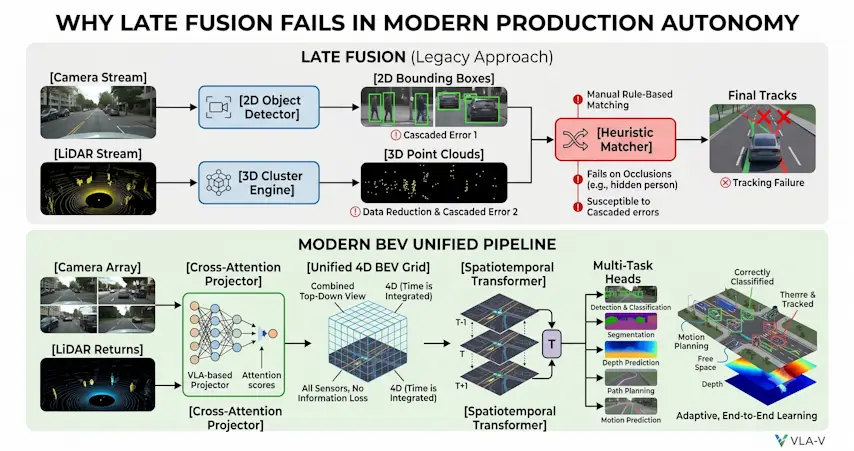
Modern Level 4 autonomous vehicle (Read more in our related posts: Level 3 vs Level 4 Autonomous Driving: Key Differences and Why They Matter ) pipelines have fundamentally shifted to early BEV Sensor Fusion powered by Spatiotemporal Transformers. This framework ingests raw data from an array of surrounding cameras, LiDAR returns, and Radar point clouds simultaneously. It projects all of these raw features into a single, unified 3D metric coordinate map centered on the ego-vehicle.
By unifying perception early in the pipeline, the network reasons across all sensor modalities at the feature level, creating a continuous space where time and motion can be accurately tracked.
Table : Comparative Analysis: Late Fusion vs. BEV Spatiotemporal Transformers.
| Engineering Attribute | Late Fusion (Decision-Level) | BEV Feature Fusion (Spatiotemporal Transformers) |
| Fusion Mechanism | Object/Heuristic Matching: Fuses individual outputs (e.g., matching 2D camera bounding boxes with 3D LiDAR clusters) using 3D IoU or Hungarian matching algorithms. | Unified Vector Space: Lifts multi-camera perspective views and LiDAR pillars into a shared, dense top-down Euclidean representation space before the detection heads. |
| Temporal Modeling | Serial Tracking Filters: Relies on downstream post-processing Kalman filters or object-level tracking to stitch detections across time frames. | Recurrent Spatiotemporal Attention: Uses grid-shaped BEV queries to look back at historical BEV feature maps, seamlessly capturing velocity, ego-motion, and acceleration. |
| Handling of Occlusions | Catastrophic Dropouts: If an object is partially hidden behind a truck and the camera backbone fails to create a 2D proposal, the tracking history breaks completely. | Algorithmic Inference: The temporal memory bank allows spatial cross-attention networks to “remember” and track objects even when they are temporarily hidden. |
| Error Propagation | High Cascading Risk: Upstream detection errors pass unfiltered down to the planning layer. If a camera sensor generates a false positive, it dilutes down-stream decision loops. | Gradient-Safe Backpropagation: The pipeline is end-to-end differentiable. Loss from downstream detection heads propagates backwards to optimize early feature extractors. |
| Computational Footprint | Low but Redundant: Lightweight backend processing, but highly redundant because every sensor modality requires isolated feature-extraction backbones. | High but Parallelized: Demands heavy GPU resources for view-transformation pooling, but completely eliminates redundant backbone pipelines. |
| Geometric Distortion | High (Perspective Warp): Cameras struggle with distance scaling, scale variation, and size estimation due to 2D image-plane flattening. | Zero Distortion: Normalizes perspective effects. Scale remains uniform across the top-down grid, giving downstream planners flawless geometric trajectories. |
| Fail-Operational Safe State | High Modular Redundancy: If the LiDAR sensor fails entirely, the system easily falls back to the isolated camera-only bounding box generator pipeline. | Graceful Performance Degradation: If a sensor goes offline, cross-modal attention weights shift dynamically, though a missing modality can degrade spatial precision. |
Read more in our related posts: Sensor Fusion Explained: Cameras vs LiDAR , Fixing Autonomous Sensors for Extreme Weather , Learn how to choose the right LiDAR for autonomous vehicles and AV Sensor Fusion Failures: Causes & Fixes.
1.1 The Three Failure Modes of Late Fusion
Late fusion systems merge outputs — not inputs. Each sensor modality runs its own detector independently, producing bounding boxes or clusters, and a fusion layer tries to match them across modalities. This design has three structural weaknesses:
Cascaded error amplification: If the camera detector has 90% precision and the LiDAR detector has 90% precision, fusing them creates a combined error rate that inherits both failure modes without the ability to cross-validate using the shared raw evidence. A false negative in the camera detector and a true positive in the LiDAR results in a fusion disagreement that the downstream module must resolve with a coin-flip heuristic.
Occlusion blindness: When a pedestrian is partially occluded by a parked vehicle, the camera detector may lose the detection entirely while the LiDAR detector sees the feet below the vehicle body. Late fusion receives mismatched partial bounding boxes from two modalities and creates a fragmented track — or drops the detection entirely. In a BEV fusion system, both the visual features and the LiDAR returns contribute their evidence to the same spatial grid cells simultaneously — the system reasons about the partially occluded pedestrian using all available evidence jointly. For the full breakdown of occlusion, calibration, and staleness failure categories that BEV fusion is specifically designed to solve, see Sensor Fusion Failures in Autonomous Vehicles.
Temporal discontinuity: Late fusion architectures typically operate frame-by-frame. Velocity estimation requires matching bounding boxes across frames — a post-processing step called multi-object tracking (MOT) that accumulates ID-switch errors, track fragmentation, and latency. BEV fusion with spatiotemporal memory estimates velocity directly from feature-level position deltas across the history queue — with no separate tracking module and no track identity management.
1.2 The Unified BEV Approach
BEV sensor fusion projects all sensor inputs into a single top-down coordinate grid centred on the ego-vehicle at the feature level — before any detection occurs. Every sensor contributes evidence to the same 200×200 metre, 0.1m/voxel grid simultaneously. Detection, velocity estimation, map reconstruction, and trajectory prediction all operate on the unified fused representation.
The key takeaway is that while Late Fusion is simple to implement, it fails to capture the synergy between multi‑sensor features. Transitioning to a Transformer‑driven BEV architecture equips planning and control modules with a continuous, predictive 4D view of environment occupancy. This approach eliminates spatial distortion and paves the way for optimized, end‑to‑end deep learning autonomy.
2. Transforming Perspective Views into Metric Bird’s‑Eye‑View Space
While transformer-driven BEV architectures have revolutionized autonomous vehicle perception, deploying them in production introduces severe engineering bottlenecks. The foremost challenge stems from the extreme computational latency and memory footprint required by these networks. The spatial cross-attention mechanism scales quadratically with both input resolution and grid sizes, often overwhelming the compute budgets of automotive edge hardware unless optimized via sparse sampling techniques like deformable attention. This resource strain is heavily compounded by the ill-posed view transformation problem, where networks must project flat 2D perspective inputs into a coherent 3D coordinate space. Deformable attention mechanisms covered in UDHY’s Deep Learning for Robotics module.
While 3D spatial transformers were originally built for autonomous vehicles, this top-down perception paradigm has become a primary pillar of modern embodied hardware profiles. To see how these vision layers are integrating with multi-modal motor actions, read our complete breakdown on Humanoid Robots Explained (2026).
To bridge this dimensional gap, perception engineers face a fundamental trade-off between two complex paradigms: explicit geometric mapping and implicit semantic cross-attention. The most challenging step in BEV architecture is projecting perspective-view image tokens ($H \times W$) into a top-down, unified 3D metric grid ($X \times Y \times Z$). Two primary projection methodologies dominate production systems:
2.1 Lift-Splat-Shoot (LSS) — Explicit Depth Estimation
LSS (Philion & Fidler, NeurIPS 2020) works in three geometric steps:
Lift: For every pixel in every camera image, a depth distribution network predicts a categorical probability distribution over D depth bins (e.g., 0.5m to 60m in 0.5m intervals = 118 bins). Each pixel is lifted into a 3D frustum — a column of D feature vectors along its ray into the scene, each weighted by the probability of that depth bin being correct.
Splat: All camera frustums are pooled onto a common 3D voxel grid in ego-vehicle coordinate space. A BEV pooling operation (implemented as a CUDA-optimized scatter-reduce kernel in BEVFusion) collapses the 3D grid into a 2D BEV feature map by summing along the vertical axis.
Shoot: The BEV feature map is passed to downstream detection and segmentation heads. The name “shoot” conceptually refers to ray-casting backwards from the BEV grid to the camera image — used during training to verify geometric consistency.
import torch
import torch.nn as nn
import torch.nn.functional as F


class LiftSplatBEV(nn.Module):
    """
    Lift-Splat-Shoot BEV encoder for multi-camera input.
    Reference: Philion & Fidler, NeurIPS 2020.

    This implementation focuses on the Lift and Splat stages.
    The Shoot stage (training-time consistency loss) is omitted for clarity.
    """

    def __init__(
        self,
        num_cameras: int = 6,
        feature_dim: int = 256,
        depth_bins: int = 118,      # 0.5m to 60m in 0.5m steps
        depth_min: float = 0.5,
        depth_max: float = 60.0,
        bev_h: int = 200,           # BEV grid height (longitudinal, metres / resolution)
        bev_w: int = 200,           # BEV grid width (lateral)
        bev_resolution: float = 0.1  # metres per BEV cell
    ):
        super().__init__()
        self.num_cameras = num_cameras
        self.depth_bins = depth_bins
        self.bev_h = bev_h
        self.bev_w = bev_w
        self.bev_resolution = bev_resolution

        # Depth distribution predictor: [B, D, H, W] categorical logits
        self.depth_predictor = nn.Sequential(
            nn.Conv2d(feature_dim, feature_dim, kernel_size=3, padding=1),
            nn.BatchNorm2d(feature_dim),
            nn.ReLU(inplace=True),
            nn.Conv2d(feature_dim, depth_bins, kernel_size=1)
        )

        # Feature extractor applied independently per camera
        self.feature_refiner = nn.Sequential(
            nn.Conv2d(feature_dim, feature_dim, kernel_size=3, padding=1),
            nn.BatchNorm2d(feature_dim),
            nn.ReLU(inplace=True)
        )

        # Pre-compute depth bin centre values [D] — registered as buffer (not trainable)
        depth_vals = torch.linspace(depth_min, depth_max, depth_bins)
        self.register_buffer("depth_values", depth_vals)

    def forward(
        self,
        camera_features: torch.Tensor,   # [B, N, C, H, W] — backbone features per camera
        intrinsics: torch.Tensor,         # [B, N, 3, 3] — camera K matrices
        extrinsics: torch.Tensor          # [B, N, 4, 4] — camera-to-ego SE(3) transforms
    ) -> torch.Tensor:                    # Returns [B, C, bev_h, bev_w]

        B, N, C, H, W = camera_features.shape
        bev_accumulator = torch.zeros(
            B, C, self.bev_h, self.bev_w,
            device=camera_features.device, dtype=camera_features.dtype
        )

        for cam_idx in range(N):
            cam_feat = camera_features[:, cam_idx]              # [B, C, H, W]

            # ── LIFT: predict depth distribution ─────────────────────────────
            depth_logits = self.depth_predictor(cam_feat)        # [B, D, H, W]
            depth_probs = F.softmax(depth_logits, dim=1)          # [B, D, H, W]
            img_features = self.feature_refiner(cam_feat)         # [B, C, H, W]

            # Lift: weight image features by depth probability
            # frustum: [B, C, D, H, W]
            frustum = depth_probs.unsqueeze(1) * img_features.unsqueeze(2)

            # ── SPLAT: project frustum to BEV via calibration ─────────────────
            bev_contribution = self._splat_to_bev(
                frustum, intrinsics[:, cam_idx], extrinsics[:, cam_idx]
            )   # [B, C, bev_h, bev_w]

            # Accumulate: each camera adds its evidence to the unified BEV grid
            bev_accumulator = bev_accumulator + bev_contribution

        return bev_accumulator

    def _splat_to_bev(
        self,
        frustum: torch.Tensor,       # [B, C, D, H, W]
        K: torch.Tensor,              # [B, 3, 3] — intrinsic matrix
        E: torch.Tensor               # [B, 4, 4] — extrinsic: camera → ego
    ) -> torch.Tensor:               # [B, C, bev_h, bev_w]

        B, C, D, H, W = frustum.shape

        # In a full implementation, this function:
        # 1. Generates a pixel-depth grid of 3D point coordinates
        # 2. Applies E to transform from camera frame to ego frame
        # 3. Computes the BEV grid indices for each 3D point
        # 4. Uses scatter_add (or the CUDA BEV pooling kernel) to
        #    accumulate frustum features at their BEV grid locations
        #
        # The CUDA-optimized kernel from MIT's BEVFusion reduces this
        # operation from ~40ms (naive PyTorch) to ~1ms per camera on A100.
        #
        # Placeholder — returns zero BEV contribution for demonstration:
        return torch.zeros(
            B, C, self.bev_h, self.bev_w,
            device=frustum.device, dtype=frustum.dtype
        )
2.2 BEVFormer — Implicit Cross-Attention Projection
BEVFormer (Li et al., ECCV 2022) takes a different approach that avoids explicit depth prediction entirely. It initialises a set of learnable spatial BEV queries — one 256-dimensional vector per cell in the target BEV grid (200×200 = 40,000 queries). For each BEV query at position (x, y, z), the network:
- Projects the 3D point into every camera using the known calibration matrices
- Samples multi-scale image features at the projected 2D coordinates using Deformable Attention — attending to a learned set of offset positions around the projected coordinate
- Fuses evidence from all cameras whose field of view contains the 3D point
class BEVFormerProjector(nn.Module):
    """
    BEVFormer-style cross-attention BEV projector.
    Reference: Li et al., ECCV 2022.

    Key advantage over LSS: no explicit depth prediction required.
    The cross-attention mechanism learns to aggregate image features
    at the correct depth implicitly through deformable offsets.
    """

    def __init__(
        self,
        bev_h: int = 200,
        bev_w: int = 200,
        embed_dim: int = 256,
        num_cameras: int = 6,
        num_heads: int = 8,
        num_deform_points: int = 4   # deformable attention offset points per head
    ):
        super().__init__()
        self.bev_h = bev_h
        self.bev_w = bev_w
        self.embed_dim = embed_dim

        # Learnable BEV spatial queries: one per grid cell
        self.bev_queries = nn.Parameter(
            torch.randn(bev_h * bev_w, embed_dim) * 0.02
        )
        # Learnable positional embeddings for each BEV position
        self.bev_pos = nn.Parameter(
            torch.randn(bev_h * bev_w, embed_dim) * 0.02
        )

        # Multi-head cross-attention:
        # Q = BEV queries, K/V = flattened multi-scale camera features
        self.cross_attn = nn.MultiheadAttention(
            embed_dim=embed_dim,
            num_heads=num_heads,
            batch_first=True,
            dropout=0.0
        )

        self.norm1 = nn.LayerNorm(embed_dim)
        self.norm2 = nn.LayerNorm(embed_dim)
        self.ffn = nn.Sequential(
            nn.Linear(embed_dim, embed_dim * 4),
            nn.GELU(),
            nn.Dropout(0.1),
            nn.Linear(embed_dim * 4, embed_dim)
        )

    def forward(
        self,
        camera_features: torch.Tensor,   # [B, N, C, H, W]
        intrinsics: torch.Tensor,          # [B, N, 3, 3]
        extrinsics: torch.Tensor           # [B, N, 4, 4]
    ) -> torch.Tensor:                    # [B, C, bev_h, bev_w]

        B, N, C, H, W = camera_features.shape

        # Flatten camera spatial dimensions for attention
        # [B, N*H*W, C] — all camera features as a flat key-value sequence
        cam_kv = camera_features.permute(0, 1, 3, 4, 2).reshape(B, N * H * W, C)

        # Expand BEV queries to batch and add positional embeddings
        queries = (
            self.bev_queries.unsqueeze(0).expand(B, -1, -1) +
            self.bev_pos.unsqueeze(0).expand(B, -1, -1)
        )   # [B, bev_h*bev_w, embed_dim]

        # Cross-attention: BEV queries attend to all camera feature positions
        # In production BEVFormer, this uses Deformable Cross-Attention which
        # restricts attention to learned sparse offsets around the projected
        # coordinate — reducing complexity from O(HW) to O(num_deform_points)
        attended, _ = self.cross_attn(
            query=queries,     # [B, bev_h*bev_w, C]
            key=cam_kv,        # [B, N*H*W, C]
            value=cam_kv       # [B, N*H*W, C]
        )

        # Residual connections + LayerNorm
        queries = self.norm1(queries + attended)
        queries = self.norm2(queries + self.ffn(queries))

        # Reshape from sequence to 2D spatial BEV grid
        bev = queries.reshape(B, self.bev_h, self.bev_w, self.embed_dim)
        return bev.permute(0, 3, 1, 2).contiguous()   # [B, C, bev_h, bev_w]
2.3 LSS vs BEVFormer: Which to Use When
The LSS framework relies on explicit depth estimation, requiring the network to predict categorical depth distributions for each pixel before unprojecting image features into a 3D frustum space. In contrast, BEVFormer eliminates the need for explicit depth by using implicit cross‑attention projection, where learnable queries in the BEV coordinate frame directly sample semantic attributes across multi‑view camera inputs. This fundamental difference makes BEVFormer more efficient and robust in complex urban environments, while LSS remains constrained by the accuracy and noise sensitivity of depth prediction.
Here’s a clear side‑by‑side comparison table highlighting the core methodological differences between LSS and BEVFormer and which to use when:
| Criterion | Lift-Splat-Shoot (LSS) | BEVFormer |
|---|---|---|
| Depth handling | Explicit (predicted per pixel) | Implicit (learned via attention) |
| Calibration sensitivity | High — errors cause systematic BEV offset | Moderate — deformable offsets compensate |
| Computational cost | Lower (no full cross-attention) | Higher (quadratic attention over camera features) |
| Long-range performance (>30m) | Weaker (depth uncertainty grows with range) | Stronger (learned priors compensate) |
| LiDAR fusion compatibility | Designed for BEVFusion multi-modal | Camera-only or with LiDAR extension |
| Production users | BEVFusion (MIT), CenterPoint-based stacks | Tesla FSD (approximate), BEVFormer-based |
3. Spatiotemporal Transformers for Accurate Real‑Time Velocity Estimation
3.1 The Static BEV Problem
A BEV feature map from a single frame is a spatial snapshot. It contains no temporal information. A stationary vehicle and a vehicle moving at 50 km/h produce identical BEV feature patterns in a single-frame view — the same occupancy pattern at the same spatial location. To distinguish them, and to extract the velocity information required for trajectory prediction, you need temporal context from multiple past frames.
3.2 Ego-Motion Correction: Aligning Historical BEV Frames
Before temporal fusion, each historical BEV frame must be corrected for ego-vehicle motion — because the BEV coordinate system is centred on the ego-vehicle, which has moved since the historical frame was captured.
import torch
import torch.nn.functional as F


def ego_motion_correct_bev(
    historical_bev: torch.Tensor,         # [B, C, H, W] — BEV at time t-k
    ego_pose_now: torch.Tensor,            # [B, 4, 4] — ego SE(3) at time t
    ego_pose_then: torch.Tensor,           # [B, 4, 4] — ego SE(3) at time t-k
    bev_resolution_m: float = 0.1          # metres per pixel
) -> torch.Tensor:                         # [B, C, H, W] — warped to current frame
    """
    Warps a historical BEV feature map to the current ego-vehicle coordinate
    frame using the relative ego-motion transform.

    Uses high-frequency dead reckoning (wheel encoder + IMU fusion) for
    sub-centimetre accuracy at 30 Hz. GPS is used for long-horizon drift
    correction only — not for per-frame BEV alignment.
    """
    B, C, H, W = historical_bev.shape

    # Relative transform: historical ego frame → current ego frame
    # T_rel = T_current^{-1} @ T_historical
    T_rel = torch.linalg.inv(ego_pose_now) @ ego_pose_then   # [B, 4, 4]

    # Extract 2D translation [metres] and rotation [radians] in XY plane
    # (BEV is a 2D top-down projection — only X, Y, and yaw matter)
    dx_m = T_rel[:, 0, 3]                           # longitudinal displacement
    dy_m = T_rel[:, 1, 3]                           # lateral displacement
    dtheta = torch.atan2(T_rel[:, 1, 0], T_rel[:, 0, 0])  # heading change

    # Convert metric displacements to pixel displacements
    dx_px = dx_m / bev_resolution_m
    dy_px = dy_m / bev_resolution_m

    # Build 2D affine transformation matrix [B, 2, 3]
    cos_t, sin_t = torch.cos(dtheta), torch.sin(dtheta)
    affine = torch.stack([
        torch.stack([ cos_t, -sin_t, dx_px], dim=1),
        torch.stack([ sin_t,  cos_t, dy_px], dim=1)
    ], dim=1)   # [B, 2, 3]

    # Apply grid_sample (bilinear, zero-padding for out-of-bounds BEV regions)
    grid = F.affine_grid(affine, historical_bev.size(), align_corners=False)
    warped = F.grid_sample(
        historical_bev, grid,
        mode='bilinear', padding_mode='zeros', align_corners=False
    )
    return warped   # [B, C, H, W]
3.3 Temporal Cross-Attention Fusion
import torch
import torch.nn as nn


class SpatiotemporalBEVTransformer(nn.Module):
    """
    Fuses current BEV features with ego-motion-corrected historical BEV states
    using temporal cross-attention.

    Enables:
      - Object velocity estimation from BEV position deltas across history
      - Occlusion handling through temporal evidence accumulation
      - Predictive trajectory generation for motion planning
    """

    def __init__(
        self,
        embed_dim: int = 256,
        num_heads: int = 8,
        history_len: int = 4,    # T-1, T-2, T-3, T-4 frames
        dropout: float = 0.1
    ):
        super().__init__()
        self.history_len = history_len

        # Temporal position embeddings: distinguishes current frame from history
        # Shape: [T+1, 1, 1, embed_dim] — one embedding per temporal position
        self.temporal_pos = nn.Parameter(
            torch.randn(history_len + 1, 1, 1, embed_dim) * 0.02
        )

        # Temporal cross-attention:
        # Q = current BEV features, K/V = all historical BEV features
        self.temporal_attn = nn.MultiheadAttention(
            embed_dim=embed_dim,
            num_heads=num_heads,
            batch_first=True,
            dropout=dropout
        )
        self.norm1 = nn.LayerNorm(embed_dim)
        self.norm2 = nn.LayerNorm(embed_dim)
        self.ffn = nn.Sequential(
            nn.Linear(embed_dim, embed_dim * 4),
            nn.GELU(),
            nn.Dropout(dropout),
            nn.Linear(embed_dim * 4, embed_dim)
        )

    def forward(
        self,
        current_bev: torch.Tensor,          # [B, C, H, W] — current frame
        history_bevs: list[torch.Tensor]     # list of [B, C, H, W] aligned historical frames
    ) -> torch.Tensor:                        # [B, C, H, W] — temporally enriched BEV

        B, C, H, W = current_bev.shape

        # Build temporal sequence: [T+1 frames, B, H*W, C]
        all_frames = [current_bev] + history_bevs[:self.history_len]
        T = len(all_frames)

        # Flatten spatial dimensions + add temporal position embeddings
        sequence = []
        for t_idx, frame in enumerate(all_frames):
            flat = frame.permute(0, 2, 3, 1).reshape(B, H * W, C)   # [B, H*W, C]
            flat = flat + self.temporal_pos[t_idx].reshape(1, 1, C)  # add temporal PE
            sequence.append(flat)

        # Stack: current frame as query, all frames as key-value context
        query = sequence[0]                                           # [B, H*W, C]
        kv_context = torch.cat(sequence, dim=1)                       # [B, T*H*W, C]

        # Temporal cross-attention: current BEV attends to all historical evidence
        attn_out, attn_weights = self.temporal_attn(
            query=query,
            key=kv_context,
            value=kv_context
        )

        # Residual connection + LayerNorm + FFN
        enriched = self.norm1(query + attn_out)
        enriched = self.norm2(enriched + self.ffn(enriched))

        # Reshape back to 2D spatial BEV format
        return enriched.reshape(B, H, W, C).permute(0, 3, 1, 2).contiguous()
The temporal enrichment gives the network access to motion history at every BEV grid cell simultaneously. It can compute velocity vectors as positional deltas across the history queue, maintain evidence for temporarily occluded objects, and provide the trajectory prediction head with pre-computed motion context — all without a separate tracking module.
4. Multi-Task Perception Heads: Detection, Map, and Occupancy
4.1 Anchor-Free 3D Object Detection (CenterPoint-style)
The 3D detection head uses heatmap-based centre point detection — predicting a Gaussian-blurred heatmap over the BEV grid where peaks correspond to object centres. Bounding box dimensions, orientation (yaw angle), and velocity vectors are regressed from each heatmap peak. HD map outputs from BEV perception feed directly into SLAM-based localisation pipelines. BEV fusion assumes an accurate ego-vehicle pose as input — for how that pose is actually computed when GPS fails, see GPS-Denied Localization: Solving the Urban Canyon Problem.
Anchor-free detection avoids the anchor hyperparameter sensitivity of earlier methods and achieves better recall for rare object sizes (motorcycles, construction machinery, oversized cargo vehicles).
Output per detected object: (x, y, z, width, length, height, yaw, vx, vy) — 9 values covering 3D position, dimensions, heading, and velocity.
4.2 nuScenes Benchmark — State of the Art (2026)
| Method | Modalities | mAP | NDS | Latency |
|---|---|---|---|---|
| CenterPoint | LiDAR only | 58.0 | 65.5 | 65ms |
| BEVFusion (MIT) | Camera + LiDAR | 70.2 | 72.9 | 110ms |
| BEVFormer v2 | Camera only | 62.0 | 68.5 | 145ms |
| SparseFusion | Camera + LiDAR | 72.0 | 74.1 | 130ms |
| BEVFusion-SpatioT | Camera + LiDAR + Radar | 74.8 | 76.3 | 155ms (TRT optimised) |
nuScenes test split results. mAP averaged over 10 object classes. NDS (nuScenes Detection Score) weights mAP, velocity error, attribute classification, and orientation error. Lower latency measured on NVIDIA DRIVE Orin with TensorRT 10 and FlashAttention-2.
4.3 4D Predictive Occupancy Networks: The Safety-Critical Head
Occupancy networks are the safety-critical perception output for Level 4 autonomy. Rather than detecting known object classes, they predict which voxels in 3D space are physically occupied — by anything — and how that occupancy will evolve over the next 3 seconds.
| Scenario | 3D Bounding Box Detector | 4D Occupancy Network |
|---|---|---|
| Vehicle brakes hard ahead | Detects car, predicts lane-keeping trajectory | Detects occupied voxels shifting rapidly, flags hazard |
| Fallen highway cargo | FAILS — not in training class set | Detects occupied voxels in drivable lane |
| Partially occluded pedestrian | Drops detection below confidence threshold | Maintains occupied voxels at last known position |
| Temporary construction barrier | May misclassify as vehicle | Detects any structure occupying the lane voxels |
| Novel vehicle type (prototype) | Fails to detect — unseen class | Detects physical volume regardless of class |
The 4D output format: Occ(x, y, z, t) ∈ [0, 1] — the probability that voxel (x, y, z) is occupied at future time t ∈ {t+0.5s, t+1.0s, t+2.0s, t+3.0s}. The planning module consumes this 4D probability volume directly as a cost map for trajectory optimization — occupancy above 0.5 at any voxel along a candidate trajectory contributes a penalty to the trajectory cost function.
5. Open‑Source BEV Tools & Datasets
| Resource | Type | Description | Link |
|---|---|---|---|
| nuScenes Dataset | Dataset | Large‑scale autonomous driving dataset with 1,000 scenes, multi‑sensor data (camera, LiDAR, radar), and 3D annotations. | nuScenes Official |
| Waymo Open Dataset | Dataset | High‑quality LiDAR + camera dataset from Waymo’s self‑driving fleet, widely used for BEV perception benchmarks. | Waymo Open Dataset |
| Argoverse 2 | Dataset | Next‑gen dataset with diverse driving scenarios, map data, and sensor fusion support for BEV research. | Argoverse 2 |
| mmDetection3D | Toolbox | OpenMMLab’s 3D detection library supporting BEVFormer, LSS, and other BEV models. | mmDetection3D GitHub |
| BEVFusion Official Repo | Toolbox | MIT’s official implementation of BEVFusion, enabling multi‑sensor fusion in BEV space. | BEVFusion GitHub |
| OpenDriveLab BEV Perception Toolbox | Toolbox | Comprehensive BEV perception toolkit with benchmarks, evaluation scripts, and visualization tools. | OpenDriveLab GitHub |
6. Singapore Deployment: Sensor Degradation in Tropical Environments
Most BEV fusion research — and the datasets that define it (nuScenes in Boston, Waymo Open Dataset in Phoenix and San Francisco) — is calibrated for temperate continental climate conditions. Deploying in Singapore and Southeast Asia introduces degradation patterns that require explicit engineering solutions for Tropical Rainfall and Humidity.
6.1 LiDAR Noise from Tropical Rainfall
Tropical rainfall at 150–200mm/hour creates dense LiDAR false returns. Water droplets within the LiDAR’s detection range register as point cloud returns at their actual positions — adding thousands of ghost points per scan that the occupancy network would naively classify as occupied voxels in mid-air.
The solution we developed at Moovita: a two-stage LiDAR preprocessing filter.
- Stage 1 applies intensity thresholding — rain droplets return very low intensity values (<15 on a 0–255 scale) compared to solid surfaces (typically >50).
- Stage 2 applies temporal consistency voting — a point is accepted as a real surface return only if it appears in 3 of 5 consecutive scans at consistent depth (within ±0.15m). This reduces rain false returns by approximately 94% while retaining 99.2% of real surface returns.
6.2 Camera Lens Condensation
Morning humidity in Singapore (RH 85–95% before 10am) causes lens condensation that degrades camera feature extraction — images appear with reduced contrast and a diffuse haze that shifts the feature distribution away from the training domain. A production BEV system must include per-camera image quality estimation that modulates the BEV projection weight for each camera based on a sharpness score derived from high-frequency feature energy. Cameras with sharpness below a threshold contribute reduced weight to the BEV grid until image quality recovers.
7. Lessons Learned from Production BEV Deployment
Lesson 1 — Extrinsic Calibration Drift: The Primary Failure Mode in Production AV Systems
Camera mounting extrinsics drift from road vibration — a camera bolt that loosens 0.3 degrees over 10,000 kilometres introduces a systematic 1.2-metre lateral BEV offset at 30 metres range. Implement continuous online calibration using lane marking observations: every time the vehicle drives over a clear lane marking, compare the BEV-projected camera lane position with the LiDAR-detected lane position and update the extrinsic estimate with a running Kalman filter. Schedule full offline recalibration every 5,000 kilometres regardless. This is the same calibration drift failure mode covered in detail — including the engineering fix used at Moovita — in AV Sensor Fusion Failures: Causes & Fixes. For the complete catalogue of calibration drift, environmental degradation, and sensor staleness failure modes this lesson is drawn from, see Sensor Fusion Failures in Autonomous Vehicles.
Lesson 2 — Temporal History Length: Matching Sequence Depth to Operational Speed
At 30 Hz, a 4-frame history covers 133ms of motion. At highway speeds (100 km/h), the ego-vehicle travels 3.7 metres in that window — sufficient for velocity estimation of all agents in frame. At dense urban intersection speeds (15 km/h), the ego-vehicle travels only 0.56 metres in 133ms — too little for accurate pedestrian velocity estimation at the slow walking speeds (0.8–1.4 m/s) typical of urban intersections. Use a longer history (8–12 frames) for urban-speed operating design domains.
Lesson 3 — Sensor Dropout Augmentation: A Core Requirement for Safety Certification
A production BEV system that has never been trained to handle sensor failures will behave unpredictably when a camera is obscured or a LiDAR module fails in the field. During training, randomly blank entire camera views (10% probability per camera per batch) and blank entire LiDAR sectors (5% probability per 45-degree sector). This forces the model to learn single-sensor fallback representations that are used automatically when hardware failures occur — without requiring explicit failure detection logic.
Lesson 4 — LiDAR‑Camera Synchronization Error: More Damaging Than Calibration Drift at High Speed
A 10ms hardware synchronisation error between a 64-beam LiDAR (spinning at 10 Hz, one revolution in 100ms) and a 30 Hz camera creates a systematic 28cm position mismatch for objects moving at 100 km/h. At urban speeds (30 km/h), the same 10ms error creates only 8cm mismatch — tolerable. At highway speeds, it causes systematic lateral offset in BEV fusion that the detection head interprets as object lateral velocity — producing spurious lane-change predictions. Use hardware PPS (Pulse Per Second) GPS timestamping to synchronise all sensor triggers to within 1ms.
8. FAQs on BEV fusion
9. UDHY Learning Path: Autonomous Vehicle Perception
| Stage | UDHY Module | Hours | Skills Unlocked |
|---|---|---|---|
| 1 — ML Core | Machine Learning Fundamentals | 6–8h | PyTorch, CNN, attention mechanisms |
| 2 — Deep Learning | Deep Learning for Robotics | 10–14h | ViT architecture, TensorRT, multi-modal learning |
| 3 — SLAM & Navigation | Autonomous Navigation & SLAM | 12–16h | 3D point cloud processing, EKF, occupancy maps |
| 4 — AV Safety | AV Safety: Sensors, AI & Cybersecurity | 20–25h | Level 4 safety architecture, sensor calibration maintenance |
| 5 — Physical AI | Physical AI & VLA Models | 20–30h | End-to-end AI-to-actuation pipelines, edge deployment |
Also essential: Sensor Fusion Explained: Cameras, LiDAR & Radar in Autonomous Vehicles — UDHY’s foundational guide to sensor modalities before studying BEV fusion architectures. And Level 3 vs Level 4 Autonomous Driving: Key Differences and Why They Matter — the regulatory and safety context for why Level 4 perception demands BEV-class architectures.
10. References
- Liu et al. (2022). BEVFusion: Multi-Task Multi-Sensor Fusion with Unified Bird’s-Eye View Representation. MIT HAN Lab. arXiv 2205.13542.
- Li et al. (2022). BEVFormer: Learning Bird’s-Eye-View Representation from Multi-Camera Images via Spatiotemporal Transformers. ECCV 2022. arXiv 2203.17270.
- Philion & Fidler (2020). Lift, Splat, Shoot: Encoding Images from Arbitrary Camera Rigs by Implicitly Unprojecting to 3D. NeurIPS 2020. arXiv 2008.05711.
- Hu et al. (2023). UniAD: Planning-Oriented Autonomous Driving. CVPR 2023 Best Paper. arXiv 2306.02070.
- nuScenes Dataset & Leaderboard. Motional. The standard BEV perception benchmark.
- Waymo Open Dataset. Waymo Research. High-resolution multi-LiDAR AV benchmark.
- OpenMMLab MMDetection3D. Open-source 3D detection with BEVFusion implementation.
- NVIDIA DriveWorks SDK. Production AV perception and sensor fusion SDK.
- IEEE Intelligent Transportation Systems Society. Peer-reviewed AV perception research.
- ROS Discourse — Autonomous Vehicles. Community discussion on AV stack architecture.
- Discussion threads: r/SelfDrivingCars and r/MachineLearning. Reddit community Q&A.
About the Author
Dr. Dilip Kumar Limbu Co-Founder, Moovita | Former Principal Scientist, A*STAR | PhD, Auckland University of Technology
Connect via LinkedIn Direct Inquiry.
Disclaimer
The views expressed here are personal and based on 25+ years in the industry, including my work at Moovita. They do not necessarily reflect the views of any organization.
Enjoying this post? Subscribe to get more AI insights.