How Does AI Work in Robotics? The Complete 2026 Expert Guide
If you’re searching for How Does AI Work in Robotics?, you’ve landed on the right post. Drawing on 25+ years of hands‑on experience in AI, robotics, and autonomous driving, I break down how artificial intelligence powers modern robots — from perception and planning to control and adaptive reasoning. This guide explores real‑world applications, the technologies behind breakthroughs like sensor fusion and vision‑language models, and the persistent edge cases that still challenge autonomous systems. Whether you’re a student, engineer, or industry leader, you’ll gain a technically grounded, honest perspective on what’s real, what’s hype, and what remains unsolved in robotics and AI today.
TL;DR — Quick Insights
- AI is the brain, robotics is the body: AI gives robots the ability to perceive their environment, make decisions, learn from experience, and act — transforming fixed machines into adaptive, intelligent systems
- The core pipeline: Every AI-powered robot follows the same fundamental loop — Sense → Perceive → Plan → Act — running hundreds of times per second
- Machine learning is the engine: Modern robots learn from data rather than being manually programmed for every situation, enabling them to generalise to new scenarios
- The 2026 frontier is VLA models: Vision-Language-Action models now allow robots to receive plain-English instructions and map them directly to physical actions — the biggest architectural shift in robotics AI in a decade
- Real deployments exist today: Sony AI’s robot beat professional table tennis players (published in Nature, April 2026); NVIDIA’s Isaac GR00T enables robots to understand natural language and perform complex multi-step tasks
Introduction: The Question Behind the Question
When people ask “how does AI work in robotics?”, they are usually asking something deeper: how does a machine — something made of metal and motors — become capable of seeing, thinking, and acting in the real world?
I have been answering versions of this question since 2008, when I joined A*STAR’s Institute for Infocomm Research in Singapore to work on intelligent robotics systems. I’ve worked across diverse robotics verticals — from social robots and industrial automation to advanced autonomous vehicles capable of navigating complex urban environments. I’ve architected intelligent driving behaviors that guide robots in dynamic situations and deployed autonomous shuttle that successfully carried passengers on Singapore’s streets.
In this post, I’ll answer the question ‘How does AI really work in robotics?’ — not with vague buzzwords, but with a precise, technically grounded explanation of what happens inside an AI‑powered robot. You’ll discover why these systems function, where they break down, and how robotics and autonomous driving are evolving in 2026. This is an expert perspective built on 25+ years of hands‑on experience in AI, robotics, and autonomous systems.
The Fundamental Distinction: What Makes a Robot “AI-Powered”?
Before diving into the mechanisms of robotics, the most critical distinction is between programmed robots and AI‑powered robots.
A traditional industrial robot — the type that has welded car chassis in factories since the 1970s — is purely programmed. It executes a fixed sequence of movements with extraordinary precision, but only within the environment its program anticipates. If anything changes in its workspace without reprogramming, the robot fails — welding thin air instead of metal. These robots are deterministic, rule‑based, and limited to repetitive tasks.
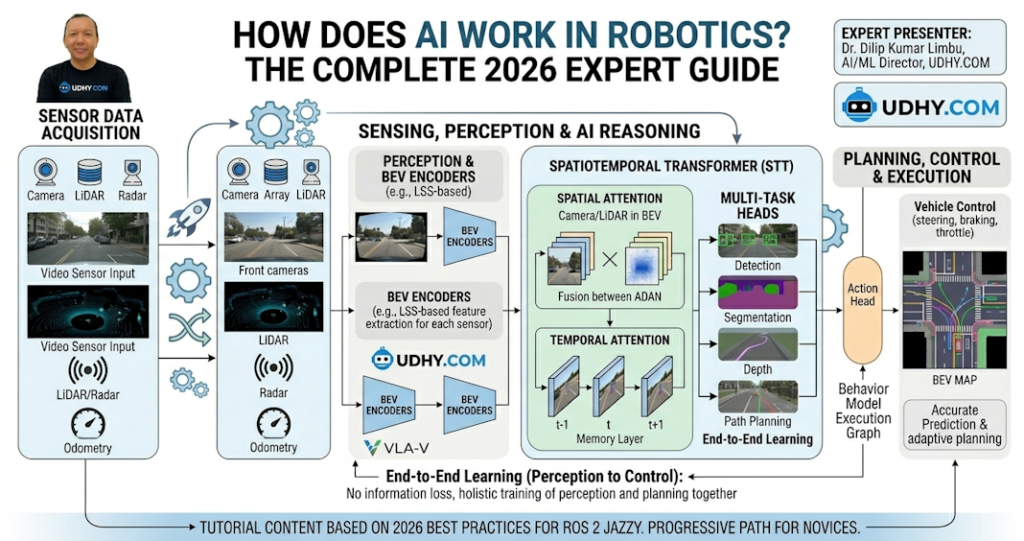
Table : Programmed Robots vs. AI‑Powered Robots
| Dimension | Programmed Robots | AI‑Powered Robots |
|---|---|---|
| Core Principle | Follow fixed, pre‑defined instructions | Learn and adapt using data and models |
| Flexibility | Rigid; fails if environment changes | Adaptive; adjusts to dynamic conditions |
| Examples | Industrial robots welding car chassis since 1970s | Autonomous vehicles, humanoid robots, service robots |
| Environment Handling | Works only in controlled, predictable settings | Operates in complex, uncertain, real‑world environments |
| Decision‑Making | Deterministic, rule‑based | Probabilistic, data‑driven, context‑aware |
| Error Tolerance | Breaks down if inputs deviate | Can interpret conflicting sensor data and choose best action |
| Human Interaction | Minimal; requires reprogramming for changes | Capable of social interaction, telepresence, and adaptive responses |
| Technology Backbone | Pre‑programmed logic, automation scripts | AI, machine learning, computer vision, sensor fusion |
| Deployment | Factory automation, repetitive tasks | Autonomous shuttles, delivery robots, urban mobility systems |
| Future Outlook | Stable but limited to repetitive precision tasks | Expanding into urban transport, healthcare, and human‑robot collaboration |
An AI‑powered robot, however, is fundamentally different. Instead of following rigid instructions, it leverages data, sensors, and learned models to adapt in real time. Using techniques such as computer vision, sensor fusion, reinforcement learning, and deep neural networks, AI robots can:
- Perceive their environment through cameras, LiDAR, radar, and other sensors.
- Understand what it is perceiving
- Predict what will happen next
- Plan how to achieve its goal – intelligent behaviors when sensor readings conflict, deciding the safest or most efficient action.
- Execute that plan – autonomously, adjusting movements and strategies based on continuous feedback.
- Learn from the outcome to do better next time
This adaptability is what enables autonomous vehicles (Continue reading : Self-Driving Cars Explained: How Autonomous Vehicles Work ) to navigate urban streets, humanoid robots to interact socially, and industrial robots to handle variable tasks without constant reprogramming.
In this post, I’ll go beyond vague buzzwords like “neural networks” and “machine learning” to provide a precise, technically grounded explanation of what happens inside an AI‑powered robot. You’ll learn why these systems succeed, where they break down, and how robotics and autonomous driving are evolving in 2026 — separating genuine progress from hype.
The AI Robotics Stack: Expert Guide to How Robots Actually Work in 2026
Every AI-powered robot, regardless of its shape or purpose, runs a version of the same fundamental architecture. I call it the Sense → Perceive → Plan → Act loop, and it is the backbone of everything from autonomous vehicles to humanoid robots to warehouse automation systems.
Layer 1: Sensing — The Robot’s Eyes and Ears
A robot can only act on information it can collect. The sensing layer is everything that connects the robot to the physical world.
Modern AI robots use multiple sensor types simultaneously:
| Sensor Type | What it measures | Strength | Weakness |
|---|---|---|---|
| RGB Camera | Colour image (2D) | Rich visual detail, cheap | No depth, fails in darkness |
| Depth Camera (RGBD) | Colour + distance per pixel | Structured depth at close range | Limited range, struggles outdoors |
| LiDAR | 3D point cloud via laser pulses | Precise 3D mapping, works in dark | Expensive, struggles in rain/fog |
| Radar | Distance and velocity via radio waves | All-weather, detects speed | Low resolution, no fine detail |
| IMU (Inertial Measurement Unit) | Acceleration and rotation | Fast, no drift on short timescales | Accumulates error over time |
| GPS (Global Positioning System)/ GNSS (Global Navigation Satellite System) | Global position | Long-range positioning | Poor accuracy indoors, blocked by buildings |
| Microphone | Sound and speech | Natural language input | Affected by noise |
| Force/Torque sensors | Contact forces at joints | Critical for manipulation | Requires physical contact |
| Tactile sensors | Surface texture and pressure | Fine grasping control | Complex, expensive |
A key insight from my years at A*STAR: no single sensor is sufficient for real-world robot operation. Every sensor has failure modes. Cameras go blind in glare or darkness. LiDAR scatters in heavy rain. GPS fails in tunnels. This is why real AI robots — autonomous vehicles, humanoids, warehouse robots — combine multiple sensor types and fuse their data together.
This process of combining sensor data into a unified, reliable understanding of the environment is called sensor fusion, and it is one of the most technically challenging and commercially valuable skills in the robotics field. Read more : Sensor Fusion Explained — Cameras, LiDAR and Radar.
Layer 2: Perception — Making Sense of Sensor Data
Raw sensor data is useless on its own. A camera produces millions of pixel values per second. A LiDAR produces hundreds of thousands of 3D points per second. The perception layer transforms this raw data into meaningful information about the world.
Perception in modern AI robotics is primarily handled by deep learning — specifically convolutional neural networks (CNNs) for image data and point cloud processing networks for LiDAR data. Continue reading : Best LiDAR Sensors for Rain & Fog 2026: The Top Weather-Resilient Picks.
What perception systems do:
- Object Detection and Classification
The robot needs to know what is in its environment — not just that something is there, but what it is. A person. A car. A door. A package. A box of strawberries. Modern perception networks, trained on millions of labelled images, can classify hundreds of object categories in real time at over 30 frames per second. - Semantic Segmentation
Beyond identifying objects, robots often need to understand every pixel of an image — this is road surface, this is footpath, this is a wall, this is a person’s arm. Semantic segmentation assigns a category label to every point in the robot’s field of view. - Depth Estimation
Even without a depth sensor, modern AI can estimate the distance to objects from a single camera image. This is called monocular depth estimation, and it is what Tesla’s FSD system uses — inferring 3D structure from 2D images using neural networks trained on billions of driving examples. - 3D Object Detection
When working with LiDAR point clouds, perception systems identify the 3D bounding boxes of objects — their position, dimensions, and orientation in three-dimensional space. This is critical for autonomous vehicles that need to know exactly where a pedestrian is and how they are oriented. - Pose Estimation
For manipulation tasks, robots need to know not just where an object is but how it is oriented in 3D space — its pose. A robot picking up a mug needs to know which way the handle is facing. Pose estimation networks solve this problem.
Key 2026 development: The newest frontier in robotics AI is the Vision-Language-Action (VLA) model — a single model that takes in what a robot sees, interprets a natural-language instruction, and outputs the physical actions to carry it out. Instead of stitching together separate perception, planning, and control systems, a VLA maps raw camera and sensor input plus a text command directly to motor commands.
This is a fundamental architectural shift. Rather than modular systems where perception feeds planning feeds control, VLA models collapse the entire pipeline into a single learned model. It is the most significant change in robotics AI architecture in a decade.
Layer 3: Localisation and Mapping — Where Am I?
Before a robot can plan where to go, it needs to know where it is. This sounds simple. In practice, it is one of the hardest problems in robotics. GPS gives position to within 3–5 metres — far too imprecise for a robot navigating a warehouse aisle or an AV changing lanes. The solution is SLAM: Simultaneous Localisation and Mapping.
SLAM allows a robot to:
- Build a map of its environment using sensor data
- Simultaneously localise itself within that map
- Update both the map and its estimated position continuously as it moves
At A*STAR, SLAM was central to every robots and autonomous system we built. Our autonomous vehicles maintained centimetre-level position estimates by combining GPS, IMU data, wheel odometry, and LiDAR-based scan matching against pre-built HD maps of the operational area.
Modern SLAM algorithms use deep learning to improve robustness — neural networks can identify stable landmarks in sensor data that traditional algorithms would miss, enabling reliable localisation even in challenging environments like underground car parks or rain-soaked streets.
Layer 4: Prediction — What Will Happen Next?
A robot operating in a shared environment — a warehouse, a road, a hospital corridor — cannot just react to what is currently there. It needs to anticipate what will happen in the next few seconds.
Motion prediction models the future trajectories of detected objects. A pedestrian at a kerb — will they step into the road? A cyclist approaching an intersection — are they slowing to turn or continuing straight? A forklift moving through a warehouse — where will it be in 3 seconds?
Deep learning-based prediction models, trained on thousands of hours of real-world movement data, learn the patterns of how different types of agents move in different contexts. They output probability distributions over possible future trajectories — not a single prediction, but a range of possibilities with associated likelihoods.
This probabilistic approach is essential. The robot does not know with certainty what the pedestrian will do. But it can plan conservatively around the possibilities — slowing down if the probability of the pedestrian stepping out is above a threshold, adjusting its path to give more margin.
Layer 5: Planning — What Should I Do?
Given an understanding of the current environment and predictions about its future state, the planning layer decides what the robot should do.
Planning in AI robotics operates at multiple timescales simultaneously:
- Strategic planning (long horizon)
Where is the robot going overall? What route should it take from point A to point B given the current map and known obstacles? Strategic planners use graph search algorithms (A*, Dijkstra’s) and learned global planners to find efficient routes. - Tactical planning (medium horizon)
How should the robot navigate the next 10–30 seconds? Should it wait for a pedestrian to cross before proceeding? Should it change lanes to avoid a slow-moving vehicle? Tactical planners handle interactions with other agents in the environment. - Reactive planning (short horizon)
What should the robot do right now, in the next fraction of a second, to avoid an immediate obstacle or track its target trajectory? Reactive planners operate at high frequency (10–100Hz) and handle the immediate moment-to-moment execution.
The key challenge in planning — which I saw repeatedly at A*STAR — is the interaction between these timescales. A long-horizon plan that leads through a crowded area may become impossible to execute reactively if the crowd is denser than predicted. The planning system needs to detect when its short-horizon execution is deviating from its long-horizon plan and trigger replanning accordingly.
Modern AI systems use reinforcement learning (RL) to train planning policies. Instead of hand-coding the rules for every situation, the robot learns by trial and error in simulation — taking actions, receiving rewards for good outcomes and penalties for bad ones, and gradually discovering policies that maximise cumulative reward. Reinforcement learning models can now anticipate how environments will change a few seconds ahead, enabling safer navigation.
Layer 6: Control — Turning Plans Into Physical Action
The control layer translates planning outputs into actual motor commands — how fast each wheel should spin, how much torque to apply to each joint, what voltage to send to each actuator.
This sounds like simple engineering. It is not.
Real robot hardware is imperfect. Motors have backlash. Joints have friction. Surfaces are not perfectly rigid. The relationship between a commanded motor voltage and the resulting physical movement is complex, nonlinear, and varies with temperature, wear, and load.
PID controllers (Proportional-Integral-Derivative) are the classical approach — they continuously measure the error between where the robot is and where it should be, and apply corrective forces proportionally. They work well for simple, well-modelled systems.
For complex systems — humanoid robot locomotion, dexterous manipulation, high-speed dynamic motion — learned controllers trained with reinforcement learning significantly outperform hand-tuned PID. The robot learns through millions of simulated trials what control signals produce desired movements, including how to recover from perturbations that no hand-coded controller anticipated.
Sony AI’s project Ace — published in Nature in April 2026 — demonstrated a robot that beat professional table tennis players using low-latency perception and control systems capable of reacting to unusual shots, including balls bouncing off the net. This represents the first known real-world autonomous system competitive with elite and professional-level human players in a commonly played competitive sport — and it relied on reinforcement-learned control policies that no human programmer could have hand-coded.
Layer 7: Learning — How Robots Get Better Over Time
What makes AI-powered robots categorically different from traditional programmed robots is the ability to learn — to improve performance based on experience.
- Supervised learning trains models on labelled datasets. A perception system is trained on millions of images labelled “pedestrian,” “car,” “cyclist” — it learns to classify new images by finding patterns in the training data. This is how virtually all modern robot perception systems work.
- Unsupervised and self-supervised learning allows robots to learn structure from unlabelled data. A robot that has observed thousands of hours of object manipulation can learn the physical properties of different materials — how they deform, how they respond to force — without anyone explicitly labelling each interaction.
- Reinforcement learning trains robots through reward signals rather than labelled data. The robot tries actions, observes outcomes, and updates its policy to maximise cumulative reward. This is how robots learn to walk, how they learn to play table tennis, and increasingly how they learn to plan in complex environments.
- Imitation learning / Learning from demonstration allows robots to learn by observing human demonstrations. A human performs a task — folding a towel, sorting packages — while a robot records the demonstration. The robot then learns to replicate the behaviour from its own sensor perspective. This is the foundation of the teleoperation-based data collection approach used by Figure AI, 1X Technologies, and others.
Foundation models and transfer learning are the most significant recent development. Rather than training each robot from scratch for each task, pre-trained foundation models encode broad knowledge about the physical world — from internet-scale visual data, from simulation, from robot demonstrations. These models can then be fine-tuned for specific tasks with far less data than training from scratch would require.
NVIDIA’s Isaac GR00T open models enable robots to understand natural language instructions and perform complex, multistep tasks using vision-language-action reasoning. NVIDIA Cosmos world models for generating synthetic data help robots learn more efficiently and generalise across environments.
The AI Robotics Architecture in 2026: What Has Changed
When I was at A*STAR in 2008, the architecture I described above was modular and sequential — dedicated perception modules fed their outputs to dedicated planning modules, which fed dedicated control modules. Each module was hand-engineered, each interface carefully specified.
In 2026, this is changing fundamentally. The pattern of perception → planning → action underlies many of the most advanced robotic systems emerging in 2025–2026. Vision-language models now guide robot manipulation through AI systems that understand instructions in natural language.
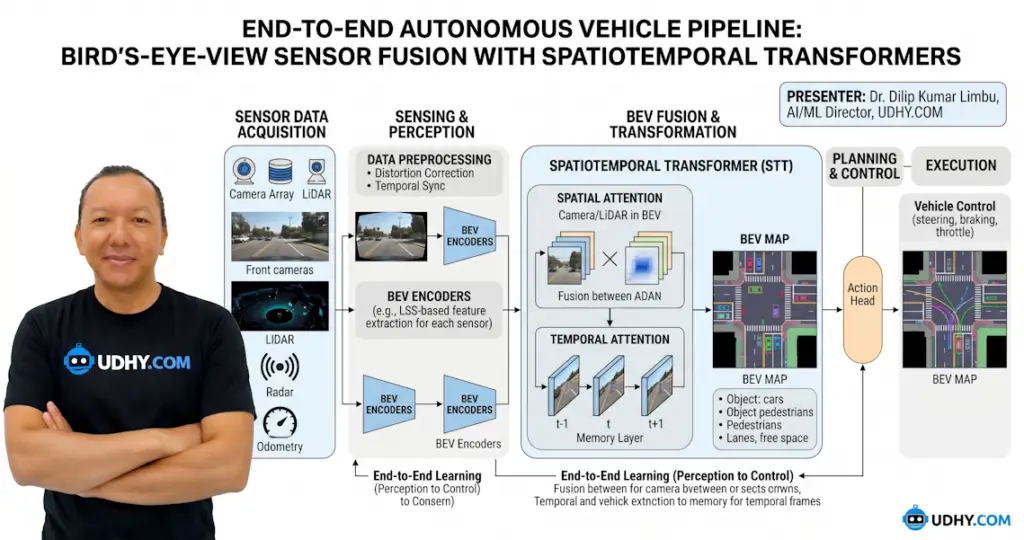
The shift is from modular, hand-engineered pipelines to end-to-end learned systems — particularly Vision-Language-Action (VLA) models — where a single large neural network takes raw sensor data and a natural language instruction as input and outputs motor commands directly.
The advantages of this approach are significant:
- No information is lost between modules (the perception module’s uncertainty is directly available to the planner)
- The system can learn jointly across the entire pipeline
- Natural language provides a flexible, human-understandable interface to robot behaviour
The disadvantages are also real:
- End-to-end models are harder to debug and interpret
- Failures can be opaque — it is difficult to know which part of the model caused an error
- They require large amounts of high-quality training data
This tension — between the power of end-to-end learning and the interpretability of modular systems — is one of the central debates in robotics AI in 2026 and will likely remain unresolved for years.
Real-World Applications: AI in Robotics Across Industries
Artificial Intelligence is no longer confined to research labs — it is transforming robotics across every major industry. From autonomous vehicles navigating complex city streets to industrial robots optimizing factory production, AI‑powered systems are redefining how machines perceive, plan, and act in dynamic environments.
Unlike traditional programmed robots that follow rigid instructions, AI‑driven robots adapt in real time using data, sensors, and learned models. This adaptability enables breakthroughs in:
Manufacturing and Industrial Automation
AI-powered robots in manufacturing have moved beyond simple welding and assembly. Modern systems use computer vision for quality inspection — detecting defects at micron resolution that human inspectors miss. Collaborative robots (cobots) use force sensing and AI to work safely alongside humans without physical barriers. Flexible manufacturing cells use AI planning to switch between product configurations without reprogramming.
Autonomous Vehicles
The most visible application of AI in robotics. Every autonomous vehicle is a robot — it senses the environment through cameras, LiDAR, and radar; perceives and classifies objects; predicts their behaviour; plans its route; and controls its motion. At Moovita, our autonomous shuttle systems deployed exactly this architecture on real Singapore roads. Read more Self-Driving Cars Explained — the most visible application of AI in robotics and Is AI Helping or Hurting Self-Driving Car Development ? and The Complete Guide to AV Teleoperation.
Warehouse and Logistics Robotics
Amazon’s fleet of 750,000+ warehouse robots uses AI for navigation, object recognition, and task allocation. The newest generation — including systems like Amazon’s Sparrow — uses deep learning-based manipulation to pick irregular, previously unseen items. This was considered an unsolved problem as recently as 2020. Continue reading : Autonomous Delivery Robots Future | How They Work & Who’s Deploying Them.
Healthcare and Surgical Robotics
The da Vinci surgical system, used in over 1.5 million procedures annually, uses AI to filter hand tremor, enhance surgeon vision, and provide haptic feedback. Research systems are moving toward semi-autonomous surgical subtasks — suturing, tissue retraction — where the robot performs routine actions under surgeon supervision.
Humanoid Robots
The newest and most ambitious application. The 2026 CVPR Embodied AI Workshop will host the ManipArena Competition, evaluating models’ physical reasoning, generalisation, and decision-making across 20 real-world tasks — measuring progress toward reproducible, general-purpose embodied intelligence.
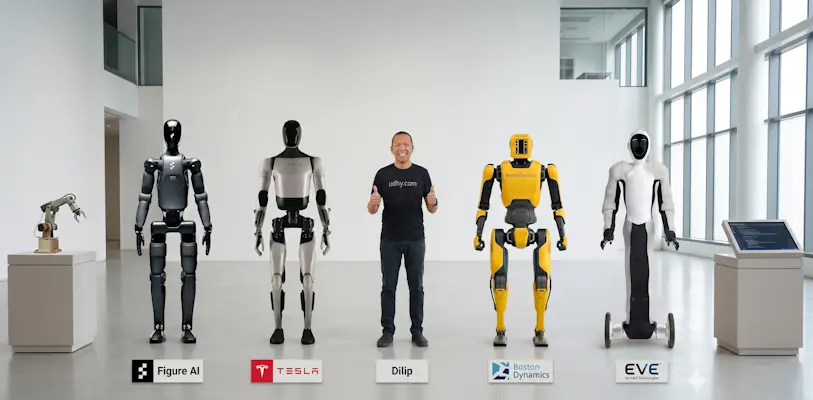
Companies including Figure AI, Boston Dynamics, Tesla, 1X Technologies, and Unitree are deploying humanoid robots in factory environments using exactly the AI architecture described in this post — with VLA models increasingly replacing modular pipelines. Continue reading : Humanoid Robots 2026: Figure AI, Tesla Optimus & Boston Dynamics Atlas Explained and The Data Gap That Could Kill the Humanoid Robot Revolution.
The Role of ROS 2 in AI Robotics
Almost every research and commercial AI robotics system in 2026 is built on or interfaces with ROS 2 (Robot Operating System 2) — the industry-standard framework for robot software development.
ROS 2 is not an operating system in the traditional sense. It is a middleware framework that:
- Provides standardised message types for sensor data, robot state, and control commands
- Enables modular software architecture through a publish-subscribe communication model
- Includes tools for simulation (Gazebo), visualisation (RViz2), and debugging
- Provides real-time capabilities critical for robot control
When an AI perception model detects an object, it publishes its result as a ROS 2 message. The planning module subscribes to that message, computes a plan, and publishes its own message. The control module subscribes to the plan and sends motor commands. Each module is independent and can be replaced or upgraded without affecting the others.
Understanding ROS 2 is the most important practical skill for anyone who wants to build AI robotic systems. It is the connective tissue of the entire field. Learn ROS 2 Jazzy Tutorial for Beginners: Setup, Nodes & First Robot (2026).
How AI Robotics Differs From Pure AI (Like ChatGPT)
Artificial Intelligence is often discussed as if it were a single technology, but in reality, AI in robotics and pure AI systems like ChatGPT operate in very different domains. While large language models (LLMs) such as ChatGPT excel at processing text, generating knowledge, and reasoning in a virtual environment, AI‑powered robots must interact with the physical world — sensing, perceiving, planning, and acting in real time.
This distinction is critical in 2026, as industries increasingly deploy robots in autonomous vehicles, healthcare, logistics, and manufacturing, while pure AI tools dominate knowledge work, customer service, and content creation. The table below highlights the key differences between these two branches of AI, showing why robotics requires a more complex stack of perception, planning, and control compared to purely language‑based AI.
A common misconception: the AI in robotics is fundamentally the same as the AI in large language models like ChatGPT or Claude. This is worth addressing directly.
| Dimension | AI in Language Models | AI in Robotics |
|---|---|---|
| Input | Text tokens | Multi-modal sensor data (images, point clouds, IMU, GPS) |
| Output | Text tokens | Motor commands, physical actions |
| Real-time requirement | Seconds acceptable | Milliseconds required for control |
| Environment | Static (the training data does not change) | Dynamic (the physical world changes continuously) |
| Failure consequences | Wrong answer | Physical damage, safety risk |
| Training data | Internet-scale text (trillions of tokens) | Scarce robot experience data (~100,000 hours globally) |
| Learning approach | Primarily supervised on static data | Mix of supervised, RL, imitation, and self-supervised |
The fundamental challenge of robotics AI — compared to language AI — is that it must operate in the real, physical world, in real time, with consequences for errors that range from inefficiency to danger. This makes robotics one of the hardest frontiers in AI, and it is why progress, while real and accelerating, is more incremental than in language AI.
Lessons Learned: What This Means for Learners and Professionals
Having spent 25 years building AI robotics systems, here are the practical takeaways for anyone trying to understand or enter this field:
1. Master the pipeline before specialising
Understand all seven layers — sensing, perception, localisation, prediction, planning, control, and learning — before deciding where to focus. The most valuable engineers in the industry are those who understand the full system, not just one module. Specialists who know how their piece fits into the whole are far more effective than those who only know their piece.
2. Sensor fusion is the highest-value technical skill
The ability to combine data from multiple sensors into a reliable, unified world model is foundational to almost every real-world AI robotic system. It requires signal processing, probabilistic reasoning, and software engineering — a rare combination. Employers in AV and robotics pay significant premiums for this expertise.
3. Simulation is not optional
You cannot build and train AI robotics systems without simulation. Physical hardware is expensive, slow, and dangerous to experiment on. Modern robotics AI development happens overwhelmingly in simulation (Isaac Sim, Gazebo, PyBullet, Webots) with real hardware used primarily for validation. Learning to build simulation environments is as important as learning to work with real hardware.
4. The data problem is the field’s central challenge
Unlike language AI where training data is abundant, robotics training data is extraordinarily scarce. Understanding why — and understanding the approaches being used to address it (teleoperation, sim-to-real, foundation models, VLA) — gives you a clearer view of where the field is heading than any amount of benchmark-watching.
5. ROS 2 is non-negotiable
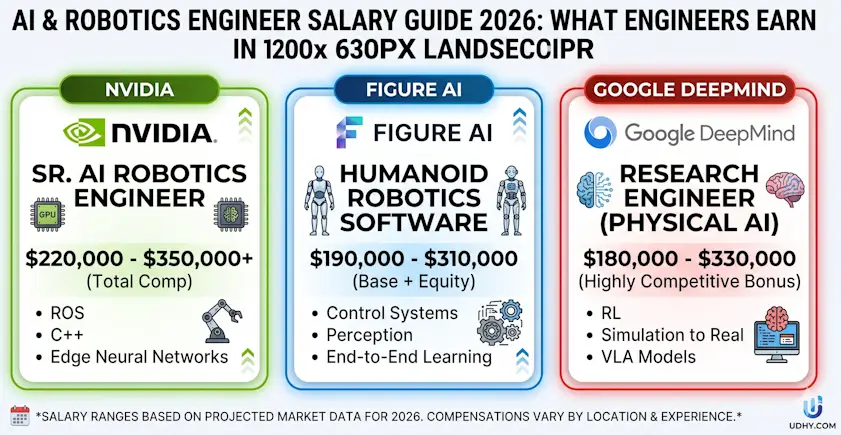
If you want to work in AI robotics, you need to know ROS 2. It is the industry standard. Resumes that include ROS 2 experience stand out in ways that few other skills can. If you’re mapping this knowledge to an actual career path, see the complete breakdown in How to Become a Robotics Engineer: The Ultimate Career Guide — including real 2026 salary data and the 3 fastest entry routes.
👉 Start learning: Robotics for Beginners — Free Course
👉 Go deeper: Robotics for Advanced — Free Course
👉 Expert level: Physical AI and Vision-Language-Action Models
FAQs How Does AI Work in Robotics
Conclusion
The question “how does AI work in robotics” is really asking: how does intelligence emerge in a machine?
The answer, as I have tried to show through 25 years of building these systems, is not magic and it is not a black box. It is a carefully engineered pipeline — sensing, perceiving, localising, predicting, planning, controlling, and learning — where each layer builds on the one before it, and where AI provides the capability for each layer to generalise beyond what was explicitly programmed.
What has changed dramatically in 2026 is the architecture of that pipeline. Vision-Language-Action models are beginning to collapse the modular pipeline into unified learned systems that can accept natural language instructions and map them directly to physical actions. This is the most significant architectural shift in robotics AI in a decade, and it is why humanoid robots are advancing faster in 2026 than at any point in the history of robotics.
But the fundamentals I learned at A*STAR in 2008 – 2016 — the importance of reliable sensing, robust perception, principled uncertainty handling, and safe planning — remain as relevant as ever. Technology changes. The physics of the real world does not.
If you want to understand AI robotics at a level that genuinely advances your career or your understanding of the world, UDHY’s free courses are the best place to start. Not because I built them — but because they are built on 25 years of doing the actual work.
Start your free journey → AI Beginner Course | Robotics for Beginners | Physical AI Expert Track
About the Author
Dr. Dilip Kumar Limbu Co-Founder, Moovita | Former Principal Scientist, A*STAR | PhD, Auckland University of Technology
Connect via LinkedIn Direct Inquiry.
Disclaimer
The views expressed here are personal and based on 25+ years in the industry, including my work at Moovita. They do not necessarily reflect the views of any organization.
Enjoying this post? Subscribe to get more AI insights.